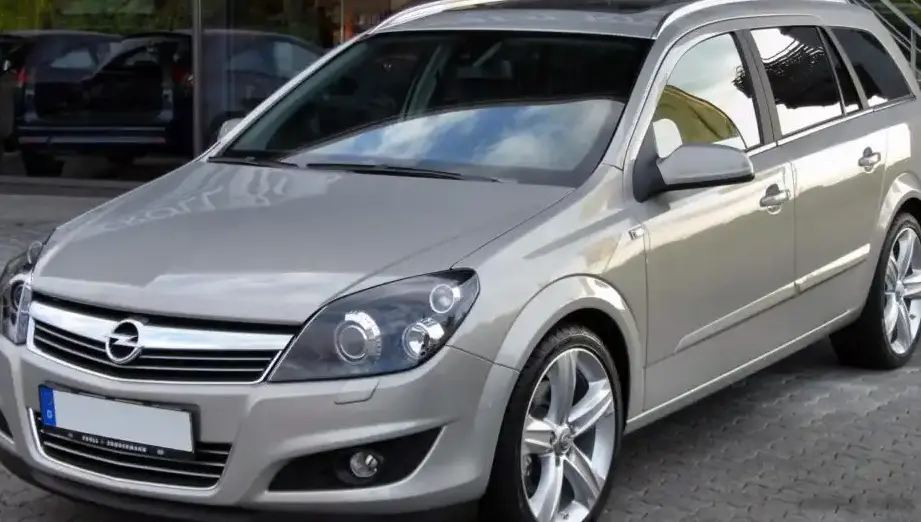
The Opel Astra H Caravan (facelift, produced 2007-2010) 1.6 ecoFLEX, equipped with a 115 horsepower engine and capable of running on both petrol and Liquefied Petroleum Gas (LPG), represented a fuel-conscious option within the Astra H range. Introduced in July 2009 and continuing through November 2010, this variant aimed to balance practicality, economy, and reduced emissions, particularly appealing to buyers in European markets where station wagons (known as ‘Caravans’ in Opel terminology) were highly popular and LPG conversions were common. It sat as a mid-range offering, positioned above the base models but below the more powerful and often better-equipped petrol and diesel variants.
Technical Specifications
| Brand | Opel |
| Model | Astra |
| Generation | Astra H Caravan (facelift 2007) |
| Type (Engine) | 1.6 ecoFLEX (115/114 Hp) LPG |
| Start of production | July, 2009 |
| End of production | November, 2010 |
| Powertrain Architecture | Internal Combustion engine |
| Body type | Station wagon (estate) |
| Seats | 5 |
| Doors | 5 |
| Fuel consumption (economy) – urban (NEDC) | 8.8 l/100 km (26.7 US mpg, 32.1 UK mpg, 11.4 km/l) |
| Fuel consumption (economy) – urban (LPG) (NEDC) | 12.4 l/100 km |
| Fuel consumption (economy) – extra urban (NEDC) | 5.3 l/100 km (44.4 US mpg, 53.3 UK mpg, 18.9 km/l) |
| Fuel consumption (economy) – extra urban (LPG) (NEDC) | 7.3 l/100 km |
| Fuel consumption (economy) – combined (NEDC) | 6.6 l/100 km (35.6 US mpg, 42.8 UK mpg, 15.2 km/l) |
| Fuel consumption (economy) – combined (LPG) (NEDC) | 9.2 l/100 km |
| CO2 emissions (NEDC) | 158 g/km |
| CO2 emissions (LPG) (NEDC) | 144 g/km |
| Fuel Type | Petrol / LPG |
| Acceleration 0 – 100 km/h | 12 sec |
| Acceleration 0 – 62 mph | 12 sec |
| Acceleration 0 – 100 km/h (LPG) | 12.2 sec |
| Acceleration 0 – 60 mph (Calculated) | 11.4 sec |
| Maximum speed | 191 km/h (118.68 mph) |
| Maximum speed (LPG) | 189 km/h |
| Emission standard | Euro 4 |
| Weight-to-power ratio | 11.1 kg/Hp, 90 Hp/tonne |
| Weight-to-torque ratio | 8.2 kg/Nm, 121.3 Nm/tonne |
| Power | 115 Hp @ 6000 rpm |
| Power per litre | 72 Hp/l |
| Power (LPG) | 114 Hp @ 6000 rpm |
| Power per litre (LPG) | 71.3 Hp/l |
| Torque | 155 Nm @ 4000 rpm (114.32 lb.-ft. @ 4000 rpm) |
| Torque (LPG) | 147 Nm @ 4000 rpm |
| Engine layout | Front, Transverse |
| Engine Model/Code | Z16XER |
| Engine displacement | 1598 cm3 (97.52 cu. in.) |
| Number of cylinders | 4 |
| Engine configuration | Inline |
| Cylinder Bore | 79 mm (3.11 in.) |
| Piston Stroke | 81.5 mm (3.21 in.) |
| Compression ratio | 10.8:1 |
| Number of valves per cylinder | 4 |
| Fuel injection system | Multi-port manifold injection |
| Engine aspiration | Naturally aspirated |
| Valvetrain | DOHC |
| Engine oil capacity | 4.5 l (4.76 US qt, 3.96 UK qt) |
| Coolant capacity | 6.1 l (6.45 US qt, 5.37 UK qt) |
| Kerb Weight | 1278 kg (2817.51 lbs.) |
| Max. weight | 1830 kg (4034.46 lbs.) |
| Max load | 552 kg (1216.95 lbs.) |
| Trunk (boot) space – minimum | 500 l (17.66 cu. ft.) |
| Trunk (boot) space – maximum | 1590 l (56.15 cu. ft.) |
| Fuel tank capacity | 52 l (13.74 US gal, 11.44 UK gal) |
| Max. roof load | 100 kg (220.46 lbs.) |
| Permitted trailer load (braked) | 1100 kg (2425.08 lbs.) |
| Permitted trailer load (unbraked) | 630 kg (1388.91 lbs.) |
| Length | 4515 mm (177.76 in.) |
| Width | 1753 mm (69.02 in.) |
| Width with mirrors folded | 1804 mm (71.02 in.) |
| Width including mirrors | 2033 mm (80.04 in.) |
| Height | 1500 mm (59.06 in.) |
| Wheelbase | 2703 mm (106.42 in.) |
| Front track | 1488 mm (58.58 in.) |
| Rear track | 1488 mm (58.58 in.) |
| Front overhang | 871 mm (34.29 in.) |
| Rear overhang | 941 mm (37.05 in.) |
| Ride height (ground clearance) | 160 mm (6.3 in.) |
| Drag coefficient (Cd) | 0.31 |
| Minimum turning circle | 11.5 m (37.73 ft.) |
| Drivetrain | Front wheel drive |
| Number of gears & type | 5 gears, manual transmission |
| Front suspension | Independent, McPherson with coil spring & anti-roll bar |
| Rear suspension | Torsion beam |
| Front brakes | Ventilated discs |
| Rear brakes | Discs |
| Assisting systems | ABS (Anti-lock braking system) |
| Steering type | Steering rack and pinion |
| Power steering | Electric |
| Tire size | 195/65 R15; 205/55 R16; 225/45 R17; 225/40 R18 |
| Wheel rims size | 6.5J x 15; 6.5J x 16; 7J x 17; 7.5J x 18 |
INTRODUCTION
The Astra H Caravan, launched in 2004 and facelifted in 2007, was Opel’s offering in the competitive C-segment station wagon market. The 1.6 ecoFLEX variant, introduced in 2009, combined a 1.6-liter petrol engine with the flexibility of LPG fuel. This allowed owners to switch between fuels, potentially reducing running costs and emissions. The ‘ecoFLEX’ designation indicated Opel’s efforts to improve fuel efficiency and environmental performance. This particular model was primarily sold in Europe, where LPG infrastructure was more developed and station wagons remained a popular body style. It was designed to appeal to families and individuals seeking a practical, economical, and relatively environmentally friendly vehicle.
Powertrain & Engine Architecture
The heart of the Astra H Caravan 1.6 ecoFLEX is the Z16XER engine, a 1.6-liter (1598cc) inline-four cylinder petrol engine. This engine utilizes multi-point fuel injection and a double overhead camshaft (DOHC) valvetrain. The engine produces 115 horsepower at 6000 rpm and 155 Nm (114.32 lb-ft) of torque at 4000 rpm. When running on LPG, the power output is slightly reduced to 114 horsepower. The engine’s LPG system is typically a sequential injection system, ensuring precise fuel delivery for optimal combustion and reduced emissions. The engine is transversely mounted at the front of the vehicle. The transmission is a 5-speed manual gearbox, chosen for its efficiency and affordability. While an automatic transmission was available on other Astra H models, it wasn’t offered with this specific 1.6 ecoFLEX LPG configuration.
Driving Characteristics
The 1.6-liter engine, paired with the 5-speed manual transmission, provides adequate, but not exhilarating, performance. Acceleration from 0 to 100 km/h (0-62 mph) takes around 12 seconds. The engine feels most comfortable in the mid-range, offering sufficient power for everyday driving and highway cruising. The gear ratios are tuned for fuel efficiency rather than outright speed. Compared to the more powerful 1.8-liter petrol or 1.9-liter diesel variants, the 1.6 ecoFLEX feels noticeably slower, particularly when fully loaded. However, the LPG capability provides a cost-effective alternative, and the engine runs smoothly on both fuels. The manual transmission allows for greater driver control and contributes to the vehicle’s overall fuel economy.
Equipment & Trim Levels
The 1.6 ecoFLEX trim level typically included standard features such as air conditioning, power windows, central locking, and an audio system. Safety features included ABS brakes, front airbags, and seatbelt pretensioners. Interior upholstery was typically cloth, with a functional and durable design. Optional extras included alloy wheels, a trip computer, and upgraded audio systems. The trim level focused on providing essential features at an affordable price point, making it an attractive option for budget-conscious buyers. The dashboard layout was typical of the Astra H, with a clear and straightforward design.
Chassis & Braking
The Astra H Caravan 1.6 ecoFLEX utilizes an independent McPherson strut suspension system at the front, providing a comfortable ride and good handling. The rear suspension employs a torsion beam setup, which is cost-effective and space-efficient. The braking system consists of ventilated discs at the front and solid discs at the rear. ABS (Anti-lock Braking System) is standard, enhancing safety during emergency braking. The suspension is tuned for a balance between comfort and handling, providing a stable and predictable driving experience. Stabilizer bars are fitted to both the front and rear axles to reduce body roll during cornering.
Market Reception & Comparison
The Astra H Caravan 1.6 ecoFLEX LPG was generally well-received by critics as a practical and economical option. Its ability to run on both petrol and LPG was a significant selling point, particularly in countries with high fuel prices. Compared to the petrol-only versions, the LPG variant offered lower running costs, although the initial cost of LPG conversion (if not factory-fitted) could be a factor. The 1.9-liter diesel variants offered superior fuel economy and torque, but were typically more expensive to purchase and maintain. The 1.8-liter petrol models provided more power, but at the expense of fuel efficiency. The 1.6 ecoFLEX LPG struck a balance between these factors, appealing to buyers seeking a compromise between performance, economy, and environmental considerations.
Legacy
The Z16XER engine, while generally reliable, is known to be susceptible to timing chain wear, particularly if oil changes are neglected. The LPG system, if properly maintained, is generally durable. The Astra H Caravan 1.6 ecoFLEX LPG remains a relatively affordable option in the used car market. Its practicality, fuel efficiency, and LPG capability continue to appeal to buyers seeking a cost-effective and versatile vehicle. However, potential buyers should be aware of the potential for timing chain issues and ensure that the LPG system has been regularly serviced.