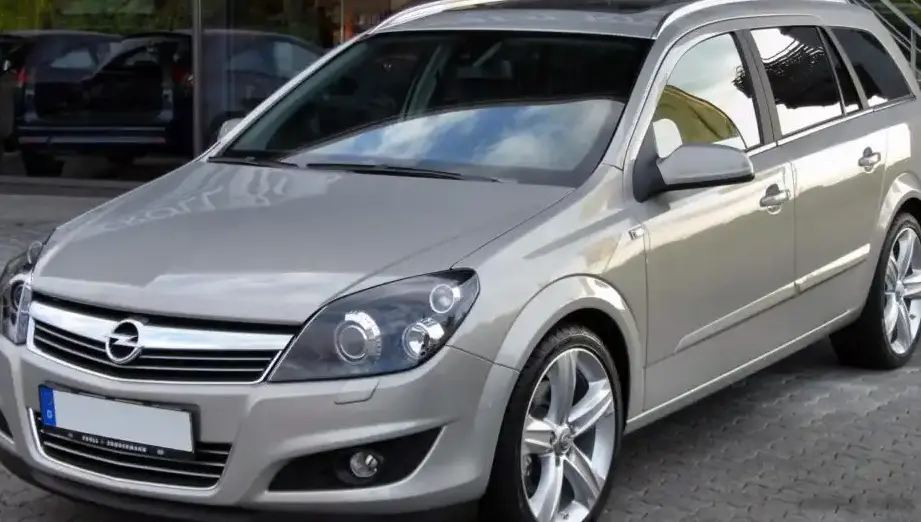
The Opel Astra H Caravan (facelift, produced in 2007) equipped with the 1.6 Twinport ECOTEC engine producing 105 horsepower represents a mainstream, family-oriented variant within the broader Astra H range. Introduced as part of the facelift for the H generation (2004-2009), this model aimed to provide a balance of fuel efficiency, practicality, and affordability for European buyers. The Astra H, in general, was Opel’s competitor in the compact family car segment, taking on rivals like the Ford Focus, Volkswagen Golf, and Peugeot 308. This specific 1.6L engine and five-speed manual transmission combination was positioned as an entry-level to mid-range offering, appealing to customers prioritizing economy over outright performance.
Technical Specifications
| Brand | Opel |
| Model | Astra |
| Generation | Astra H Caravan (facelift 2007) |
| Type (Engine) | 1.6 Twinport ECOTEC (105 Hp) |
| Start of production | 2007 |
| End of production | 2007 |
| Powertrain Architecture | Internal Combustion engine |
| Body type | Station wagon (estate) |
| Seats | 5 |
| Doors | 5 |
| Fuel consumption (urban) | 8.9-9.1 l/100 km (26.4 – 25.8 US mpg) |
| Fuel consumption (extra urban) | 5.4-5.6 l/100 km (43.6 – 42 US mpg) |
| Fuel consumption (combined) | 6.7-6.9 l/100 km (35.1 – 34.1 US mpg) |
| CO2 emissions | 161-166 g/km |
| Fuel Type | Petrol (Gasoline) |
| Acceleration 0 – 100 km/h | 12.7 sec |
| Acceleration 0 – 62 mph | 12.7 sec |
| Acceleration 0 – 60 mph | 12.1 sec |
| Maximum speed | 185 km/h (114.95 mph) |
| Emission standard | Euro 4 |
| Weight-to-power ratio | 11.8 kg/Hp |
| Weight-to-torque ratio | 8.3 kg/Nm |
| Power | 105 Hp @ 5600 rpm |
| Torque | 150 Nm @ 4000 rpm (110.63 lb.-ft. @ 4000 rpm) |
| Engine layout | Front, Transverse |
| Engine Model/Code | Z16XEP |
| Engine displacement | 1598 cm3 (97.52 cu. in.) |
| Number of cylinders | 4 |
| Engine configuration | Inline |
| Cylinder Bore | 79 mm (3.11 in.) |
| Piston Stroke | 81.5 mm (3.21 in.) |
| Compression ratio | 10.5:1 |
| Number of valves per cylinder | 4 |
| Fuel injection system | Multi-port manifold injection |
| Engine aspiration | Naturally aspirated |
| Valvetrain | DOHC |
| Engine oil capacity | 4.5 l (4.76 US qt | 3.96 UK qt) |
| Coolant capacity | 6.1 l (6.45 US qt | 5.37 UK qt) |
| Kerb Weight | 1240 kg (2733.73 lbs.) |
| Max. weight | 1840 kg (4056.51 lbs.) |
| Max load | 600 kg (1322.77 lbs.) |
| Trunk (boot) space – minimum | 500 l (17.66 cu. ft.) |
| Trunk (boot) space – maximum | 1590 l (56.15 cu. ft.) |
| Fuel tank capacity | 52 l (13.74 US gal | 11.44 UK gal) |
| Max. roof load | 100 kg (220.46 lbs.) |
| Permitted trailer load (braked) | 1100 kg (2425.08 lbs.) |
| Permitted trailer load (unbraked) | 660 kg (1455.05 lbs.) |
| Length | 4515 mm (177.76 in.) |
| Width | 1753 mm (69.02 in.) |
| Width with mirrors folded | 1804 mm (71.02 in.) |
| Width including mirrors | 2033 mm (80.04 in.) |
| Height | 1500 mm (59.06 in.) |
| Wheelbase | 2703 mm (106.42 in.) |
| Front track | 1488 mm (58.58 in.) |
| Rear track | 1488 mm (58.58 in.) |
| Front overhang | 871 mm (34.29 in.) |
| Rear overhang | 941 mm (37.05 in.) |
| Drag coefficient (Cd) | 0.31 |
| Minimum turning circle | 11.5 m (37.73 ft.) |
| Drivetrain | Front wheel drive |
| Number of gears | 5 |
| Gearbox type | Manual transmission |
| Front suspension | Independent, McPherson with coil spring and anti-roll bar |
| Rear suspension | Torsion beam |
| Front brakes | Ventilated discs |
| Rear brakes | Discs |
| Assisting systems | ABS (Anti-lock braking system) |
| Steering type | Steering rack and pinion |
| Power steering | Electric |
| Tires size | 195/65 R15; 205/55 R16; 225/45 R17; 225/40 R18 |
| Wheel rims size | 6.5J x 15; 6.5J x 16; 7J x 17; 7.5J x 18 |
INTRODUCTION
The Opel Astra H Caravan 1.6 Twinport ECOTEC (105 hp) was a key variant in the facelifted Astra H lineup, launched in 2007. The “Caravan” designation signifies the station wagon (estate) body style, offering increased cargo capacity compared to the hatchback version. This model was designed to appeal to families and individuals needing a practical and economical vehicle. The facelift brought subtle styling updates, improved interior materials, and refinements to the engine range. Positioned within the Astra H range, this 1.6L engine represented the entry point for buyers seeking a petrol-powered option, slotting below the more powerful 1.8L and 2.0L turbocharged engines.
Powertrain & Engine Architecture
The heart of this Astra variant is the Z16XEP engine, a 1.6-liter inline-four cylinder petrol engine. This engine belongs to Opel’s ‘ECOTEC’ family, emphasizing fuel efficiency and reduced emissions. The Z16XEP features multi-port fuel injection and a double overhead camshaft (DOHC) valvetrain with four valves per cylinder. The ‘Twinport’ designation refers to the dual exhaust ports per cylinder, designed to improve exhaust gas flow and enhance combustion efficiency. The engine produces 105 horsepower at 5600 rpm and 150 Nm (110.63 lb-ft) of torque at 4000 rpm. Paired with this engine is a five-speed manual transmission, providing a balance between fuel economy and drivability. The transmission is a standard front-wheel-drive configuration.
Driving Characteristics
The 1.6L Twinport engine, coupled with the five-speed manual transmission, delivers adequate performance for everyday driving. Acceleration from 0 to 100 km/h (0-62 mph) takes approximately 12.7 seconds, and the top speed is around 185 km/h (114.95 mph). While not particularly sporty, the engine provides sufficient power for highway cruising and city driving. The gear ratios are tuned for fuel efficiency, meaning the engine needs to be revved somewhat to achieve brisk acceleration. Compared to the more powerful 1.8L or turbocharged variants, this 1.6L engine feels less responsive, particularly when fully loaded. However, the lighter engine weight contributes to better handling and a more nimble feel compared to its higher-powered siblings.
Equipment & Trim Levels
The Astra H Caravan 1.6 Twinport ECOTEC typically came with a reasonable level of standard equipment. This included central locking, electric front windows, power steering, an adjustable steering column, and an audio system. Safety features such as ABS (Anti-lock Braking System) and front airbags were also standard. Higher trim levels, such as ‘Enjoy’ or ‘Cosmo’, added features like air conditioning, alloy wheels, rear electric windows, and a more sophisticated audio system. Optional extras included a sunroof, parking sensors, and upgraded upholstery.
Chassis & Braking
The Astra H Caravan utilizes an independent McPherson strut suspension setup at the front, providing a comfortable ride and decent handling. The rear suspension employs a torsion beam, which is a cost-effective and space-saving solution. The braking system consists of ventilated discs at the front and solid discs at the rear. The electric power steering provides a light and responsive feel, making it easy to maneuver in urban environments. Tire sizes varied depending on the trim level, ranging from 195/65 R15 to 225/40 R18.
Market Reception & Comparison
The Astra H Caravan 1.6 Twinport ECOTEC was generally well-received by critics as a practical and economical family car. It was praised for its spacious interior, comfortable ride, and reasonable fuel economy. However, some reviewers noted that the engine lacked outright power and could feel strained when fully loaded or driving uphill. Compared to the 1.8L variant, the 1.6L offered better fuel economy but significantly less performance. The 1.9 CDTi diesel engine provided even better fuel economy and more torque, but at a higher purchase price. The 1.6L model was often seen as a sensible choice for buyers prioritizing value and practicality over performance.
Legacy
The Z16XEP engine, while generally reliable, is known to be susceptible to occasional issues with the intake manifold and ignition coils. Regular maintenance, including oil changes and spark plug replacements, is crucial for ensuring long-term reliability. Today, the Astra H Caravan 1.6 Twinport ECOTEC can be found on the used car market at affordable prices. It remains a practical and economical option for buyers seeking a spacious and reliable estate car. Its relatively simple mechanical design makes it easier and cheaper to maintain compared to more modern vehicles. However, potential buyers should be aware of the potential issues with the intake manifold and ignition coils and ensure a thorough inspection before purchase.