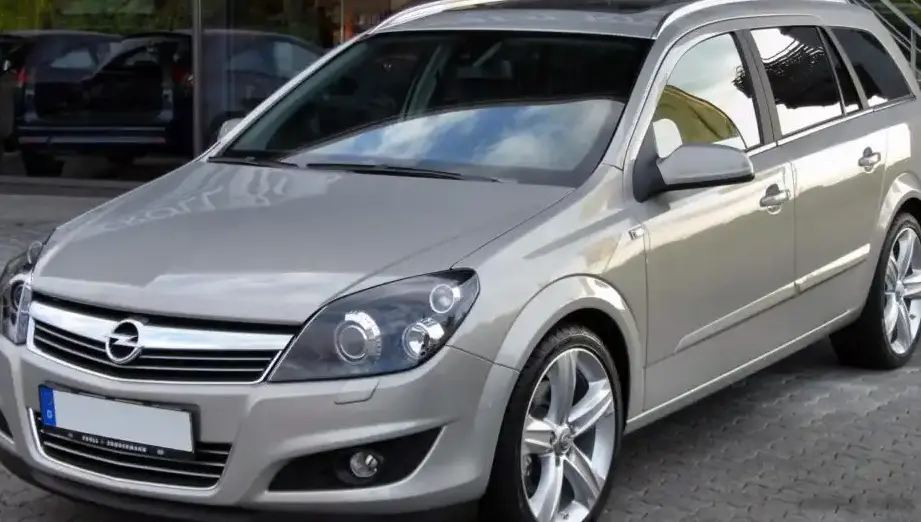
The Opel Astra H Caravan (facelift, produced from April 2007 to June 2010) 1.7 CDTI ECOTEC variant, generating 125 horsepower, represented a significant offering in the European compact station wagon market. Positioned as a mid-range option within the Astra H lineup, it aimed to balance fuel efficiency with practical space and reasonable performance. This facelifted version of the Astra H, known as the Astra Caravan, built upon the success of the original H generation (introduced in 2004) with styling updates and refinements to the powertrain. It competed directly with vehicles like the Ford Focus Estate, Volkswagen Passat Variant, and Peugeot 307 SW.
Technical Specifications
| Brand | Opel |
| Model | Astra |
| Generation | Astra H Caravan (facelift 2007) |
| Type (Engine) | 1.7 CDTI ECOTEC (125 Hp) |
| Start of production | April, 2007 |
| End of production | June, 2010 |
| Powertrain Architecture | Internal Combustion engine |
| Body type | Station wagon (estate) |
| Seats | 5 |
| Doors | 5 |
| Fuel consumption (urban) | 6.8 l/100 km (34.6 US mpg, 41.5 UK mpg, 14.7 km/l) |
| Fuel consumption (extra urban) | 4.7 l/100 km (50 US mpg, 60.1 UK mpg, 21.3 km/l) |
| Fuel consumption (combined) | 5.5 l/100 km (42.8 US mpg, 51.4 UK mpg, 18.2 km/l) |
| CO2 emissions | 149 g/km |
| Fuel Type | Diesel |
| Acceleration 0 – 100 km/h | 10.7 sec |
| Acceleration 0 – 62 mph | 10.7 sec |
| Acceleration 0 – 60 mph | 10.2 sec |
| Maximum speed | 195 km/h (121.17 mph) |
| Emission standard | Euro 4 |
| Weight-to-power ratio | 10.5 kg/Hp, 94.8 Hp/tonne |
| Weight-to-torque ratio | 4.7 kg/Nm, 212.4 Nm/tonne |
| Power | 125 Hp @ 4000 rpm |
| Power per litre | 74.1 Hp/l |
| Torque | 280 Nm @ 2300 rpm (206.52 lb.-ft. @ 2300 rpm) |
| Engine layout | Front, Transverse |
| Engine Model/Code | Z17DTR |
| Engine displacement | 1686 cm3 (102.89 cu. in.) |
| Number of cylinders | 4 |
| Engine configuration | Inline |
| Cylinder Bore | 79 mm (3.11 in.) |
| Piston Stroke | 86 mm (3.39 in.) |
| Compression ratio | 18:1 |
| Number of valves per cylinder | 4 |
| Fuel injection system | Diesel Commonrail |
| Engine aspiration | Turbocharger, Intercooler |
| Valvetrain | DOHC |
| Engine oil capacity | 5.4 l (5.71 US qt | 4.75 UK qt) |
| Coolant capacity | 7.1 l (7.5 US qt | 6.25 UK qt) |
| Kerb Weight | 1318 kg (2905.69 lbs.) |
| Max. weight | 1935 kg (4265.94 lbs.) |
| Max load | 617 kg (1360.25 lbs.) |
| Trunk (boot) space – minimum | 500 l (17.66 cu. ft.) |
| Trunk (boot) space – maximum | 1590 l (56.15 cu. ft.) |
| Fuel tank capacity | 52 l (13.74 US gal | 11.44 UK gal) |
| Max. roof load | 100 kg (220.46 lbs.) |
| Permitted trailer load (braked) | 1400 kg (3086.47 lbs.) |
| Permitted trailer load (unbraked) | 700 kg (1543.24 lbs.) |
| Length | 4515 mm (177.76 in.) |
| Width | 1753 mm (69.02 in.) |
| Width with mirrors folded | 1804 mm (71.02 in.) |
| Width including mirrors | 2033 mm (80.04 in.) |
| Height | 1500 mm (59.06 in.) |
| Wheelbase | 2703 mm (106.42 in.) |
| Front track | 1488 mm (58.58 in.) |
| Rear track | 1488 mm (58.58 in.) |
| Front overhang | 871 mm (34.29 in.) |
| Rear overhang | 941 mm (37.05 in.) |
| Ride height | 160 mm (6.3 in.) |
| Drag coefficient (Cd) | 0.31 |
| Turning circle | 11.5 m (37.73 ft.) |
| Drivetrain | Front wheel drive |
| Number of gears | 6 |
| Gearbox type | Manual transmission |
| Front suspension | Independent, McPherson with coil spring and anti-roll bar |
| Rear suspension | Torsion |
| Front brakes | Ventilated discs |
| Rear brakes | Disc |
| Assisting systems | ABS (Anti-lock braking system) |
| Steering type | Steering rack and pinion |
| Power steering | Electric |
| Tires size | 205/55 R16; 225/45 R17; 225/40 R18 |
| Wheel rims size | 6.5J x 16; 7J x 17; 7.5J x 18 |
Powertrain & Engine Architecture
The heart of this Astra variant is the Z17DTR, a 1.7-liter inline-four cylinder diesel engine. This engine belongs to Opel/Vauxhall’s ‘ECOTEC’ family, known for its focus on efficiency and reduced emissions. The Z17DTR utilizes a common rail direct injection system, delivering fuel at extremely high pressure for optimized combustion. A turbocharger with an intercooler is employed to boost power output, providing 125 horsepower at 4000 rpm and a respectable 280 Nm (206.52 lb-ft) of torque at 2300 rpm. The engine features a double overhead camshaft (DOHC) valvetrain with four valves per cylinder, contributing to its breathing efficiency. The engine is transversely mounted in the front of the vehicle. The 6-speed manual transmission was the standard offering, providing a good balance between fuel economy and driver control.
Driving Characteristics
The 1.7 CDTI ECOTEC with the 6-speed manual gearbox offered a practical and economical driving experience. While not a performance-oriented variant, the 125 hp engine provided adequate power for everyday driving and highway cruising. Acceleration from 0-60 mph took around 10.2 seconds, and top speed was rated at 195 km/h (121.17 mph). The gear ratios were tuned for fuel efficiency, with taller gearing in higher gears to reduce engine speed at cruising speeds. Compared to the more powerful 1.9 CDTI variants, this engine felt less responsive, particularly during overtaking maneuvers. However, the lower power output also translated to improved fuel economy and reduced stress on the drivetrain.
Equipment & Trim Levels
The 1.7 CDTI ECOTEC typically came equipped as a mid-range trim level. Standard features generally included air conditioning, power windows, power mirrors, a CD/radio system, and ABS brakes. Interior upholstery was typically cloth, with a functional and durable design. Optional extras included alloy wheels, a sunroof, parking sensors, and upgraded audio systems. The Astra H Caravan offered a spacious interior for passengers and a generous cargo area, making it a practical choice for families and those needing to transport larger items.
Chassis & Braking
The Astra H Caravan featured an independent McPherson strut suspension setup at the front, providing a comfortable ride and decent handling. The rear suspension utilized a torsion beam setup, which was a cost-effective solution that offered a good compromise between ride comfort and handling. Brakes consisted of ventilated discs at the front and solid discs at the rear. ABS (Anti-lock Braking System) was standard, enhancing safety during emergency braking situations. The steering was rack and pinion with electric power assistance, providing a light and responsive feel.
Market Reception & Comparison
The 1.7 CDTI ECOTEC variant of the Astra H Caravan was generally well-received by critics as a sensible and economical choice. It offered a good balance between fuel efficiency, practicality, and affordability. Compared to the more powerful 1.9 CDTI models, it was seen as a more economical option, but lacked the same level of performance. Fuel economy figures of around 5.5 l/100 km (42.8 US mpg) were competitive for its class. Reliability was generally good, although some owners reported issues with the diesel particulate filter (DPF) system, a common concern with modern diesel engines.
Legacy
The Opel Astra H Caravan 1.7 CDTI ECOTEC remains a relatively common sight on European roads today. The Z17DTR engine, while not known for being exceptionally powerful, has proven to be reasonably durable and reliable when properly maintained. The availability of spare parts is good, and maintenance costs are generally moderate. In the used car market, this variant represents a good value proposition for buyers seeking a practical, economical, and spacious station wagon. However, potential buyers should be aware of the potential for DPF issues and ensure that the vehicle has been regularly serviced.