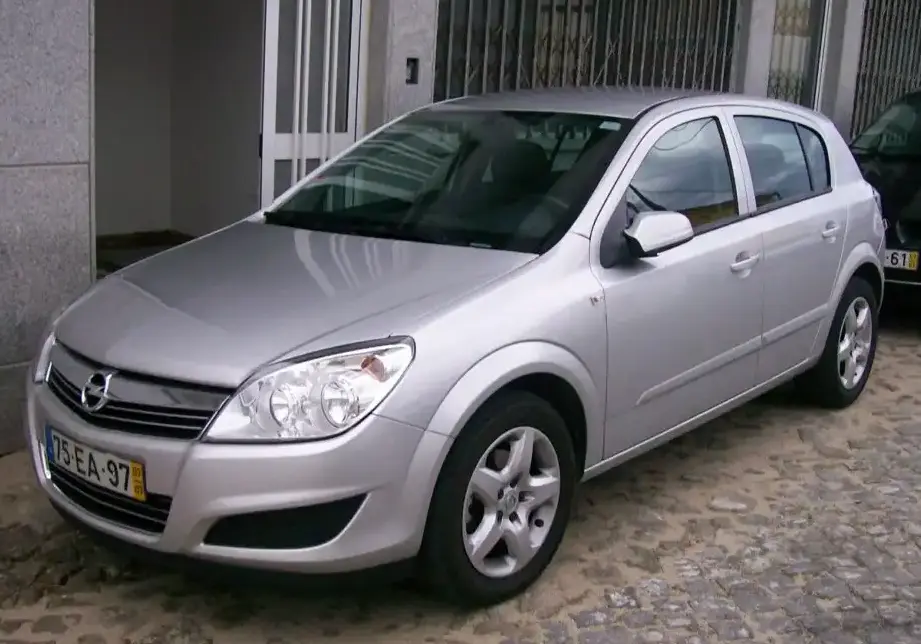
The Opel Astra H (facelift, produced 2007-2009) 1.3 CDTI ECOTEC variant, generating 90 horsepower, represented an entry-level diesel option within the broader Astra H range. Introduced as part of the facelifted H generation (internally designated as the A04 generation), this model aimed to provide fuel efficiency and affordability to a wider customer base. Positioned below the more powerful 1.7 CDTI and 1.9 CDTI models, and alongside the gasoline variants, the 1.3 CDTI served as a practical choice for urban commuters and those prioritizing economy over outright performance. It was primarily sold in European markets, where diesel engines held a significant market share.
Technical Specifications
| Brand | Opel |
| Model | Astra |
| Generation | Astra H (facelift 2007) |
| Type (Engine) | 1.3 CDTI ECOTEC (90 Hp) |
| Start of production | 2007 |
| End of production | 2009 |
| Powertrain Architecture | Internal Combustion engine |
| Body type | Hatchback |
| Seats | 5 |
| Doors | 5 |
| Fuel consumption (urban) | 6.2 l/100 km (37.9 US mpg, 45.6 UK mpg, 16.1 km/l) |
| Fuel consumption (extra urban) | 4 l/100 km (58.8 US mpg, 70.6 UK mpg, 25 km/l) |
| Fuel consumption (combined) | 4.8 l/100 km (49 US mpg, 58.9 UK mpg, 20.8 km/l) |
| CO2 emissions | 130 g/km |
| Fuel Type | Diesel |
| Acceleration 0 – 100 km/h | 13.7 sec |
| Acceleration 0 – 62 mph | 13.7 sec |
| Acceleration 0 – 60 mph | 13 sec |
| Maximum speed | 172 km/h (106.88 mph) |
| Emission standard | Euro 4 |
| Weight-to-power ratio | 14.1 kg/Hp, 71.1 Hp/tonne |
| Weight-to-torque ratio | 6.3 kg/Nm, 158.1 Nm/tonne |
| Power | 90 Hp @ 4000 rpm |
| Power per litre | 72.1 Hp/l |
| Torque | 200 Nm @ 1750-2500 rpm (147.51 lb.-ft. @ 1750-2500 rpm) |
| Engine layout | Front, Transverse |
| Engine Model/Code | Z13DTH |
| Engine displacement | 1248 cm3 (76.16 cu. in.) |
| Number of cylinders | 4 |
| Engine configuration | Inline |
| Cylinder Bore | 69.6 mm (2.74 in.) |
| Piston Stroke | 82 mm (3.23 in.) |
| Compression ratio | 17.6:1 |
| Number of valves per cylinder | 4 |
| Fuel injection system | Diesel Commonrail |
| Engine aspiration | Turbocharger, Intercooler |
| Valvetrain | DOHC |
| Engine oil capacity | 3.2 l (3.38 US qt | 2.82 UK qt) |
| Coolant capacity | 7.6 l (8.03 US qt | 6.69 UK qt) |
| Kerb Weight | 1265 kg (2788.85 lbs.) |
| Max. weight | 1815 kg (4001.39 lbs.) |
| Max load | 550 kg (1212.54 lbs.) |
| Trunk (boot) space – minimum | 380 l (13.42 cu. ft.) |
| Trunk (boot) space – maximum | 1295 l (45.73 cu. ft.) |
| Fuel tank capacity | 52 l (13.74 US gal | 11.44 UK gal) |
| Max. roof load | 75 kg (165.35 lbs.) |
| Permitted trailer load with brakes (12%) | 1300 kg (2866.01 lbs.) |
| Permitted trailer load without brakes | 650 kg (1433 lbs.) |
| Length | 4249 mm (167.28 in.) |
| Width | 1753 mm (69.02 in.) |
| Width with mirrors folded | 1804 mm (71.02 in.) |
| Width including mirrors | 2033 mm (80.04 in.) |
| Height | 1460 mm (57.48 in.) |
| Wheelbase | 2614 mm (102.91 in.) |
| Front track | 1488 mm (58.58 in.) |
| Rear track | 1488 mm (58.58 in.) |
| Front overhang | 871 mm (34.29 in.) |
| Rear overhang | 764 mm (30.08 in.) |
| Drag coefficient (Cd) | 0.32 |
| Minimum turning circle | 11.2 m (36.75 ft.) |
| Drivetrain Architecture | Front wheel drive |
| Number of gears | 6 |
| Gearbox type | Manual transmission |
| Front suspension | Independent, type McPherson with coil spring and anti-roll bar |
| Rear suspension | Torsion |
| Front brakes | Ventilated discs |
| Rear brakes | Disc |
| Assisting systems | ABS (Anti-lock braking system) |
| Steering type | Steering rack and pinion |
| Power steering | Electric Steering |
| Tires size | 195/65 R15; 205/55 R16; 225/45 R17; 225/40 R18 |
| Wheel rims size | 6.5J x 15; 6.5J x 16; 7J x 17; 7.5J x 18 |
Powertrain & Engine Architecture
The heart of this Astra variant is the Z13DTH engine, a 1.3-liter inline-four cylinder diesel. This engine belongs to Opel/Fiat’s family of small-displacement diesel engines, known for their fuel efficiency. The Z13DTH utilizes a common rail direct injection system, delivering fuel at extremely high pressure for optimized combustion. A turbocharger with an intercooler is employed to boost power output, overcoming the limitations of the small displacement. The engine features a double overhead camshaft (DOHC) valvetrain with four valves per cylinder, enhancing breathing and contributing to improved performance. The 6-speed manual transmission was standard, chosen for its efficiency and driver engagement. The engine’s design prioritized low-end torque, making it suitable for everyday driving conditions.
Driving Characteristics
The 90 hp output and 200 Nm of torque delivered by the 1.3 CDTI ECOTEC resulted in a driving experience focused on economy rather than speed. Acceleration from 0-100 km/h took approximately 13.7 seconds, and top speed was limited to 172 km/h. The engine felt responsive at lower RPMs, providing adequate power for urban driving and overtaking on slower roads. However, when fully loaded or tackling steep inclines, the engine could feel strained. The 6-speed manual transmission helped to keep the engine within its optimal power band, but required frequent shifting to maintain momentum. Compared to the 1.7 CDTI or 1.9 CDTI variants, this engine offered significantly less power, but also consumed less fuel.
Equipment & Trim Levels
The 1.3 CDTI ECOTEC typically came equipped as a base or mid-range trim level. Standard features generally included air conditioning, power steering, electric front windows, and a basic audio system. Safety features such as ABS and front airbags were also standard. Higher trim levels offered options like alloy wheels, rear electric windows, a more advanced audio system, and climate control. Interior upholstery was typically cloth, with a functional and durable design. The dashboard layout was typical of the Astra H, with a focus on ergonomics and ease of use.
Chassis & Braking
The Astra H’s chassis featured an independent McPherson strut suspension at the front and a torsion beam suspension at the rear. This setup provided a reasonable balance between ride comfort and handling. The front brakes were ventilated discs, while the rear brakes were solid discs. The steering was electrically assisted, offering light and precise control. The suspension was tuned for comfort, but could feel somewhat soft during spirited driving. Stabilizer bars were fitted to both the front and rear axles to reduce body roll.
Market Reception & Comparison
The 1.3 CDTI ECOTEC variant was generally well-received by critics for its fuel efficiency and affordability. However, its lack of outright performance was often noted. Compared to the 1.7 CDTI, the 1.3 CDTI offered better fuel economy but significantly less power. The 1.9 CDTI provided a more substantial performance upgrade, but at a higher price point. In terms of reliability, the Z13DTH engine proved to be generally robust, although issues with the diesel particulate filter (DPF) could occur, particularly on vehicles primarily used for short journeys.
Legacy
The Opel Astra H 1.3 CDTI ECOTEC remains a relatively common sight on European roads today. Its fuel efficiency and affordability have made it a popular choice for budget-conscious buyers. While not known for its performance, the powertrain has proven to be reasonably reliable, provided it has been properly maintained. The Z13DTH engine, while superseded by newer designs, continues to be a viable option for those seeking a cost-effective and economical diesel vehicle. Parts availability remains good, and maintenance costs are generally reasonable.