Technical Specifications
| Brand | Opel |
| Model | Astra |
| Generation | Astra H (facelift 2007) |
| Type (Engine) | 1.8 ECOTEC (140 Hp) |
| Start of production | 2007 |
| End of production | 2009 |
| Powertrain Architecture | Internal Combustion engine |
| Body type | Hatchback |
| Seats | 5 |
| Doors | 5 |
| Fuel consumption (urban) | 9.9-10.1 l/100 km (23.8 – 23.3 US mpg) |
| Fuel consumption (extra urban) | 5.8-6 l/100 km (40.6 – 39.2 US mpg) |
| Fuel consumption (combined) | 7.3-7.5 l/100 km (32.2 – 31.4 US mpg) |
| CO2 emissions | 175-180 g/km |
| Fuel Type | Petrol (Gasoline) |
| Acceleration 0 – 100 km/h | 10.2 sec |
| Acceleration 0 – 62 mph | 10.2 sec |
| Acceleration 0 – 60 mph | 9.7 sec |
| Maximum speed | 208 km/h (129.25 mph) |
| Emission standard | Euro 4 |
| Weight-to-power ratio | 8.6 kg/Hp |
| Weight-to-torque ratio | 6.9 kg/Nm |
| Power | 140 Hp @ 6300 rpm |
| Torque | 175 Nm @ 3800 rpm (129.07 lb.-ft. @ 3800 rpm) |
| Engine layout | Front, Transverse |
| Engine Model/Code | Z18XER |
| Engine displacement | 1796 cm3 (109.6 cu. in.) |
| Number of cylinders | 4 |
| Engine configuration | Inline |
| Cylinder Bore | 80.5 mm (3.17 in.) |
| Piston Stroke | 88.2 mm (3.47 in.) |
| Compression ratio | 10.5:1 |
| Number of valves per cylinder | 4 |
| Fuel injection system | Multi-port manifold injection |
| Engine aspiration | Naturally aspirated |
| Valvetrain | DOHC |
| Engine oil capacity | 4.5 l (4.76 US qt | 3.96 UK qt) |
| Coolant capacity | 6.1 l (6.45 US qt | 5.37 UK qt) |
| Kerb Weight | 1203 kg (2652.16 lbs.) |
| Max. weight | 1760 kg (3880.14 lbs.) |
| Max load | 557 kg (1227.97 lbs.) |
| Trunk (boot) space – minimum | 380 l (13.42 cu. ft.) |
| Trunk (boot) space – maximum | 1295 l (45.73 cu. ft.) |
| Fuel tank capacity | 52 l (13.74 US gal | 11.44 UK gal) |
| Max. roof load | 75 kg (165.35 lbs.) |
| Permitted trailer load (braked) | 1300 kg (2866.01 lbs.) |
| Permitted trailer load (unbraked) | 630 kg (1388.91 lbs.) |
| Length | 4249 mm (167.28 in.) |
| Width | 1753 mm (69.02 in.) |
| Width with mirrors folded | 1804 mm (71.02 in.) |
| Width including mirrors | 2033 mm (80.04 in.) |
| Height | 1460 mm (57.48 in.) |
| Wheelbase | 2614 mm (102.91 in.) |
| Front track | 1488 mm (58.58 in.) |
| Rear track | 1488 mm (58.58 in.) |
| Front overhang | 871 mm (34.29 in.) |
| Rear overhang | 764 mm (30.08 in.) |
| Drag coefficient (Cd) | 0.32 |
| Minimum turning circle | 11.2 m (36.75 ft.) |
| Drivetrain | Front wheel drive |
| Number of gears | 5 |
| Gearbox type | Manual transmission |
| Front suspension | Independent, McPherson with coil spring and anti-roll bar |
| Rear suspension | Torsion |
| Front brakes | Ventilated discs |
| Rear brakes | Disc |
| Assisting systems | ABS (Anti-lock braking system) |
| Steering type | Steering rack and pinion |
| Power steering | Electric |
| Tires size | 195/65 R15; 205/55 R16; 225/45 R17; 225/40 R18 |
| Wheel rims size | 6.5J x 15; 6.5J x 16; 7J x 17; 7.5J x 18 |
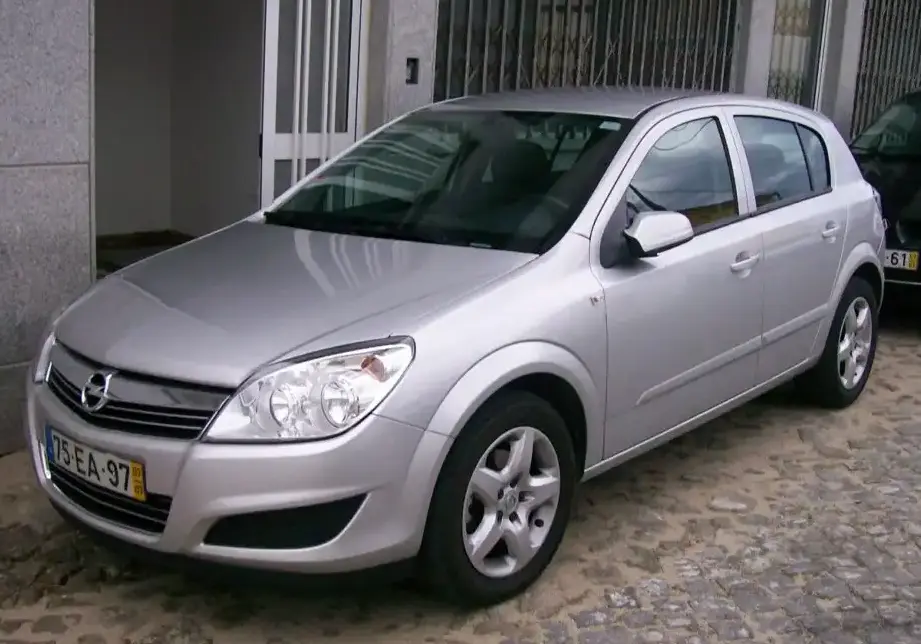
The Opel Astra H facelift 1.8 ECOTEC (140 hp), produced from 2007 to 2009, was a refined iteration of the popular Astra H. Based on the GM Delta platform (internally designated 1HX0/A3), the facelift brought cosmetic updates, improved interior quality, and revised engine options. This 1.8-liter version was positioned as a balanced choice for drivers seeking a step up in performance and refinement from the base models, without the higher costs associated with the OPC performance variants. It was primarily marketed in Europe, where it competed with established rivals like the Volkswagen Golf, Ford Focus, and Peugeot 308.
Powertrain & Engine Architecture
The Astra H 1.8L’s powertrain centers around the Z18XER engine, a 1.8-liter inline-four cylinder gasoline engine. This engine belongs to Opel’s Ecotec family, renowned for its emphasis on efficiency and smooth operation. The Z18XER features multi-port fuel injection and a dual overhead camshaft (DOHC) valvetrain with four valves per cylinder. Its 1796 cc displacement, combined with a 10.5:1 compression ratio, generates 140 horsepower at 6300 rpm and 175 Nm (129.07 lb-ft) of torque at 3800 rpm. The engine is mounted transversely in the front of the vehicle. While a five-speed manual transmission was standard, a four-speed automatic transmission was also offered, and is the focus of this discussion. The automatic transmission, while providing convenience, did result in a slight performance decrease compared to the manual counterpart.
Driving Characteristics
The Astra H 1.8L equipped with the four-speed automatic transmission delivered a comfortable and predictable driving experience. While not overtly sporty, the engine provided sufficient power for daily commutes and highway travel. The automatic transmission, though smooth, lacked the responsiveness of more modern transmissions. Gear ratios were optimized for fuel economy rather than rapid acceleration. Acceleration from 0-60 mph took approximately 9.7 seconds, with a top speed around 129 mph. Compared to the manual transmission version, the automatic resulted in a modest reduction in fuel economy and a slightly slower 0-60 mph time. The automatic transmission included a ‘winter’ mode, which adjusted shift points to enhance traction on slippery surfaces.
Equipment & Trim Levels
The 1.8 ECOTEC variant was typically available in mid-range trim levels, such as ‘Enjoy’ or ‘Cosmo’. Standard features generally included air conditioning, power windows, power mirrors, a CD stereo, and ABS brakes. Higher trim levels added features like alloy wheels, a multi-function steering wheel, cruise control, and upgraded interior materials. Optional extras included a sunroof, parking sensors, and a more sophisticated audio system. Interior upholstery was typically cloth, with higher trims offering partial leather options. The dashboard layout was functional and well-designed, featuring clear instrumentation and intuitive controls.
Chassis & Braking
The Astra H employed an independent McPherson strut suspension at the front, providing a comfortable ride and reasonable handling. The rear suspension utilized a torsion beam setup, a cost-effective solution that balanced ride comfort and handling capabilities. Braking was handled by ventilated discs at the front and solid discs at the rear, with ABS (Anti-lock Braking System) as standard equipment. The chassis was engineered to deliver a stable and predictable driving experience, prioritizing safety and comfort. Stabilizer bars were fitted to both the front and rear axles to minimize body roll during cornering.
Market Reception & Comparison
The Astra H 1.8 ECOTEC automatic received generally favorable reviews from automotive critics. It was praised for its comfortable ride, refined engine, and respectable fuel economy. However, some reviewers noted that the automatic transmission felt somewhat dated compared to those offered by competitors. Compared to the lower-powered 1.4L and 1.6L variants, the 1.8L offered a noticeable improvement in performance. In contrast to the high-performance OPC models, the 1.8L was more affordable to operate and maintain, making it a more practical choice for everyday use. Fuel economy was competitive within its class, averaging around 32 mpg in combined driving. Reliability was generally good, although some owners reported minor issues with the vehicle’s electronic systems.
Legacy
The Opel Astra H 1.8 ECOTEC automatic remains a relatively common vehicle on European roads today. The Z18XER engine is known for its durability and relatively low maintenance requirements. While not a particularly exciting car, it represents a solid and dependable choice for buyers seeking a practical and affordable compact hatchback. Parts availability is generally good, and the car’s relatively simple mechanical design makes it reasonably easy to repair. On the used car market, these Astras are typically priced affordably, making them an attractive option for first-time buyers or those seeking a budget-friendly vehicle.