
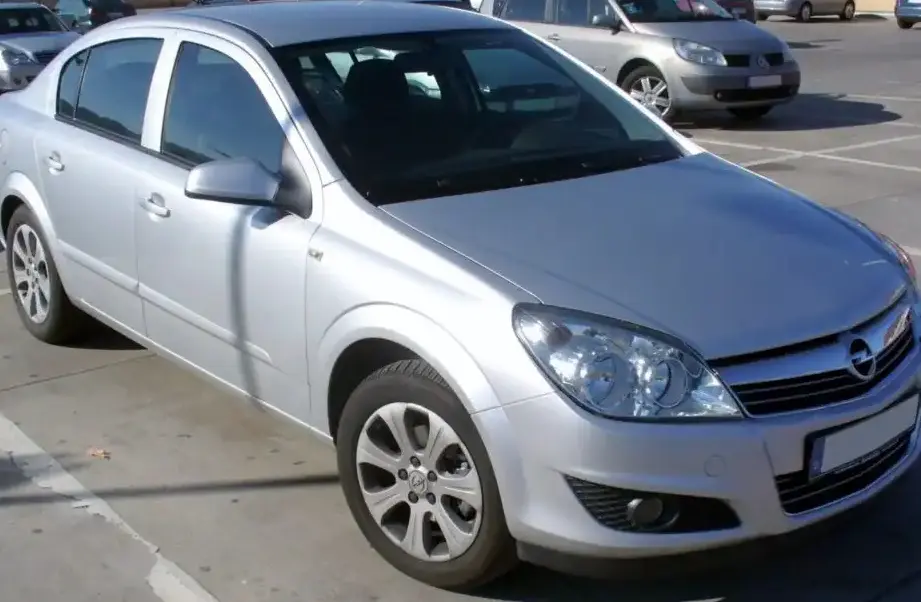
The Opel Astra H Sedan 1.3 CDTI, producing 90 horsepower, was a key variant in the Astra H range, manufactured between 2007 and 2010. Positioned as an entry-level offering, it aimed to provide fuel-efficient transportation for families and commuters. This sedan body style, part of the broader Astra H generation (based on the GM Delta platform), was particularly popular in European markets where compact sedans held a significant share. The 1.3 CDTI engine represented Opel’s effort to balance affordability with modern diesel technology, offering a compromise between performance and economy.
Technical Specifications
| Brand | Opel |
| Model | Astra |
| Generation | Astra H Sedan |
| Type (Engine) | 1.3 CDTI (90 Hp) |
| Start of production | 2007 |
| End of production | 2010 |
| Powertrain Architecture | Internal Combustion engine |
| Body type | Sedan |
| Seats | 5 |
| Doors | 4 |
| Fuel consumption (urban) | 6.5 l/100 km (36.2 US mpg) |
| Fuel consumption (extra urban) | 4.3 l/100 km (54.7 US mpg) |
| Fuel consumption (combined) | 5.1 l/100 km (46.1 US mpg) |
| CO2 emissions | 137 g/km |
| Fuel Type | Diesel |
| Acceleration 0 – 100 km/h | 13.7 sec |
| Acceleration 0 – 62 mph | 13.7 sec |
| Acceleration 0 – 60 mph | 13 sec |
| Maximum speed | 172 km/h (106.88 mph) |
| Emission standard | Euro 4 |
| Power | 90 Hp @ 4000 rpm |
| Torque | 200 Nm @ 1750 rpm (147.51 lb.-ft. @ 1750 rpm) |
| Engine layout | Front, Transverse |
| Engine Model/Code | Z13DTH |
| Engine displacement | 1248 cm3 (76.16 cu. in.) |
| Number of cylinders | 4 |
| Engine configuration | Inline |
| Cylinder Bore | 69.6 mm (2.74 in.) |
| Piston Stroke | 82 mm (3.23 in.) |
| Compression ratio | 18.4:1 |
| Number of valves per cylinder | 4 |
| Fuel injection system | Diesel Commonrail |
| Engine aspiration | Turbocharger, Intercooler |
| Valvetrain | DOHC |
| Engine oil capacity | 3.1 l (3.28 US qt | 2.73 UK qt) |
| Coolant | 6.8 l (7.19 US qt | 5.98 UK qt) |
| Trunk (boot) space – maximum | 490 l (17.3 cu. ft.) |
| Fuel tank capacity | 52 l (13.74 US gal | 11.44 UK gal) |
| Length | 4587 mm (180.59 in.) |
| Width | 1753 mm (69.02 in.) |
| Width with mirrors folded | 1804 mm (71.02 in.) |
| Width including mirrors | 2033 mm (80.04 in.) |
| Height | 1458 mm (57.4 in.) |
| Wheelbase | 2703 mm (106.42 in.) |
| Front track | 1488 mm (58.58 in.) |
| Rear track | 1479 mm (58.23 in.) |
| Ride height (ground clearance) | 170 mm (6.69 in.) |
| Drag coefficient (Cd) | 0.30 |
| Minimum turning circle | 11.50 m (37.73 ft.) |
| Drivetrain Architecture | Front wheel drive |
| Number of gears | 5 |
| Gearbox type | Manual transmission |
| Front suspension | Independent, McPherson with coil spring and anti-roll bar |
| Rear suspension | Rigid axle suspension |
| Front brakes | Ventilated discs |
| Rear brakes | Disc |
| Assisting systems | ABS (Anti-lock braking system) |
| Steering type | Steering rack and pinion |
| Tires size | 205 / 55 R16 |
| Wheel rims size | 16 |
Powertrain & Engine Architecture
The heart of the Astra H Sedan 1.3 CDTI was the Z13DTH engine, a 1.3-liter inline-four cylinder diesel. This engine was part of Opel/Fiat’s family of small-displacement diesel engines, known for their fuel efficiency. It featured a common rail direct injection system, delivering fuel at extremely high pressure for optimized combustion. A turbocharger with an intercooler was employed to boost power output, overcoming the limitations of the small displacement. The engine utilized a double overhead camshaft (DOHC) valvetrain with four valves per cylinder, enhancing breathing and contributing to improved performance. The 5-speed manual transmission was the standard offering, chosen for its simplicity and contribution to fuel economy. The engine’s relatively high compression ratio of 18.4:1 was typical for diesel engines, maximizing thermal efficiency.
Driving Characteristics
The 90 hp output and 200 Nm (147.51 lb.-ft.) of torque resulted in modest, but adequate, performance. Acceleration from 0 to 60 mph took around 13 seconds, and top speed was limited to 172 km/h (106.88 mph). The engine’s torque peak at 1750 rpm provided reasonable responsiveness in everyday driving situations, making it suitable for city commuting and highway cruising. Compared to higher-output Astra H variants, such as the 1.9 CDTI or the petrol 1.8, the 1.3 CDTI felt noticeably slower. However, the 5-speed manual transmission allowed drivers to keep the engine in its optimal power band. The gear ratios were tuned for economy rather than outright acceleration. The driving experience was generally comfortable, prioritizing fuel efficiency and practicality over sporty handling.
Equipment & Trim Levels
The 1.3 CDTI variant typically came with a base level of equipment, focusing on essential features. Standard amenities included power steering, central locking, electric front windows, and an audio system. Air conditioning was often an optional extra. Interior upholstery was typically cloth, and the dashboard featured a functional, if somewhat basic, design. Higher trim levels, available at an additional cost, could add features like alloy wheels, upgraded audio systems, and more sophisticated interior trim. Safety features included ABS brakes and driver/passenger airbags. The overall trim level was designed to appeal to budget-conscious buyers seeking a reliable and economical vehicle.
Chassis & Braking
The Astra H Sedan 1.3 CDTI utilized a McPherson strut front suspension and a rigid axle rear suspension. This setup provided a reasonable balance between ride comfort and handling. The front suspension incorporated a stabilizer bar to reduce body roll during cornering. Braking duties were handled by ventilated discs at the front and solid discs at the rear. ABS (Anti-lock Braking System) was standard, enhancing braking performance and stability, particularly on slippery surfaces. The suspension tuning was geared towards comfort, prioritizing a smooth ride over sporty handling characteristics. The relatively lightweight engine contributed to a balanced weight distribution.
Market Reception & Comparison
The Astra H Sedan 1.3 CDTI was generally well-received as an economical and practical option. Critics praised its fuel efficiency and low running costs, but noted its modest performance. Compared to the 1.8-liter petrol version, the 1.3 CDTI offered significantly better fuel economy, but lacked the petrol engine’s responsiveness. The 1.9 CDTI diesel provided more power and torque, but at a higher price point and with slightly increased running costs. The 1.3 CDTI appealed to buyers who prioritized fuel economy and affordability over outright performance. Its reliability was generally considered good, although diesel particulate filter (DPF) issues could arise with infrequent long-distance driving.
Legacy
The Opel Astra H Sedan 1.3 CDTI remains a relatively common sight on used car markets today. The Z13DTH engine, while not known for its blistering performance, has proven to be reasonably durable with proper maintenance. Common issues include DPF clogging, turbocharger wear, and occasional injector problems. However, parts availability is generally good, and repair costs are typically moderate. The Astra H Sedan 1.3 CDTI continues to offer an affordable and fuel-efficient transportation option for those seeking a practical and reliable compact sedan. Its legacy lies in providing economical motoring for a wide range of drivers.

