Technical Specifications
| Brand | Opel |
| Model | Astra |
| Generation | Astra H Sedan |
| Type (Engine) | 1.7 CDTI (101 Hp) |
| Start of production | 2007 |
| End of production | 2010 |
| Powertrain Architecture | Internal Combustion engine |
| Body type | Sedan |
| Seats | 5 |
| Doors | 4 |
| Fuel consumption (urban) | 6.3 l/100 km (37.3 US mpg, 44.8 UK mpg, 15.9 km/l) |
| Fuel consumption (extra urban) | 4.2 l/100 km (56 US mpg, 67.3 UK mpg, 23.8 km/l) |
| Fuel consumption (combined) | 5 l/100 km (47 US mpg, 56.5 UK mpg, 20 km/l) |
| Fuel Type | Diesel |
| Acceleration 0 – 100 km/h | 12.3 sec |
| Acceleration 0 – 62 mph | 12.3 sec |
| Acceleration 0 – 60 mph | 11.7 sec |
| Maximum speed | 181 km/h (112.47 mph) |
| Emission standard | Euro 4 |
| Power | 101 Hp @ 4400 rpm |
| Power per litre | 59.9 Hp/l |
| Torque | 320 Nm (236.02 lb.-ft.) |
| Engine layout | Front, Transverse |
| Engine Model/Code | Z17DTH |
| Engine displacement | 1686 cm3 (102.89 cu. in.) |
| Number of cylinders | 4 |
| Engine configuration | Inline |
| Cylinder Bore | 79 mm (3.11 in.) |
| Piston Stroke | 86 mm (3.39 in.) |
| Compression ratio | 18.4:1 |
| Number of valves per cylinder | 4 |
| Fuel injection system | Diesel Commonrail |
| Engine aspiration | Turbocharger, Intercooler |
| Engine oil capacity | 5 l (5.28 US qt | 4.4 UK qt) |
| Coolant | 6.8 l (7.19 US qt | 5.98 UK qt) |
| Trunk (boot) space – maximum | 490 l (17.3 cu. ft.) |
| Fuel tank capacity | 52 l (13.74 US gal | 11.44 UK gal) |
| Length | 4587 mm (180.59 in.) |
| Width | 1753 mm (69.02 in.) |
| Width with mirrors folded | 1801 mm (70.91 in.) |
| Width including mirrors | 2033 mm (80.04 in.) |
| Height | 1458 mm (57.4 in.) |
| Wheelbase | 2703 mm (106.42 in.) |
| Front track | 1488 mm (58.58 in.) |
| Rear (Back) track | 1479 mm (58.23 in.) |
| Ride height (ground clearance) | 170 mm (6.69 in.) |
| Drag coefficient (Cd) | 0.30 |
| Drivetrain Architecture | The Internal combustion engine (ICE) drives the front wheels of the vehicle. |
| Drive wheel | Front wheel drive |
| Number of gears and type of gearbox | 5 gears, manual transmission |
| Front suspension | Independent, type McPherson with coil spring and anti-roll bar |
| Rear suspension | Rigid axle suspension |
| Front brakes | Ventilated discs |
| Rear brakes | Disc |
| Assisting systems | ABS (Anti-lock braking system) |
| Steering type | Steering rack and pinion |
| Tires size | 205/55 R16 |
| Wheel rims size | 16 |
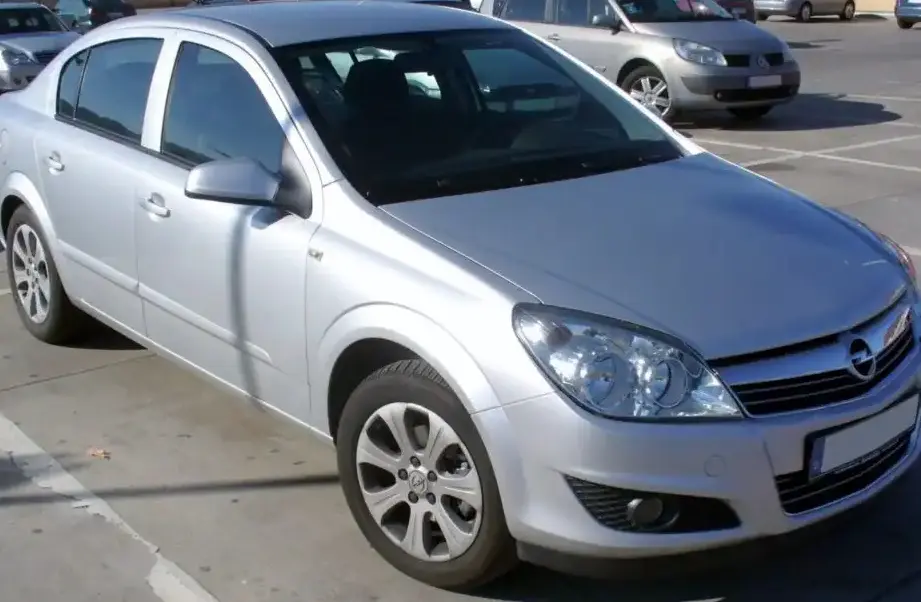
The Opel Astra H Sedan 1.7 CDTI, produced between 2007 and 2010, was a significant variant within the Astra H Sedan range. Positioned as an entry-level to mid-range offering, it aimed to deliver a balance of fuel efficiency, practicality, and affordability for everyday use. This model represented Opel’s response to the increasing demand for diesel vehicles in Europe, particularly for commuters and families. The Astra H Sedan was built on the GM Delta platform, internally designated as 1HX0, a versatile architecture also underpinning vehicles like the Chevrolet Cruze and Saab 9-3.
Powertrain & Engine Architecture
The Astra H Sedan 1.7 CDTI’s powertrain revolved around the Z17DTH engine, a 1.7-liter inline-four cylinder diesel. This engine belonged to Opel/Vauxhall’s ‘A’ family of diesel engines, recognized for its compact dimensions and fuel-saving design. It employed a common rail direct injection system, injecting fuel at extremely high pressure to optimize combustion efficiency. A turbocharger, coupled with an intercooler, boosted power output and broadened the torque curve. The engine featured four valves per cylinder and a single overhead camshaft. Generating 101 horsepower and 320 Nm (236 lb-ft) of torque, the Z17DTH provided adequate performance for typical driving scenarios. The most common transmission pairing was a five-speed manual gearbox. While automatic transmissions were available on other Astra H models, they were rarely, if ever, offered in conjunction with the 1.7 CDTI engine.
Driving Characteristics
The 1.7 CDTI, equipped with the five-speed manual transmission, provided a pragmatic and economical driving experience. Acceleration from 0 to 60 mph took approximately 11.7 seconds, with a top speed around 112 mph. The engine delivered usable torque from relatively low engine speeds, making it suitable for both urban commutes and highway journeys. However, it wasn’t designed for sporty performance; power delivery was linear but lacked the excitement of higher-output engines. The five-speed gearbox was well-matched to the engine’s characteristics, offering smooth and precise gear changes. Compared to the more powerful 1.9 CDTI variants, the 1.7 CDTI felt noticeably less responsive, particularly when overtaking. Its strength lay in fuel economy, consistently achieving around 47 mpg in combined driving conditions.
Equipment & Trim Levels
The Astra H Sedan 1.7 CDTI typically came with a base level of standard equipment, prioritizing practicality and value. Common features included air conditioning, power windows, central locking, and a CD player-equipped audio system. Safety features such as ABS, front airbags, and seatbelt pretensioners were also standard. Higher trim levels, like ‘Enjoy’ or ‘Cosmo’, added features like alloy wheels, climate control, cruise control, and upgraded interior materials. Interior upholstery was generally cloth, designed for durability and functionality. Optional extras included parking sensors, a sunroof, and a more sophisticated audio system.
Chassis & Braking
The Astra H Sedan utilized a McPherson strut front suspension and a rigid axle rear suspension. This configuration prioritized ride comfort, although it didn’t offer the same level of handling precision as more sophisticated suspension setups. The front brakes were ventilated discs, while the rear brakes were solid discs. ABS (Anti-lock Braking System) was standard, improving braking performance and stability. The steering system was a rack and pinion type, providing responsive and accurate steering feel. The 1.7 CDTI models typically rode on 205/55 R16 tires, striking a balance between grip and fuel efficiency.
Market Reception & Comparison
The Astra H Sedan 1.7 CDTI was generally well-regarded by automotive critics as a sensible and economical choice. Its fuel efficiency and comfortable ride were frequently praised. However, some reviewers pointed out that the engine lacked the power of its larger counterparts. Compared to the 1.9 CDTI models, the 1.7 CDTI offered lower running costs but at the expense of performance. It also competed with other compact sedans like the Ford Focus, Volkswagen Jetta, and Peugeot 308. The Astra H Sedan 1.7 CDTI often represented a more affordable entry point into the Opel lineup, appealing to buyers seeking a budget-friendly and practical vehicle.
Legacy
The Z17DTH engine, while generally reliable, has been known to experience issues with the diesel particulate filter (DPF) and the electronic fuel injection system as vehicles age. Consistent maintenance, including the use of high-quality diesel fuel, is crucial for mitigating these potential problems. Today, the Astra H Sedan 1.7 CDTI is available on the used car market at competitive prices. It remains a popular option for those seeking a fuel-efficient and practical compact sedan. However, prospective buyers should be aware of the potential maintenance costs associated with diesel engines and the importance of a thorough pre-purchase inspection to assess the condition of the DPF and fuel injection system.