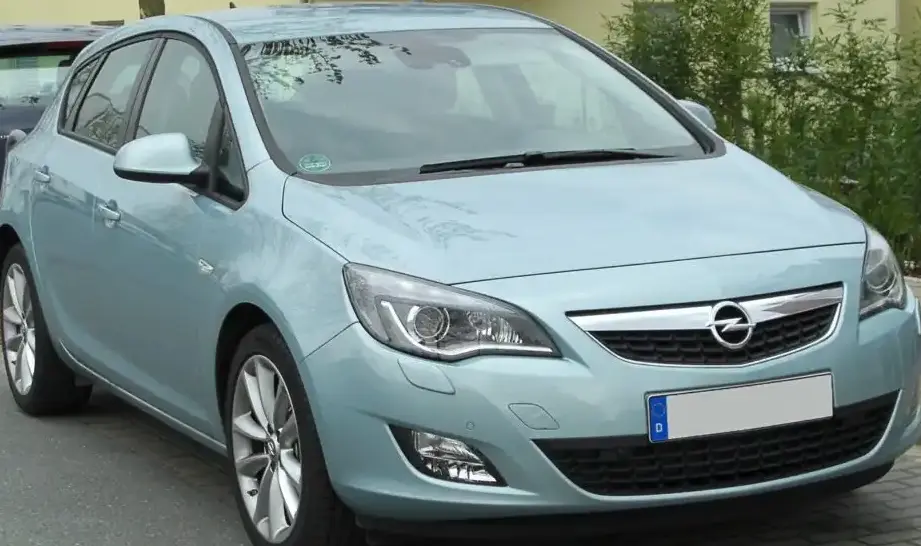
The Opel Astra J 1.4 Turbo (140 hp) Automatic, produced between 2009 and 2012, represented a key offering within the broader Astra J range (2009-2015). Positioned as a mid-range trim, it aimed to balance fuel efficiency with respectable performance, appealing to buyers seeking a comfortable and practical hatchback with an automatic transmission. This variant was a significant part of Opel’s strategy to modernize the Astra, moving it upmarket in terms of technology and perceived quality. The Astra J, built on the GM Delta II platform, was a crucial model for Opel in Europe, competing directly with the Volkswagen Golf, Ford Focus, and Peugeot 308.
Technical Specifications
| Brand | Opel |
| Model | Astra |
| Generation | Astra J |
| Type (Engine) | 1.4 Turbo (140 Hp) Automatic |
| Start of production | 2009 |
| End of production | 2012 |
| Powertrain Architecture | Internal Combustion engine |
| Body type | Hatchback |
| Seats | 5 |
| Doors | 5 |
| Fuel consumption (urban) | 8.9 l/100 km (26.4 US mpg) |
| Fuel consumption (extra urban) | 5.2 l/100 km (45.2 US mpg) |
| Fuel consumption (combined) | 6.6 l/100 km (35.6 US mpg) |
| CO2 emissions | 154 g/km |
| Fuel Type | Petrol (Gasoline) |
| Acceleration 0 – 100 km/h | 10.2 sec |
| Acceleration 0 – 62 mph | 10.2 sec |
| Acceleration 0 – 60 mph | 9.7 sec |
| Maximum speed | 200 km/h (124.27 mph) |
| Emission standard | Euro 5 |
| Weight-to-power ratio | 9.3 kg/Hp |
| Weight-to-torque ratio | 6.5 kg/Nm |
| Power | 140 Hp @ 4900-6000 rpm |
| Torque | 200 Nm @ 1850-4900 rpm (147.51 lb.-ft.) |
| Engine layout | Front, Transverse |
| Engine Model/Code | A14NET |
| Engine displacement | 1364 cm3 (83.24 cu. in.) |
| Number of cylinders | 4 |
| Engine configuration | Inline |
| Cylinder Bore | 72.5 mm (2.85 in.) |
| Piston Stroke | 82.6 mm (3.25 in.) |
| Compression ratio | 9.5:1 |
| Number of valves per cylinder | 4 |
| Fuel injection system | Multi-port manifold injection |
| Engine aspiration | Turbocharger, Intercooler |
| Engine oil capacity | 4 l (4.23 US qt | 3.52 UK qt) |
| Coolant capacity | 6.2 l (6.55 US qt | 5.46 UK qt) |
| Kerb Weight | 1298 kg (2861.6 lbs.) |
| Max. weight | 1870 kg (4122.64 lbs.) |
| Max load | 572 kg (1261.04 lbs.) |
| Trunk (boot) space – minimum | 370 l (13.07 cu. ft.) |
| Trunk (boot) space – maximum | 1235 l (43.61 cu. ft.) |
| Fuel tank capacity | 56 l (14.79 US gal | 12.32 UK gal) |
| Length | 4419 mm (173.98 in.) |
| Width | 1814 mm (71.42 in.) |
| Width including mirrors | 2013 mm (79.25 in.) |
| Height | 1510 mm (59.45 in.) |
| Wheelbase | 2685 mm (105.71 in.) |
| Front track | 1541 mm (60.67 in.) |
| Rear track | 1551 mm (61.06 in.) |
| Ride height (ground clearance) | 160 mm (6.3 in.) |
| Drag coefficient (Cd) | 0.31 |
| Minimum turning circle | 11.4 m (37.4 ft.) |
| Drivetrain | Front wheel drive |
| Number of gears | 6 |
| Gearbox type | Automatic transmission |
| Front brakes | Ventilated discs |
| Rear brakes | Disc |
| Assisting systems | ABS (Anti-lock braking system) |
| Steering type | Steering rack and pinion |
| Tires size | 215/50 R17 |
| Wheel rims size | 17 |
Powertrain & Engine Architecture
The heart of the Astra J 1.4 Turbo Automatic is the A14NET engine, a 1.4-liter inline-four cylinder gasoline engine. This engine utilizes a single-scroll turbocharger with an intercooler to boost power and efficiency. The A14NET features multi-point fuel injection and a timing chain, contributing to its relatively robust design. The engine produces 140 horsepower at 4900-6000 rpm and 200 Nm (147.51 lb-ft) of torque between 1850 and 4900 rpm. The six-speed automatic transmission, sourced from Aisin, was chosen for its smoothness and efficiency. It features adaptive shift patterns, adjusting to the driver’s style and road conditions. This transmission wasn’t known for being particularly sporty, prioritizing comfort and fuel economy over rapid gear changes.
Driving Characteristics
The 1.4 Turbo Automatic offered a comfortable and refined driving experience. Acceleration from 0-60 mph took around 9.7 seconds, which was adequate for everyday driving but noticeably slower than the 1.6L turbo or the diesel variants. The automatic transmission, while smooth, could feel somewhat hesitant during quick overtaking maneuvers. The gear ratios were tuned for fuel efficiency, meaning the engine often operated at lower RPMs. This resulted in a quieter cabin but sometimes required a downshift to access more power. Compared to the manual transmission version of the same engine, the automatic sacrificed some responsiveness, but gained in ease of use, particularly in urban environments.
Equipment & Trim Levels
The 1.4 Turbo Automatic typically came equipped with features like air conditioning, a CD/MP3 stereo system, electric front windows, and central locking. Higher trim levels, such as the ‘Sport’ or ‘SE’ variants, added features like alloy wheels, cruise control, automatic headlights and rain sensors, and upgraded interior trim. Interior upholstery was generally cloth, with options for leather upgrades. The dashboard layout was functional and modern for its time, with a focus on ergonomics. Optional extras included a panoramic sunroof, navigation system, and parking sensors.
Chassis & Braking
The Astra J 1.4 Turbo Automatic featured a MacPherson strut front suspension and a torsion beam rear suspension. The torsion beam setup was a cost-effective solution, but it didn’t offer the same level of sophistication as a fully independent rear suspension found in some higher-spec Astra J models. Braking consisted of ventilated discs on the front wheels and solid discs on the rear. ABS (Anti-lock Braking System) was standard. The suspension tuning prioritized comfort over sporty handling, resulting in a ride that was generally compliant and forgiving on most road surfaces.
Market Reception & Comparison
The Astra J 1.4 Turbo Automatic received mixed reviews. Critics praised its fuel economy and comfortable ride, but some found the engine to be underpowered, especially when paired with the automatic transmission. Compared to the 1.6L turbo, the 1.4 offered better fuel economy but less outright performance. The diesel variants (1.3 CDTi and 1.7 CDTi) provided superior fuel efficiency and torque, but at a higher initial cost. In terms of reliability, the A14NET engine proved to be generally dependable, although some owners reported issues with the turbocharger and fuel injectors over the long term.
Legacy
The Opel Astra J 1.4 Turbo Automatic remains a relatively common sight on the used car market. Its combination of practicality, fuel efficiency, and affordability makes it an attractive option for budget-conscious buyers. While not the most exciting car to drive, it offers a comfortable and reliable transportation solution. The A14NET engine, despite some potential issues, has proven to be reasonably durable with proper maintenance. Today, these Astras represent a good value proposition for those seeking a well-rounded and economical hatchback.