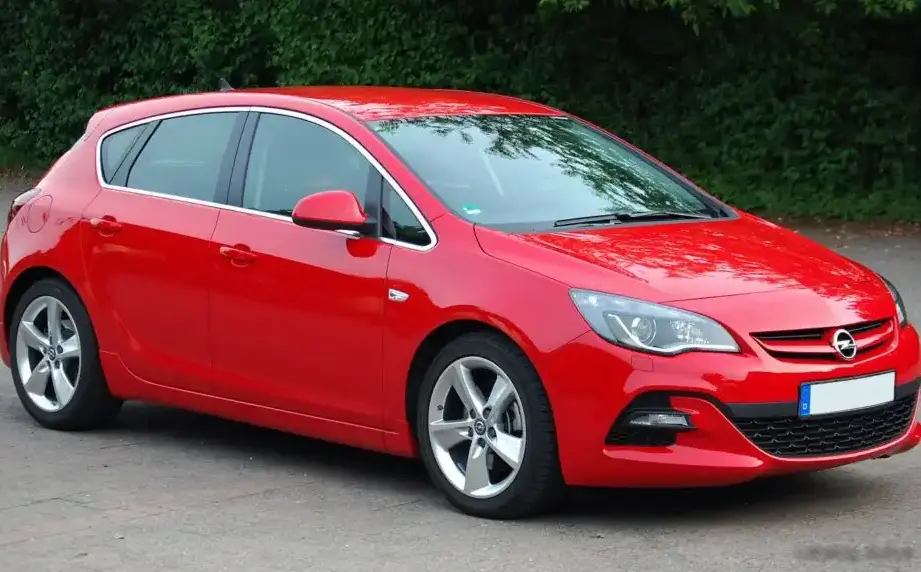
The Opel Astra J (facelift, introduced in 2012) 1.4 Turbo Ecotec, producing 120 horsepower, represented a key offering in Opel’s compact hatchback lineup. Positioned as a mid-range option, it aimed to balance fuel efficiency with acceptable performance for everyday driving. Production of this specific variant ran from 2012 to 2015, falling within the broader J generation (2009-2015) which was based on the GM Delta II platform, also known internally as the 1HX0/A3 platform. The facelift brought revised styling, improved interior materials, and updated technology compared to the pre-2012 models, enhancing the Astra’s appeal in the competitive European C-segment.
Technical Specifications
| Brand | Opel |
| Model | Astra |
| Generation | Astra J (facelift 2012) |
| Type (Engine) | 1.4 (120 Hp) Turbo Ecotec |
| Start of production | 2012 |
| End of production | 2015 |
| Powertrain Architecture | Internal Combustion engine |
| Body type | Hatchback |
| Seats | 5 |
| Doors | 5 |
| Fuel consumption (urban) | 7.6-7.8 l/100 km (30.9 – 30.2 US mpg) |
| Fuel consumption (extra urban) | 4.8-5.1 l/100 km (49 – 46.1 US mpg) |
| Fuel consumption (combined) | 5.8-6.1 l/100 km (40.6 – 38.6 US mpg) |
| CO2 emissions | 137-143 g/km |
| Fuel Type | Petrol (Gasoline) |
| Acceleration 0 – 100 km/h | 10.1 sec |
| Acceleration 0 – 62 mph | 10.1 sec |
| Acceleration 0 – 60 mph | 9.6 sec |
| Maximum speed | 192 km/h (119.3 mph) |
| Emission standard | Euro 5 |
| Weight-to-power ratio | 10.9 kg/Hp |
| Weight-to-torque ratio | 6.5 kg/Nm |
| Power | 120 Hp @ 4200-6000 rpm |
| Torque | 200 Nm @ 1850-4200 rpm (147.51 lb.-ft.) |
| Engine layout | Front, Transverse |
| Engine Model/Code | A14NEL |
| Engine displacement | 1364 cm3 (83.24 cu. in.) |
| Number of cylinders | 4 |
| Engine configuration | Inline |
| Cylinder Bore | 72.5 mm (2.85 in.) |
| Piston Stroke | 82.6 mm (3.25 in.) |
| Compression ratio | 9.5:1 |
| Number of valves per cylinder | 4 |
| Fuel injection system | Multi-port manifold injection |
| Engine aspiration | Turbocharger, Intercooler |
| Engine oil capacity | 4 l (4.23 US qt | 3.52 UK qt) |
| Coolant capacity | 6.2 l (6.55 US qt | 5.46 UK qt) |
| Kerb Weight | 1308 kg (2883.65 lbs.) |
| Max. weight | 1940 kg (4276.97 lbs.) |
| Max load | 632 kg (1393.32 lbs.) |
| Trunk (boot) space – minimum | 370 l (13.07 cu. ft.) |
| Trunk (boot) space – maximum | 1235 l (43.61 cu. ft.) |
| Fuel tank capacity | 56 l (14.79 US gal | 12.32 UK gal) |
| Max. roof load | 75 kg (165.35 lbs.) |
| Permitted trailer load with brakes (12%) | 1300 kg (2866.01 lbs.) |
| Permitted trailer load without brakes | 680 kg (1499.14 lbs.) |
| Length | 4419 mm (173.98 in.) |
| Width | 1814 mm (71.42 in.) |
| Width with mirrors folded | 1831 mm (72.09 in.) |
| Width including mirrors | 2013 mm (79.25 in.) |
| Height | 1510 mm (59.45 in.) |
| Wheelbase | 2685 mm (105.71 in.) |
| Front track | 1541 mm (60.67 in.) |
| Rear track | 1551 mm (61.06 in.) |
| Minimum turning circle | 11.4 m (37.4 ft.) |
| Drivetrain | Front wheel drive |
| Number of gears | 6 |
| Gearbox type | Manual transmission |
Powertrain & Engine Architecture
The heart of this Astra variant is the A14NEL, a 1.4-liter inline-four cylinder gasoline engine. This engine belongs to Opel’s “Ecotec” family, emphasizing efficiency and reduced emissions. The A14NEL features multi-point fuel injection and a single turbocharger with an intercooler. The turbocharger provides a noticeable boost in power compared to naturally aspirated 1.4-liter engines, helping to overcome the inherent limitations of a smaller displacement. The engine’s aluminum cylinder head houses four valves per cylinder, contributing to improved breathing and power output. The 6-speed manual transmission was the standard offering, providing a good balance between fuel economy and driver control. The engine produces 200 Nm (147.51 lb-ft) of torque between 1850 and 4200 rpm, making it reasonably responsive in everyday driving situations.
Driving Characteristics
The 1.4 Turbo Ecotec with the 6-speed manual transmission delivers a competent, if not particularly thrilling, driving experience. Acceleration from 0-60 mph takes around 9.6 seconds, and top speed is rated at 119.3 mph. The turbocharger provides a noticeable surge of power during acceleration, but it’s not a dramatic boost. The gear ratios are well-chosen for everyday driving, offering a good balance between fuel economy and responsiveness. Compared to the more powerful 1.6-liter turbo or diesel variants, this 1.4 feels less eager, particularly when fully loaded or tackling steep inclines. However, the lighter engine weight contributes to nimble handling and predictable cornering.
Equipment & Trim Levels
The 1.4 Turbo Ecotec trim typically included standard features such as air conditioning, power windows, power mirrors, a CD/MP3 stereo system, and ABS brakes. Higher trim levels, such as ‘Sport’ or ‘Enjoy’, added features like alloy wheels, cruise control, a multi-function steering wheel, and upgraded interior trim. Optional extras included a panoramic sunroof, parking sensors, and a navigation system. Interior upholstery was typically cloth, with the option of leather seats on higher-spec models. The dashboard layout was functional and well-designed, with a clear instrument cluster and intuitive controls.
Chassis & Braking
The Astra J utilized a MacPherson strut front suspension and a torsion beam rear suspension. This setup provided a good compromise between ride comfort and handling. The front brakes were ventilated discs, while the rear brakes were typically drum brakes on the base models, with disc brakes available on higher trim levels. Electric power steering was standard, offering light and precise steering feel. Stabilizer bars were fitted to both the front and rear axles to reduce body roll during cornering.
Market Reception & Comparison
The Astra J 1.4 Turbo Ecotec was generally well-received by automotive critics as a sensible and economical choice. It offered a good balance of fuel efficiency, practicality, and affordability. However, some reviewers noted that the engine could feel strained when pushed hard, and the interior, while improved over previous generations, wasn’t as refined as some of its rivals. Compared to the 1.6-liter turbo, the 1.4 offered better fuel economy but less performance. The diesel variants (1.3 CDTi and 1.7 CDTi) provided even better fuel economy but were more expensive to purchase. The 1.4 Turbo Ecotec appealed to buyers who prioritized fuel efficiency and affordability over outright performance.
Legacy
The A14NEL engine, while not known for being exceptionally durable, generally proved to be reliable with regular maintenance. Common issues included turbocharger failure and occasional problems with the fuel injectors. The Astra J, as a whole, has become a popular used car choice due to its affordability and practicality. The 1.4 Turbo Ecotec variant remains a viable option for buyers seeking a fuel-efficient and reasonably reliable compact hatchback. However, prospective buyers should be aware of the potential for turbocharger issues and ensure that the vehicle has been properly maintained.