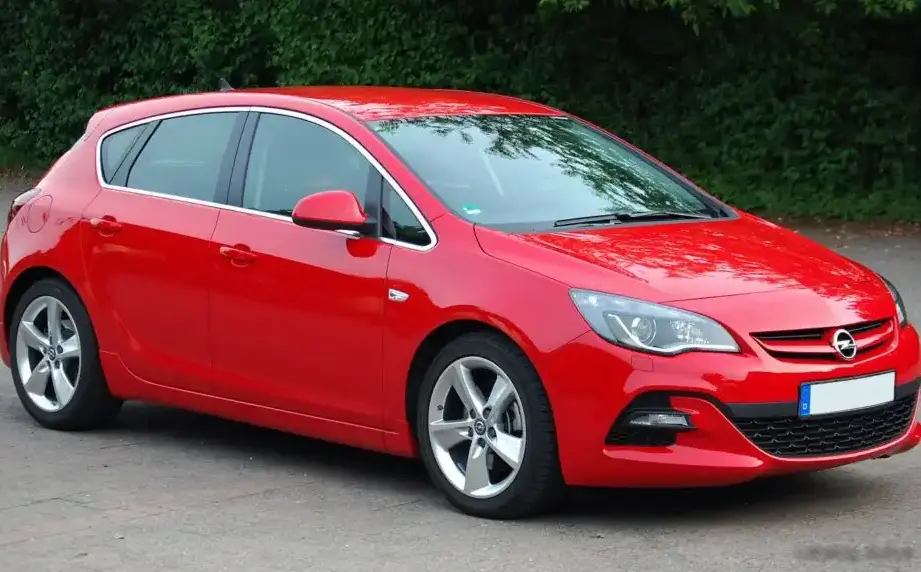
The Opel Astra J (facelift, introduced in 2012) 1.4 Ecotec, producing 87 horsepower, represented an entry-level offering within the broader Astra J range. Positioned as a fuel-efficient and affordable option, this variant was primarily aimed at buyers prioritizing economy over outright performance. Production of this specific configuration ran from 2012 to 2015, falling within the mid-life cycle refresh of the J generation Astra, which spanned from 2009 to 2015. The facelift brought styling updates and revised engine options, including refinements to the 1.4-liter Ecotec engine. This model was particularly significant in European markets, where compact hatchbacks are a dominant vehicle segment.
Technical Specifications
| Brand | Opel |
| Model | Astra |
| Generation | Astra J (facelift 2012) |
| Type (Engine) | 1.4 (87 Hp) Ecotec |
| Start of production | 2012 |
| End of production | 2015 |
| Powertrain Architecture | Internal Combustion engine |
| Body type | Hatchback |
| Seats | 5 |
| Doors | 5 |
| Fuel consumption (urban) | 7.2 l/100 km (32.7 US mpg) |
| Fuel consumption (extra urban) | 4.5 l/100 km (52.3 US mpg) |
| Fuel consumption (combined) | 5.5 l/100 km (42.8 US mpg) |
| CO2 emissions | 136 g/km |
| Fuel Type | Petrol (Gasoline) |
| Acceleration 0 – 100 km/h | 15.1 sec |
| Acceleration 0 – 62 mph | 15.1 sec |
| Acceleration 0 – 60 mph | 14.3 sec |
| Maximum speed | 170 km/h (105.63 mph) |
| Emission standard | Euro 5 |
| Weight-to-power ratio | 15.8 kg/Hp |
| Weight-to-torque ratio | 10.6 kg/Nm |
| Power | 87 Hp @ 6000 rpm |
| Torque | 130 Nm @ 4000 rpm (95.88 lb.-ft. @ 4000 rpm) |
| Engine layout | Front, Transverse |
| Engine Model/Code | A14XEL |
| Engine displacement | 1398 cm3 (85.31 cu. in.) |
| Number of cylinders | 4 |
| Engine configuration | Inline |
| Cylinder Bore | 73.4 mm (2.89 in.) |
| Piston Stroke | 82.6 mm (3.25 in.) |
| Compression ratio | 10.5:1 |
| Number of valves per cylinder | 4 |
| Fuel injection system | Multi-port manifold injection |
| Engine aspiration | Naturally aspirated |
| Engine oil capacity | 4 l (4.23 US qt | 3.52 UK qt) |
| Coolant capacity | 6.2 l (6.55 US qt | 5.46 UK qt) |
| Kerb Weight | 1373 kg (3026.95 lbs.) |
| Max. weight | 1870 kg (4122.64 lbs.) |
| Max load | 497 kg (1095.7 lbs.) |
| Trunk (boot) space – minimum | 370 l (13.07 cu. ft.) |
| Trunk (boot) space – maximum | 1235 l (43.61 cu. ft.) |
| Fuel tank capacity | 56 l (14.79 US gal | 12.32 UK gal) |
| Max. roof load | 75 kg (165.35 lbs.) |
| Permitted trailer load with brakes (12%) | 850 kg (1873.93 lbs.) |
| Permitted trailer load without brakes | 670 kg (1477.1 lbs.) |
| Length | 4419 mm (173.98 in.) |
| Width | 1814 mm (71.42 in.) |
| Width with mirrors folded | 1831 mm (72.09 in.) |
| Width including mirrors | 2013 mm (79.25 in.) |
| Height | 1510 mm (59.45 in.) |
| Wheelbase | 2685 mm (105.71 in.) |
| Front track | 1544 mm (60.79 in.) |
| Rear track | 1554 mm (61.18 in.) |
| Ride height (ground clearance) | 165 mm (6.5 in.) |
| Minimum turning circle | 11.4 m (37.4 ft.) |
| Drivetrain Architecture | Front wheel drive |
| Number of gears | 5 |
| Gearbox type | Manual transmission |
Powertrain & Engine Architecture
The Astra J 1.4 Ecotec utilized the A14XEL engine code, a naturally aspirated, four-cylinder inline engine displacing 1398 cc. This engine featured multi-point fuel injection and a dual overhead camshaft (DOHC) valvetrain with four valves per cylinder. The A14XEL was designed with fuel efficiency in mind, employing technologies like variable valve timing to optimize combustion. The 87 horsepower output was achieved at 6000 rpm, with peak torque of 130 Nm (95.88 lb-ft) delivered at 4000 rpm. The engine was transversely mounted in the front of the vehicle. The standard transmission for this variant was a five-speed manual gearbox, although a six-speed automatic transmission was also offered as an option, albeit less common. The automatic transmission was a conventional torque converter type, prioritizing smooth shifts over outright performance.
Driving Characteristics
The 1.4-liter, 87 hp Astra J with the five-speed manual transmission offered adequate, but not exhilarating, performance. Acceleration from 0-60 mph took approximately 14.3 seconds, and top speed was limited to 170 km/h (105.63 mph). The engine felt strained when pushed hard, particularly when fully loaded or climbing hills. The gear ratios were geared towards economy, with a relatively tall fifth gear for highway cruising. Compared to the more powerful 1.6-liter or turbocharged 1.4-liter variants, this engine lacked responsiveness. However, the light clutch and precise gearshift made it relatively easy to drive in urban environments. The automatic transmission, while providing convenience, further diminished acceleration and responsiveness due to its less efficient power transfer and shift programming.
Equipment & Trim Levels
The 1.4 Ecotec variant typically served as the entry point to the Astra J range. Standard equipment generally included air conditioning, power windows, central locking, and a basic audio system with MP3 compatibility. Safety features such as ABS brakes, electronic stability control, and multiple airbags were also standard. Higher trim levels, such as ‘Enjoy’ or ‘Cosmo’, added features like alloy wheels, cruise control, a more advanced audio system, and upgraded interior trim. Optional extras included parking sensors, a sunroof, and a navigation system. Interior upholstery was typically cloth, with a functional, if somewhat basic, dashboard layout.
Chassis & Braking
The Astra J utilized a MacPherson strut front suspension and a torsion beam rear suspension. This setup provided a reasonable balance between ride comfort and handling. The 1.4 Ecotec models typically featured disc brakes on the front wheels and drum brakes on the rear, reflecting its position as a more affordable variant. Stabilizer bars were fitted to both the front and rear axles to reduce body roll during cornering. The steering was electrically assisted, providing light and precise control.
Market Reception & Comparison
The Astra J 1.4 Ecotec was generally well-received as a practical and economical choice. Critics praised its fuel efficiency and low running costs, but noted its lack of performance. Compared to the 1.6-liter variant, the 1.4 offered significantly lower fuel consumption but at the expense of acceleration and overall driving enjoyment. The turbocharged 1.4-liter models provided a compelling alternative, offering a better balance of performance and economy. In terms of reliability, the A14XEL engine proved to be generally robust, although issues with oil leaks and coolant system components were occasionally reported.
Legacy
The Opel Astra J 1.4 Ecotec remains a common sight on European roads today. Its relatively simple engine design and readily available parts contribute to its affordability and ease of maintenance. While not a performance icon, it represents a sensible and reliable option for buyers seeking a fuel-efficient and practical compact hatchback. On the used car market, these models typically command lower prices than their more powerful counterparts, making them an attractive option for budget-conscious buyers. The powertrain, while not groundbreaking, proved durable enough to withstand years of daily use, solidifying its place as a dependable, if unremarkable, member of the Astra J family.