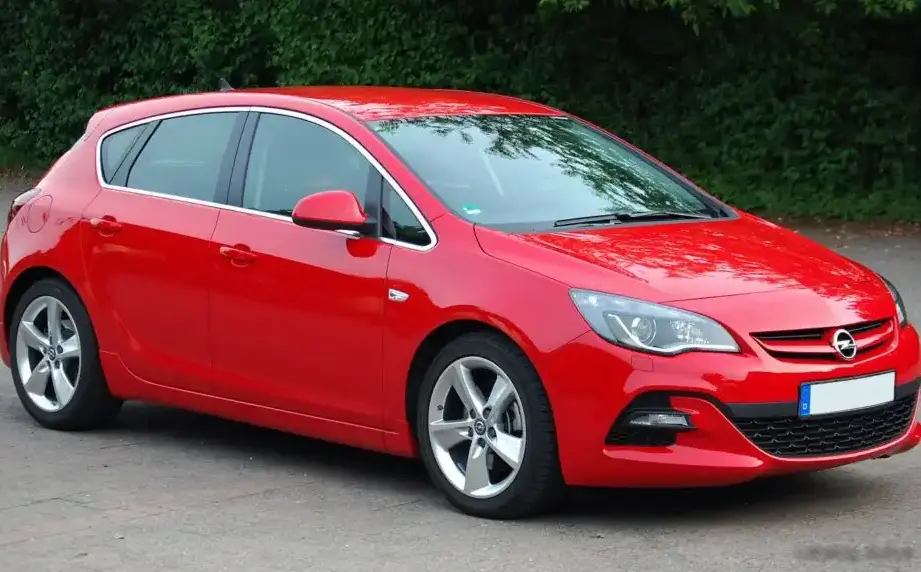
The Opel Astra J (facelift, introduced in 2012) 1.6 Ecotec Automatic represents a mainstream offering within the highly competitive European compact car segment. Produced from 2012 to 2015, this variant aimed to provide a balance of affordability, fuel efficiency, and ease of use for buyers prioritizing comfort over outright performance. It sat within the broader Astra J range, which included more powerful petrol engines, diesel options, and various trim levels. This specific configuration – the 1.6-liter petrol engine paired with a six-speed automatic transmission – was positioned as a mid-range option, appealing to drivers seeking a convenient and economical daily driver.
Technical Specifications
| Brand | Opel |
| Model | Astra |
| Generation | Astra J (facelift 2012) |
| Type (Engine) | 1.6 (115 Hp) Ecotec Automatic |
| Start of production | 2012 |
| End of production | 2015 |
| Powertrain Architecture | Internal Combustion engine |
| Body type | Hatchback |
| Seats | 5 |
| Doors | 5 |
| Fuel consumption (urban) | 9.9-10.1 l/100 km (23.8 – 23.3 US mpg) |
| Fuel consumption (extra urban) | 5.5-5.8 l/100 km (42.8 – 40.6 US mpg) |
| Fuel consumption (combined) | 7.1-7.4 l/100 km (33.1 – 31.8 US mpg) |
| CO2 emissions | 167-173 g/km |
| Fuel Type | Petrol (Gasoline) |
| Acceleration 0 – 100 km/h | 13.3 sec |
| Acceleration 0 – 62 mph | 13.3 sec |
| Acceleration 0 – 60 mph | 12.6 sec |
| Maximum speed | 182 km/h (113.09 mph) |
| Emission standard | Euro 5 |
| Weight-to-power ratio | 11.4 kg/Hp |
| Weight-to-torque ratio | 8.5 kg/Nm |
| Power | 115 Hp @ 6000 rpm |
| Torque | 155 Nm @ 4000 rpm (114.32 lb.-ft. @ 4000 rpm) |
| Engine layout | Front, Transverse |
| Engine Model/Code | A16XER |
| Engine displacement | 1598 cm3 (97.52 cu. in.) |
| Number of cylinders | 4 |
| Engine configuration | Inline |
| Cylinder Bore | 79 mm (3.11 in.) |
| Piston Stroke | 81.5 mm (3.21 in.) |
| Number of valves per cylinder | 4 |
| Fuel injection system | Multi-port manifold injection |
| Engine aspiration | Naturally aspirated engine |
| Engine oil capacity | 4.5 l (4.76 US qt | 3.96 UK qt) |
| Coolant capacity | 5.6 l (5.92 US qt | 4.93 UK qt) |
| Kerb Weight | 1313 kg (2894.67 lbs.) |
| Max. weight | 1885 kg (4155.71 lbs.) |
| Max load | 572 kg (1261.04 lbs.) |
| Trunk (boot) space – minimum | 370 l (13.07 cu. ft.) |
| Trunk (boot) space – maximum | 1235 l (43.61 cu. ft.) |
| Fuel tank capacity | 56 l (14.79 US gal | 12.32 UK gal) |
| Max. roof load | 75 kg (165.35 lbs.) |
| Permitted trailer load with brakes (12%) | 1250 kg (2755.78 lbs.) |
| Permitted trailer load without brakes | 680 kg (1499.14 lbs.) |
| Length | 4419 mm (173.98 in.) |
| Width | 1814 mm (71.42 in.) |
| Width with mirrors folded | 1831 mm (72.09 in.) |
| Width including mirrors | 2013 mm (79.25 in.) |
| Height | 1510 mm (59.45 in.) |
| Wheelbase | 2685 mm (105.71 in.) |
| Front track | 1541 mm (60.67 in.) |
| Rear (Back) track | 1551 mm (61.06 in.) |
| Minimum turning circle | 11.4 m (37.4 ft.) |
| Drivetrain Architecture | Front wheel drive |
| Number of gears and type of gearbox | 6 gears, automatic transmission |
Powertrain & Engine Architecture
The heart of this Astra J variant is the A16XER engine, a 1.6-liter inline-four cylinder petrol engine. This engine belongs to Opel’s Ecotec family, known for its focus on efficiency and refinement. The A16XER utilizes multi-port fuel injection, delivering fuel directly into the intake ports rather than directly into the combustion chamber. This system, while not as advanced as direct injection, was cost-effective and provided adequate performance for the intended market segment. The engine features a dual overhead camshaft (DOHC) valvetrain with four valves per cylinder, contributing to improved breathing and power output. The six-speed automatic transmission, sourced from Aisin, was chosen for its smooth operation and relatively quick shifts. It’s a conventional torque converter automatic, prioritizing comfort and ease of use over the sportier feel of a dual-clutch transmission.
Driving Characteristics
The 1.6-liter engine, producing 115 horsepower and 155 Nm of torque, delivers adequate but not exhilarating performance. Acceleration from 0 to 60 mph takes around 12.6 seconds, and the top speed is 182 km/h (113 mph). The automatic transmission is tuned for fuel economy, meaning it upshifts quickly to maintain lower engine speeds. This results in a relaxed driving experience, particularly on the highway. However, it can feel somewhat sluggish when needing to accelerate quickly, such as when overtaking. Compared to the more powerful 1.4 Turbo or 1.6 Turbo variants, this 1.6 naturally aspirated engine lacks the punch and responsiveness. The gear ratios are optimized for cruising, with a relatively tall final drive to improve fuel efficiency. The automatic transmission doesn’t offer manual shift modes, further emphasizing its focus on convenience.
Equipment & Trim Levels
The 1.6 Ecotec Automatic typically came equipped with a reasonable level of standard features. These included air conditioning, power windows, power mirrors, a basic audio system with USB connectivity, and ABS brakes. Higher trim levels, such as ‘Enjoy’ or ‘Cosmo’, added features like alloy wheels, cruise control, a more advanced infotainment system, and parking sensors. Interior upholstery was typically cloth, with options for upgraded materials on higher trims. The dashboard layout was functional and straightforward, prioritizing usability over stylistic flair. Optional extras included a sunroof, leather seats, and a navigation system.
Chassis & Braking
The Astra J utilized a MacPherson strut front suspension and a torsion beam rear suspension. This setup provided a good balance of ride comfort and handling. The torsion beam rear suspension was a cost-effective solution, but it didn’t offer the same level of sophistication as a multi-link setup found on some higher-end trims. Braking consisted of disc brakes on the front wheels and drum brakes on the rear wheels. ABS (Anti-lock Braking System) was standard. The steering was electrically assisted, providing light and easy steering feel. Stabilizer bars were fitted to both the front and rear axles to reduce body roll during cornering.
Market Reception & Comparison
The Astra J 1.6 Ecotec Automatic was generally well-received as a practical and affordable family car. Critics praised its comfortable ride, decent fuel economy, and user-friendly automatic transmission. However, it was often criticized for its lack of performance and somewhat bland styling. Compared to the 1.4 Turbo, the 1.6 offered lower running costs but significantly less power. The 1.7 CDTi diesel variant provided even better fuel economy but came with a higher purchase price. In terms of reliability, the A16XER engine proved to be generally dependable, although some owners reported issues with the timing chain.
Legacy
The Opel Astra J 1.6 Ecotec Automatic remains a relatively common sight on the used car market. Its affordability and reputation for reliability make it an attractive option for budget-conscious buyers. While it may not offer the excitement of more powerful variants, it provides a comfortable and practical driving experience. The A16XER engine, while not a technological marvel, is known for its durability and relatively low maintenance costs. Parts availability is generally good, and the car’s simple design makes it relatively easy to repair. As a mainstream compact car, the Astra J 1.6 Automatic played a significant role in Opel’s sales success during the early 2010s.