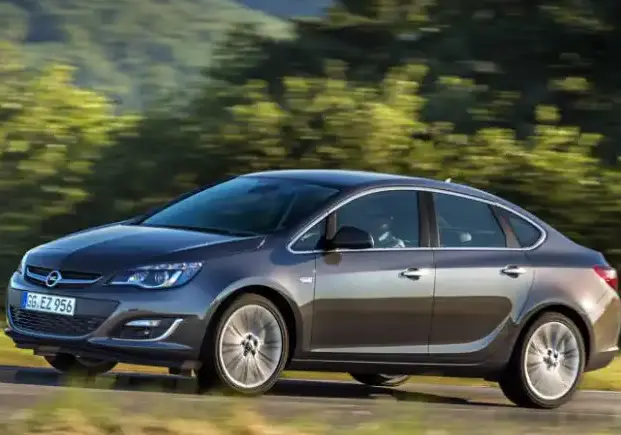
The Opel Astra J Sedan 1.6 (115 hp) was a mainstream offering within the broader Astra J Sedan range, produced from 2012 to 2018. Positioned as an entry-to-mid-level trim, it aimed to provide a balance of affordability, fuel efficiency, and practicality for family buyers in the European market. The Astra J Sedan, a four-door notchback, was designed to appeal to customers who preferred a traditional sedan body style over the more common hatchback configuration offered elsewhere in the Astra J lineup. This variant specifically utilized Opel’s A16XER engine paired with a six-speed manual transmission, making it a popular choice for drivers prioritizing fuel economy and ease of use.
Technical Specifications
| Brand | Opel |
| Model | Astra |
| Generation | Astra J Sedan |
| Type (Engine) | 1.6 (115 Hp) |
| Start of production | 2012 |
| End of production | 2018 |
| Powertrain Architecture | Internal Combustion engine |
| Body type | Sedan |
| Seats | 5 |
| Doors | 4 |
| Fuel consumption (urban) | 9.9 – 9.8 l/100 km (23.8 – 24 US mpg) |
| Fuel consumption (extra urban) | 5.8 – 5.5 l/100 km (40.6 – 42.8 US mpg) |
| Fuel consumption (combined) | 7.3 – 7.0 l/100 km (32.2 – 33.6 US mpg) |
| Fuel Type | Petrol (Gasoline) |
| Acceleration 0 – 100 km/h | 13.7 sec |
| Acceleration 0 – 62 mph | 13.7 sec |
| Acceleration 0 – 60 mph | 13 sec |
| Maximum speed | 180 km/h (111.85 mph) |
| Emission standard | Euro 5 |
| Weight-to-power ratio | 12.2 kg/Hp |
| Weight-to-torque ratio | 9.1 kg/Nm |
| Power | 115 Hp @ 6000 rpm |
| Torque | 155 Nm @ 4000 rpm (114.32 lb.-ft. @ 4000 rpm) |
| Engine layout | Front, Transverse |
| Engine Model/Code | A16XER |
| Engine displacement | 1598 cm3 (97.52 cu. in.) |
| Number of cylinders | 4 |
| Engine configuration | Inline |
| Cylinder Bore | 79 mm (3.11 in.) |
| Piston Stroke | 81.5 mm (3.21 in.) |
| Number of valves per cylinder | 4 |
| Fuel injection system | Multi-port manifold injection |
| Engine aspiration | Naturally aspirated engine |
| Engine oil capacity | 4.5 l (4.76 US qt | 3.96 UK qt) |
| Coolant capacity | 5.6 l (5.92 US qt | 4.93 UK qt) |
| Kerb Weight | 1405 kg (3097.49 lbs.) |
| Max. weight | 1895 kg (4177.76 lbs.) |
| Max load | 490 kg (1080.27 lbs.) |
| Trunk (boot) space – minimum | 460 l (16.24 cu. ft.) |
| Trunk (boot) space – maximum | 1010 l (35.67 cu. ft.) |
| Fuel tank capacity | 56 l (14.79 US gal | 12.32 UK gal) |
| Length | 4658 mm (183.39 in.) |
| Width | 1814 mm (71.42 in.) |
| Width including mirrors | 2013 mm (79.25 in.) |
| Height | 1500 mm (59.06 in.) |
| Wheelbase | 2685 mm (105.71 in.) |
| Front track | 1541 mm (60.67 in.) |
| Rear track | 1551 mm (61.06 in.) |
| Front overhang | 974 mm (38.35 in.) |
| Rear overhang | 999 mm (39.33 in.) |
| Minimum turning circle | 11.5 m (37.73 ft.) |
| Drivetrain Architecture | Front wheel drive |
| Number of gears | 6 |
| Gearbox type | Manual transmission |
| Front brakes | Ventilated discs |
| Assisting systems | ABS (Anti-lock braking system) |
| Steering type | Steering rack and pinion |
| Power steering | Electric Steering |
Powertrain & Engine Architecture
The heart of the Astra J Sedan 1.6 was the A16XER engine, a 1.6-liter inline-four cylinder gasoline engine. This engine was a mainstay of Opel/Vauxhall’s lineup for several years, known for its relatively simple design and reasonable reliability. The A16XER featured a multi-point fuel injection system, delivering fuel directly into the intake ports. It utilized a single overhead camshaft (SOHC) design with four valves per cylinder, contributing to its modest power output. The engine’s 115 horsepower at 6,000 rpm and 155 Nm (114 lb-ft) of torque at 4,000 rpm were considered adequate for everyday driving, but not particularly sporty. The six-speed manual transmission offered precise shifts and helped to maximize fuel efficiency. The transmission’s gear ratios were tuned for economy, with a relatively long final drive.
Driving Characteristics
The 1.6-liter engine and manual transmission combination in the Astra J Sedan provided a comfortable, if not exhilarating, driving experience. Acceleration from 0 to 60 mph took around 13 seconds, and top speed was limited to 111.85 mph. The engine felt somewhat strained when pushed hard, particularly when overtaking or climbing hills. The manual gearbox, while precise, required frequent shifting to maintain momentum. Compared to higher-output versions of the Astra J, such as those equipped with the 1.4 Turbo or 2.0 CDTI diesel engines, the 1.6-liter model felt noticeably slower. However, it offered a more engaging driving experience than the automatic transmission options available on other Astra J variants.
Equipment & Trim Levels
The Astra J Sedan 1.6 typically came with a reasonable level of standard equipment. This included air conditioning, power windows, power mirrors, a basic audio system with USB connectivity, and ABS brakes. Higher trim levels added features such as alloy wheels, cruise control, a more advanced infotainment system, and parking sensors. Interior upholstery was typically cloth, with options for upgraded materials available. The dashboard layout was functional and straightforward, prioritizing usability over aesthetics. Optional extras included a sunroof, leather seats, and a navigation system.
Chassis & Braking
The Astra J Sedan utilized a MacPherson strut front suspension and a torsion beam rear suspension. This setup provided a comfortable ride quality, although it wasn’t particularly sporty. The front brakes were ventilated discs, while the rear brakes were typically drum brakes on the base models, with disc brakes available on higher trim levels. The steering was electrically assisted, providing light and precise control. The Astra J Sedan’s chassis was designed to prioritize safety and stability, rather than outright performance.
Market Reception & Comparison
The Astra J Sedan 1.6 was generally well-received by critics as a practical and affordable family car. It was praised for its fuel efficiency, comfortable ride, and spacious interior. However, it was also criticized for its lack of power and somewhat uninspired driving dynamics. Compared to other trims in the Astra J lineup, the 1.6-liter model offered the best fuel economy but the lowest performance. It was a popular choice for drivers who prioritized value and practicality over driving excitement. The 1.6L engine was known to be reliable, but regular maintenance was crucial to prevent issues.
Legacy
The Opel Astra J Sedan 1.6 remains a relatively common sight on used car lots today. The A16XER engine is generally considered to be reliable, although it is prone to occasional issues such as oil leaks and timing chain wear. Parts availability is good, and maintenance costs are relatively low. The Astra J Sedan 1.6 represents a solid, if unremarkable, choice for buyers seeking an affordable and practical family car. Its fuel efficiency and reasonable running costs continue to make it an attractive option in the used car market.