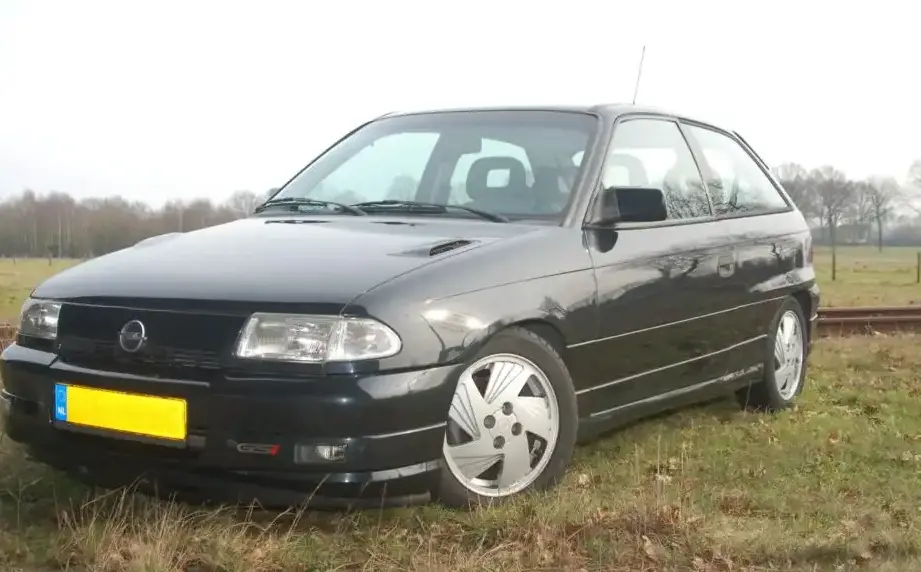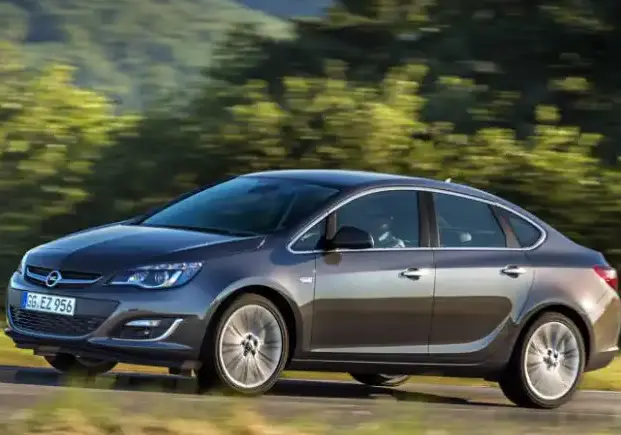
The Opel Astra J Sedan 1.6 Turbo, producing 170 horsepower, was a significant offering in the European market from 2012 to 2018. Positioned as a mid-range trim within the broader Astra J Sedan lineup, it aimed to balance performance and fuel efficiency for buyers seeking a more engaging driving experience than the base models, without the higher costs associated with the more powerful variants. This model represented Opel’s attempt to cater to a wider audience within the competitive compact sedan segment, offering a modern design and a turbocharged engine in a practical package.
Technical Specifications
| Brand | Opel |
| Model | Astra |
| Generation | Astra J Sedan |
| Type (Engine) | 1.6 Turbo (170 Hp) |
| Start of production | 2012 |
| End of production | 2018 |
| Powertrain Architecture | Internal Combustion engine |
| Body type | Sedan |
| Seats | 5 |
| Doors | 4 |
| Fuel consumption (urban) | 7.8 l/100 km (30.2 US mpg) |
| Fuel consumption (extra urban) | 4.9 l/100 km (48 US mpg) |
| Fuel consumption (combined) | 5.9 l/100 km (39.9 US mpg) |
| CO2 emissions | 139 g/km |
| Fuel Type | Petrol (Gasoline) |
| Acceleration 0 – 100 km/h | 8.8 sec |
| Acceleration 0 – 62 mph | 8.8 sec |
| Acceleration 0 – 60 mph | 8.4 sec |
| Maximum speed | 222 km/h (137.94 mph) |
| Emission standard | Euro 5 |
| Power | 170 Hp @ 6000 rpm |
| Torque | 260 Nm @ 1650-3200 rpm (191.77 lb.-ft.) |
| Engine layout | Front, Transverse |
| Engine Model/Code | A16XHT |
| Engine displacement | 1598 cm3 (97.52 cu. in.) |
| Number of cylinders | 4 |
| Engine configuration | Inline |
| Cylinder Bore | 79 mm (3.11 in.) |
| Piston Stroke | 81.5 mm (3.21 in.) |
| Number of valves per cylinder | 4 |
| Fuel injection system | Direct injection |
| Engine aspiration | Turbocharger, Intercooler |
| Engine oil capacity | 5.5 l (5.81 US qt | 4.84 UK qt) |
| Coolant | 6.3 l (6.66 US qt | 5.54 UK qt) |
| Trunk (boot) space – minimum | 460 l (16.24 cu. ft.) |
| Trunk (boot) space – maximum | 1010 l (35.67 cu. ft.) |
| Fuel tank capacity | 56 l (14.79 US gal | 12.32 UK gal) |
| Length | 4658 mm (183.39 in.) |
| Width | 1814 mm (71.42 in.) |
| Width including mirrors | 2013 mm (79.25 in.) |
| Height | 1500 mm (59.06 in.) |
| Wheelbase | 2685 mm (105.71 in.) |
| Front track | 1541 mm (60.67 in.) |
| Rear track | 1551 mm (61.06 in.) |
| Front overhang | 974 mm (38.35 in.) |
| Rear overhang | 999 mm (39.33 in.) |
| Minimum turning circle | 11.5 m (37.73 ft.) |
| Drivetrain Architecture | Front wheel drive |
| Number of gears | 6 gears, manual transmission |
| Front brakes | Ventilated discs |
| Assisting systems | ABS (Anti-lock braking system) |
| Steering type | Steering rack and pinion |
| Power steering | Electric Steering |
Powertrain & Engine Architecture
The heart of the Astra J Sedan 1.6 Turbo was the A16XHT engine, a 1.6-liter inline-four cylinder powerplant. This engine utilized direct fuel injection and a turbocharger with an intercooler to boost power output to 170 horsepower and 260 Nm (191.77 lb.-ft.) of torque. The direct injection system allowed for precise fuel delivery, improving both efficiency and performance. The turbocharger provided increased air intake, resulting in a broader torque curve peaking between 1650 and 3200 rpm. This made the engine responsive in everyday driving situations. The engine was transversely mounted in the front of the vehicle, driving the front wheels. The six-speed manual transmission was the standard offering, providing drivers with full control over gear selection.
Driving Characteristics
The 1.6 Turbo engine provided a noticeable step up in performance compared to the base 1.4-liter naturally aspirated engines available in the Astra J Sedan. Acceleration from 0 to 100 km/h (0-62 mph) took approximately 8.8 seconds, making it a competitive performer in its class. The turbocharger did exhibit some lag at lower engine speeds, but once spooled up, the engine delivered a strong and linear power delivery. The six-speed manual transmission was well-matched to the engine’s characteristics, allowing drivers to keep the engine in its optimal power band. Compared to the higher-output 2.0-liter Turbo models, the 1.6 Turbo offered a more balanced driving experience, prioritizing fuel efficiency and everyday usability over outright performance.
Equipment & Trim Levels
The Astra J Sedan 1.6 Turbo typically came equipped with a respectable level of standard features. These included air conditioning, power windows, power mirrors, a CD/MP3 stereo system, and alloy wheels. Higher trim levels offered additional features such as automatic climate control, a touchscreen infotainment system, parking sensors, and cruise control. Interior upholstery was typically cloth, with optional leather upgrades available. The dashboard layout was modern and functional, with a focus on ergonomics. Safety features included ABS, electronic stability control, and multiple airbags.
Chassis & Braking
The Astra J Sedan featured a MacPherson strut front suspension and a multi-link rear suspension, providing a comfortable and controlled ride. The suspension was tuned to balance handling and ride quality, making it suitable for both city driving and longer journeys. The front brakes were ventilated discs, providing ample stopping power. Rear brakes were typically solid discs, although some models may have featured drum brakes depending on the specific trim level and market. Electric power steering provided light and precise steering feel. A stabilizer bar was fitted to both the front and rear axles to reduce body roll during cornering.
Market Reception & Comparison
The Astra J Sedan 1.6 Turbo was generally well-received by automotive critics. It was praised for its responsive engine, comfortable ride, and well-equipped interior. Fuel economy was also a strong point, with combined fuel consumption figures around 5.9 l/100 km (39.9 US mpg). Compared to other trims in the Astra J Sedan lineup, the 1.6 Turbo offered a good balance of performance and efficiency. It was a popular choice for buyers who wanted a more engaging driving experience than the base models, but didn’t want to pay the premium for the higher-output 2.0-liter Turbo variants. Competitors in this segment included the Ford Focus, Volkswagen Golf, and Peugeot 308.
Legacy
The A16XHT engine, while generally reliable, has been known to exhibit some issues with oil consumption in certain instances. Regular oil level checks and adherence to the manufacturer’s recommended service intervals are crucial for maintaining the engine’s longevity. The Astra J Sedan 1.6 Turbo remains a relatively affordable and practical used car option today. Its combination of fuel efficiency, performance, and features makes it a compelling choice for buyers seeking a well-rounded compact sedan. Parts availability is generally good, and maintenance costs are reasonable. The Astra J Sedan 1.6 Turbo represents a solid example of Opel’s engineering prowess during the early 2010s, offering a blend of practicality, performance, and modern technology.