Technical Specifications
| Brand | Opel |
| Model | Astra |
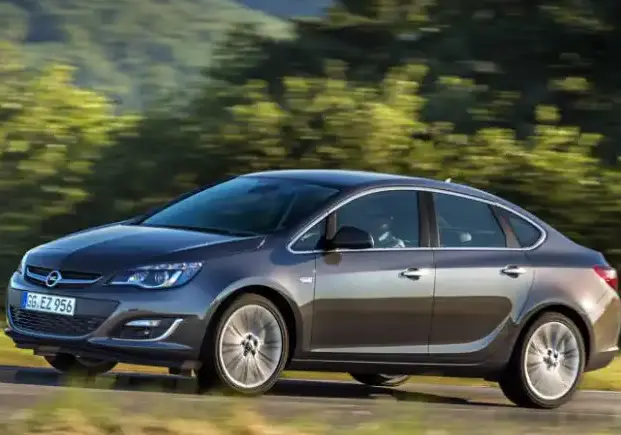
| Generation | Astra J Sedan |
| Type (Engine) | 1.6 Turbo (170 Hp) Automatic |
| Start of production | 2012 |
| End of production | 2018 |
| Powertrain Architecture | Internal Combustion engine |
| Body type | Sedan |
| Seats | 5 |
| Doors | 4 |
| Fuel consumption (urban) | 9.2 l/100 km (25.6 US mpg) |
| Fuel consumption (extra urban) | 5.4 l/100 km (43.6 US mpg) |
| Fuel consumption (combined) | 6.8 l/100 km (34.6 US mpg) |
| CO2 emissions | 159 g/km |
| Fuel Type | Petrol (Gasoline) |
| Acceleration 0 – 100 km/h | 9.2 sec |
| Acceleration 0 – 62 mph | 9.2 sec |
| Acceleration 0 – 60 mph | 8.7 sec |
| Maximum speed | 215 km/h (133.59 mph) |
| Emission standard | Euro 5 |
| Power | 170 Hp @ 6000 rpm |
| Torque | 260 Nm @ 1650-3200 rpm (191.77 lb.-ft. @ 1650-3200 rpm) |
| Engine layout | Front, Transverse |
| Engine Model/Code | A16XHT |
| Engine displacement | 1598 cm3 (97.52 cu. in.) |
| Number of cylinders | 4 |
| Engine configuration | Inline |
| Cylinder Bore | 79 mm (3.11 in.) |
| Piston Stroke | 81.5 mm (3.21 in.) |
| Number of valves per cylinder | 4 |
| Fuel injection system | Direct injection |
| Engine aspiration | Turbocharger, Intercooler |
| Engine oil capacity | 5.5 l (5.81 US qt | 4.84 UK qt) |
| Coolant capacity | 6.3 l (6.66 US qt | 5.54 UK qt) |
| Trunk (boot) space – minimum | 460 l (16.24 cu. ft.) |
| Trunk (boot) space – maximum | 1010 l (35.67 cu. ft.) |
| Fuel tank capacity | 56 l (14.79 US gal | 12.32 UK gal) |
| Length | 4658 mm (183.39 in.) |
| Width | 1814 mm (71.42 in.) |
| Width including mirrors | 2013 mm (79.25 in.) |
| Height | 1500 mm (59.06 in.) |
| Wheelbase | 2685 mm (105.71 in.) |
| Front track | 1541 mm (60.67 in.) |
| Rear track | 1551 mm (61.06 in.) |
| Front overhang | 974 mm (38.35 in.) |
| Rear overhang | 999 mm (39.33 in.) |
| Minimum turning circle | 11.5 m (37.73 ft.) |
| Gears/Transmission | 6 gears, automatic transmission |
| Front brakes | Ventilated discs |
The Opel Astra J Sedan 1.6 Turbo Automatic, produced between 2012 and 2018, was a popular choice in the compact sedan segment, particularly within European markets. Positioned as a mid-range trim within the broader Astra J Sedan lineup, it aimed to strike a balance between performance, fuel efficiency, and comfort for drivers seeking a step up from base models without the expense of the higher-spec versions. This model was a key part of Opel’s J series, representing an effort to modernize the brand’s image and more effectively compete with rivals like the Volkswagen Jetta, Ford Focus, and Peugeot 308.
Powertrain & Engine Architecture
The Astra J Sedan 1.6 Turbo Automatic is powered by the A16XHT engine, a 1.6-liter inline-four cylinder gasoline engine. This engine employs direct fuel injection and a single turbocharger with an intercooler to enhance power output. The direct injection system is a crucial component, enabling precise fuel delivery for improved efficiency and performance. The engine’s valvetrain features double overhead camshafts (DOHC) with four valves per cylinder, optimizing airflow to maximize horsepower. The six-speed automatic transmission, sourced from Aisin, was selected for its smooth shifting and generally good reliability. It’s a conventional torque converter automatic, prioritizing a comfortable driving experience over the quicker, but sometimes less refined, shifts of dual-clutch transmissions.
Driving Characteristics
The 170 horsepower output, combined with the automatic transmission, delivered a comfortable and generally responsive driving experience. Acceleration from 0-60 mph in approximately 8.7 seconds was respectable for the class, though slower than the manual transmission or the more powerful 2.0-liter Turbo variants. The automatic transmission’s gear ratios were tuned for fuel economy and smooth cruising, rather than aggressive performance. While providing sufficient power for highway merging and overtaking, it lacked the immediate urgency of its higher-output counterparts. The turbocharger provided a noticeable boost in mid-range power, but some turbo lag was present, especially at lower engine speeds. The steering was light and precise, making it easy to maneuver in city driving conditions.
Equipment & Trim Levels
The 1.6 Turbo Automatic trim typically included standard features such as air conditioning, power windows and mirrors, a CD/MP3 stereo system, and essential safety equipment like ABS and airbags. Higher trim levels, often designated as Sport or Elegance packages, added features like alloy wheels, upgraded upholstery, a touchscreen infotainment system, and parking sensors. Optional extras included a sunroof, leather seats, and a navigation system. Interior upholstery was generally cloth, with higher trims offering partial leather options. The dashboard layout was functional and straightforward, prioritizing ease of use over elaborate styling.
Chassis & Braking
The Astra J Sedan utilized a MacPherson strut front suspension and a multi-link rear suspension, providing a good compromise between ride comfort and handling. The front brakes were ventilated discs, offering adequate stopping power, while the rear brakes were typically solid discs on most variants. An Anti-lock Braking System (ABS) was standard equipment. Stabilizer bars were fitted to both the front and rear axles to minimize body roll during cornering. The suspension tuning was generally biased towards comfort, resulting in a slightly softer ride compared to sportier models.
Market Reception & Comparison
The Astra J Sedan 1.6 Turbo Automatic received generally favorable reviews, with critics praising its comfortable ride, fuel efficiency, and well-equipped interior. However, some reviewers noted that the engine lacked the punch of some competitors and that the automatic transmission could occasionally feel sluggish. Compared to the 2.0-liter Turbo models, the 1.6 Turbo offered a more affordable entry point into the Astra J Sedan range, but at the cost of performance. The 1.9-liter diesel variants offered superior fuel economy, but with a different driving character and potentially higher maintenance costs. The 1.6 Turbo Automatic appealed to buyers who prioritized comfort and fuel efficiency over outright performance.
Legacy
The A16XHT engine, while generally reliable, is known to have potential issues with timing chain wear, particularly if oil changes are not performed regularly. The Aisin automatic transmission is considered relatively durable, but consistent fluid changes are essential for maintaining its longevity. In the used car market, the Astra J Sedan 1.6 Turbo Automatic represents a good value, offering a comfortable and well-equipped sedan at an accessible price. However, prospective buyers should be aware of the potential timing chain issue and verify that the vehicle has been properly maintained. Its combination of practicality, efficiency, and comfort has ensured its continued presence on roads throughout Europe and beyond.