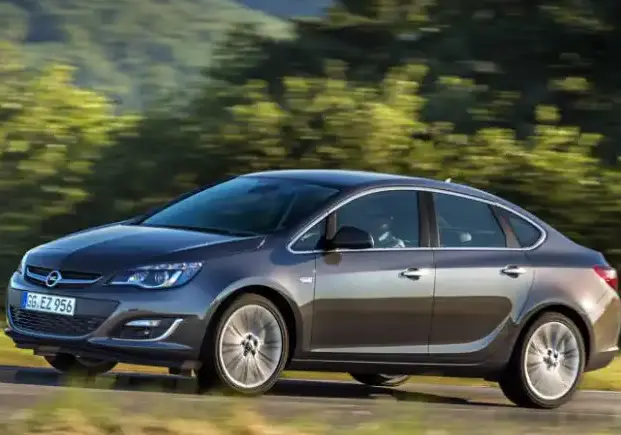
The Opel Astra J Sedan 1.6 Turbo (180 hp) was a variant of the Astra J Sedan produced primarily for the European market during the 2012 model year. Positioned as a mid-range offering within the J Sedan lineup, it aimed to provide a balance between performance and fuel efficiency. This model occupied a space between the base 1.4-liter engine options and the more powerful, yet more expensive, 2.0-liter diesel variants. The Astra J Sedan itself was a significant model for Opel, representing a move towards a more refined and modern design language, and the 1.6 Turbo variant was a key component of its sales strategy.
Technical Specifications
| Brand | Opel |
| Model | Astra |
| Generation | Astra J Sedan |
| Type (Engine) | 1.6 Turbp (180 Hp) |
| Start of production | 2012 |
| End of production | 2012 |
| Powertrain Architecture | Internal Combustion engine |
| Body type | Sedan |
| Seats | 5 |
| Doors | 4 |
| Fuel consumption (urban) | 8.8-9 l/100 km (26.7 – 26.1 US mpg) |
| Fuel consumption (extra urban) | 5.6-5.5 l/100 km (42 – 42.8 US mpg) |
| Fuel consumption (combined) | 6.8 l/100 km (34.6 US mpg) |
| CO2 emissions | 159 g/km |
| Fuel Type | Petrol (Gasoline) |
| Acceleration 0 – 100 km/h | 8.7 sec |
| Acceleration 0 – 62 mph | 8.7 sec |
| Acceleration 0 – 60 mph | 8.3 sec |
| Maximum speed | 223 km/h (138.57 mph) |
| Emission standard | Euro 5 |
| Power | 180 Hp @ 5500 rpm |
| Torque | 230 Nm @ 2200-5500 rpm (169.64 lb.-ft. @ 2200-5500 rpm) |
| Engine layout | Front, Transverse |
| Engine Model/Code | A16LET |
| Engine displacement | 1598 cm3 (97.52 cu. in.) |
| Number of cylinders | 4 |
| Engine configuration | Inline |
| Cylinder Bore | 79 mm (3.11 in.) |
| Piston Stroke | 81.5 mm (3.21 in.) |
| Number of valves per cylinder | 4 |
| Fuel injection system | Multi-port manifold injection |
| Engine aspiration | Turbocharger, Intercooler |
| Engine oil capacity | 4.5 l (4.76 US qt | 3.96 UK qt) |
| Coolant | 5.6 l (5.92 US qt | 4.93 UK qt) |
| Trunk (boot) space – minimum | 460 l (16.24 cu. ft.) |
| Trunk (boot) space – maximum | 1010 l (35.67 cu. ft.) |
| Fuel tank capacity | 56 l (14.79 US gal | 12.32 UK gal) |
| Length | 4658 mm (183.39 in.) |
| Width | 1814 mm (71.42 in.) |
| Width including mirrors | 2013 mm (79.25 in.) |
| Height | 1500 mm (59.06 in.) |
| Wheelbase | 2685 mm (105.71 in.) |
| Front track | 1541 mm (60.67 in.) |
| Rear track | 1551 mm (61.06 in.) |
| Front overhang | 974 mm (38.35 in.) |
| Rear overhang | 999 mm (39.33 in.) |
| Minimum turning circle | 11.5 m (37.73 ft.) |
| Drivetrain Architecture | Front wheel drive |
| Number of gears | 6 gears, manual transmission |
| Front brakes | Ventilated discs |
| Assisting systems | ABS (Anti-lock braking system) |
| Steering type | Steering rack and pinion |
| Power steering | Electric Steering |
Powertrain & Engine Architecture
The heart of the Astra J Sedan 1.6 Turbo was the A16LET engine, a 1.6-liter inline-four cylinder gasoline engine equipped with a turbocharger and intercooler. This engine was part of Opel’s ‘family 1’ engine series, known for its relatively compact size and efficiency. The A16LET utilized multi-port fuel injection and featured a dual overhead camshaft (DOHC) valvetrain with four valves per cylinder. The turbocharger, a key component in boosting power output, provided increased air intake to the engine, allowing for a higher compression ratio and more efficient combustion. The engine’s 180 horsepower output at 5500 rpm and 230 Nm (169.64 lb-ft) of torque between 2200-5500 rpm were respectable figures for a 1.6-liter engine, providing a noticeable performance upgrade over the base engine options.
The engine was paired with a six-speed manual transmission, which was the standard offering for this variant. While an automatic transmission was available on other Astra J Sedan models, it was not offered with the 1.6 Turbo 180 hp engine. The six-speed manual allowed drivers to effectively utilize the engine’s powerband and contribute to improved fuel economy.
Driving Characteristics
The Astra J Sedan 1.6 Turbo offered a noticeably more engaging driving experience compared to the lower-powered variants. The turbocharger provided a surge of power in the mid-range, making overtaking maneuvers and highway cruising more effortless. While not a sports car, the 1.6 Turbo delivered a respectable 0-60 mph time of around 8.3 seconds and a top speed of 138.57 mph. The six-speed manual transmission allowed for precise gear selection, and the relatively short throw of the shifter contributed to a more connected feel. Compared to the 2.0-liter diesel models, the 1.6 Turbo offered a more responsive and characterful engine, albeit with slightly lower torque figures. However, the diesel variants generally provided superior fuel economy.
Equipment & Trim Levels
The 1.6 Turbo variant typically came equipped with a reasonable level of standard features. These included air conditioning, power windows, power mirrors, a CD/MP3 stereo system, and ABS brakes. Higher trim levels, such as the ‘Sport’ or ‘Cosmo’ trims, added features like alloy wheels, fog lights, a multi-function steering wheel, cruise control, and upgraded interior upholstery. Optional extras included a sunroof, navigation system, and parking sensors.
Chassis & Braking
The Astra J Sedan featured a MacPherson strut front suspension and a torsion beam rear suspension. The suspension setup was tuned to provide a comfortable ride while maintaining reasonable handling characteristics. The front brakes were ventilated discs, providing adequate stopping power, while the rear brakes were typically solid discs. The Astra J Sedan also incorporated an electronic stability program (ESP) as standard, enhancing safety and control.
Market Reception & Comparison
The Astra J Sedan 1.6 Turbo was generally well-received by automotive critics. It was praised for its responsive engine, comfortable ride, and relatively good fuel economy. However, some critics noted that the interior materials could have been of higher quality. Compared to rivals like the Ford Focus and Volkswagen Golf, the Astra J Sedan offered a competitive package in terms of performance, features, and price. The 1.6 Turbo variant provided a compelling alternative to the diesel models, appealing to drivers who preferred the responsiveness of a gasoline engine.
Legacy
The A16LET engine, while not without its quirks, proved to be a relatively reliable unit when properly maintained. Common issues included occasional turbocharger failures and oil leaks. However, these were generally not widespread problems. Today, the Astra J Sedan 1.6 Turbo represents an affordable and practical used car option. Its combination of performance, fuel efficiency, and features makes it a viable choice for buyers seeking a well-rounded compact sedan. The engine’s relatively simple design also makes it easier and less expensive to repair compared to some of the more complex modern powertrains.