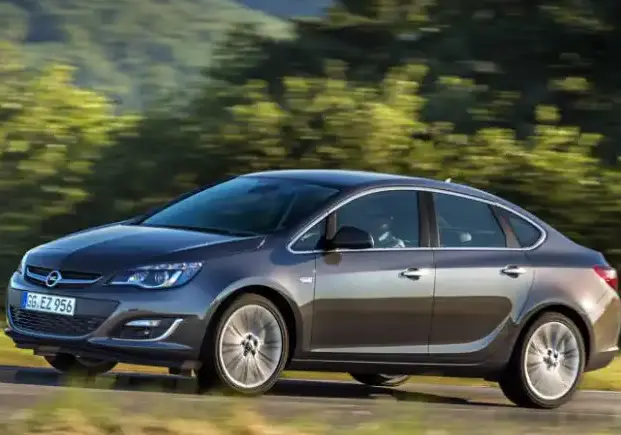
The Opel Astra J Sedan 1.7 CDTI (110 hp) ecoFLEX was a variant of the Astra J Sedan produced between 2012 and 2014. Positioned as an economy-focused option within the J Sedan range, it aimed to deliver reasonable performance with a strong emphasis on fuel efficiency. This model was primarily marketed in Europe, where compact sedans and fuel economy were highly valued. It represented a key offering in Opel’s strategy to provide a diverse range of Astra J models to cater to varying customer needs and budgets.
Technical Specifications
| Brand | Opel |
| Model | Astra |
| Generation | Astra J Sedan |
| Type (Engine) | 1.7 CDTI (110 Hp) ecoFLEX |
| Start of production | 2012 |
| End of production | 2014 |
| Powertrain Architecture | Internal Combustion engine |
| Body type | Sedan |
| Seats | 5 |
| Doors | 4 |
| Fuel consumption (urban) | 5.4 l/100 km (43.6 US mpg) |
| Fuel consumption (extra urban) | 4 l/100 km (58.8 US mpg) |
| Fuel consumption (combined) | 4.5 l/100 km (52.3 US mpg) |
| CO2 emissions | 114 g/km |
| Fuel Type | Diesel |
| Acceleration 0 – 100 km/h | 12.4 sec |
| Acceleration 0 – 62 mph | 12.4 sec |
| Acceleration 0 – 60 mph | 11.8 sec |
| Maximum speed | 188 km/h (116.82 mph) |
| Emission standard | Euro 5 |
| Power | 110 Hp @ 4000 rpm |
| Torque | 280 Nm @ 1750-2500 rpm (206.52 lb.-ft.) |
| Engine layout | Front, Transverse |
| Engine Model/Code | A17DTC |
| Engine displacement | 1686 cm3 (102.89 cu. in.) |
| Number of cylinders | 4 |
| Engine configuration | Inline |
| Cylinder Bore | 79 mm (3.11 in.) |
| Piston Stroke | 86 mm (3.39 in.) |
| Number of valves per cylinder | 4 |
| Fuel injection system | Diesel Commonrail |
| Engine aspiration | Turbocharger, Intercooler |
| Engine oil capacity | 5.4 l (5.71 US qt | 4.75 UK qt) |
| Coolant capacity | 7.1 l (7.5 US qt | 6.25 UK qt) |
| Trunk (boot) space – minimum | 460 l (16.24 cu. ft.) |
| Trunk (boot) space – maximum | 1010 l (35.67 cu. ft.) |
| Length | 4658 mm (183.39 in.) |
| Width | 1814 mm (71.42 in.) |
| Height | 1500 mm (59.06 in.) |
| Wheelbase | 2685 mm (105.71 in.) |
| Front track | 1541 mm (60.67 in.) |
| Rear track | 1551 mm (61.06 in.) |
| Minimum turning circle | 11.5 m (37.73 ft.) |
| Drivetrain | Front wheel drive |
| Number of gears | 6 |
| Gearbox type | Manual transmission |
| Front brakes | Ventilated discs |
| Assisting systems | ABS (Anti-lock braking system) |
| Steering type | Steering rack and pinion |
| Power steering | Electric Steering |
Powertrain & Engine Architecture
The Astra J Sedan 1.7 CDTI ecoFLEX was powered by the A17DTC engine, a 1.7-liter inline-four cylinder diesel engine. This engine was a member of Opel/Vauxhall’s ‘A’ family of diesel engines, known for its relatively compact size and efficiency. The A17DTC featured a common rail direct injection system, delivering fuel at high pressure directly into the combustion chamber for improved combustion efficiency and reduced emissions. A turbocharger with an intercooler was employed to boost power output, providing 110 horsepower at 4000 rpm and 280 Nm (206.52 lb.-ft.) of torque between 1750 and 2500 rpm. The engine utilized a four-valve-per-cylinder configuration and met Euro 5 emission standards, incorporating a diesel particulate filter (DPF) to trap soot particles. The engine was paired with a six-speed manual transmission, chosen for its fuel-saving characteristics.
Driving Characteristics
The 1.7 CDTI with the manual transmission offered a balance between fuel economy and usability. Acceleration from 0 to 60 mph took approximately 11.8 seconds, and top speed was rated at 116.82 mph. While not a performance-oriented variant, the engine provided sufficient torque for everyday driving situations, including highway cruising and overtaking. The six-speed gearbox allowed for efficient engine operation at various speeds, contributing to the car’s impressive fuel economy figures. Compared to higher-powered Astra J variants, such as those equipped with the 2.0 CDTI engine, the 1.7 CDTI felt less responsive, particularly at higher engine speeds. However, the trade-off was a significant improvement in fuel efficiency and lower running costs. The gear ratios were tuned for economy, meaning the engine often needed to be worked harder to achieve brisk acceleration.
Equipment & Trim Levels
The ecoFLEX trim level, as applied to the 1.7 CDTI, typically included features designed to enhance fuel efficiency. Standard equipment often included air conditioning, a CD/MP3 stereo system, electric front windows, and central locking. Safety features such as ABS, Electronic Stability Program (ESP), and multiple airbags were also standard. Interior upholstery was typically cloth, and the dashboard featured a functional, if somewhat basic, design. Optional extras available for this trim included alloy wheels, a more advanced audio system, parking sensors, and cruise control. The ecoFLEX designation also meant the vehicle incorporated specific aerodynamic enhancements and low rolling resistance tires to further improve fuel economy.
Chassis & Braking
The Astra J Sedan 1.7 CDTI ecoFLEX utilized a MacPherson strut front suspension and a torsion beam rear suspension. This setup provided a reasonable balance between ride comfort and handling. The front brakes were ventilated discs, offering adequate stopping power, while the rear brakes were typically solid discs. The electric power steering provided light and precise steering feel. Stabilizer bars were fitted to both the front and rear axles to reduce body roll during cornering. The suspension tuning was geared towards comfort rather than outright sportiness, making it well-suited for everyday driving. The chassis was designed to accommodate the weight of the diesel engine and the demands of typical European road conditions.
Market Reception & Comparison
The Astra J Sedan 1.7 CDTI ecoFLEX was generally well-received by critics for its fuel efficiency and affordability. It was seen as a practical and economical choice for drivers who prioritized low running costs over outright performance. Compared to other trims in the Astra J lineup, such as the 1.4-liter petrol or the 2.0-liter diesel, the 1.7 CDTI offered a compelling combination of fuel economy and torque. However, some reviewers noted that the engine could feel strained when fully loaded or driving uphill. In terms of reliability, the A17DTC engine proved to be generally robust, although the diesel particulate filter (DPF) could be a potential source of issues if the vehicle was primarily used for short journeys. Fuel economy figures consistently exceeded those of its petrol-powered counterparts.
Legacy
The Opel Astra J Sedan 1.7 CDTI ecoFLEX remains a relatively common sight on the used car market. The A17DTC engine has proven to be reasonably durable, and with regular maintenance, it can provide many years of reliable service. However, potential buyers should be aware of the potential for DPF issues and ensure that the vehicle has been properly maintained. The car’s fuel efficiency continues to be a major selling point, making it an attractive option for budget-conscious buyers. While not a particularly exciting vehicle to drive, the Astra J Sedan 1.7 CDTI ecoFLEX represents a practical and economical choice for those seeking a reliable and fuel-efficient compact sedan.