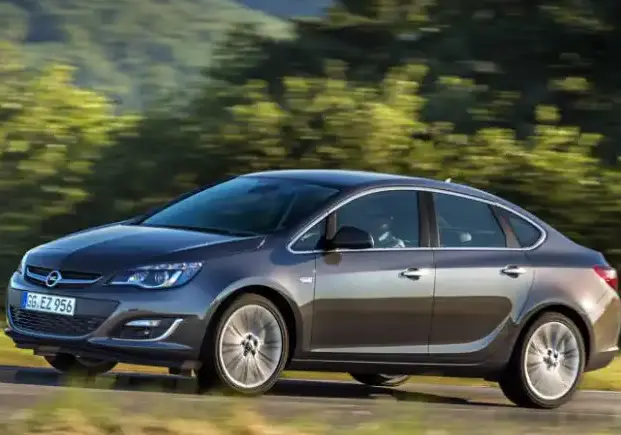
The Opel Astra J Sedan 2.0 CDTI (165 Hp) Ecotec start/stop, produced from 2012 to 2015, represented a significant offering in the European compact sedan market. Positioned as a mid-range to upper-mid-range trim within the broader Astra J Sedan lineup, it aimed to balance fuel efficiency with respectable performance, appealing to drivers seeking a practical yet capable vehicle. This variant was a key component of Opel’s strategy to offer a diverse range of powertrains within the J series, catering to varying customer preferences and driving needs. It was primarily sold in Europe, where the demand for diesel-powered sedans remained strong.
Technical Specifications
| Brand | Opel |
| Model | Astra |
| Generation | Astra J Sedan |
| Type (Engine) | 2.0 CDTI (165 Hp) Ecotec start/stop |
| Start of production | 2012 |
| End of production | 2015 |
| Powertrain Architecture | Internal Combustion engine |
| Body type | Sedan |
| Seats | 5 |
| Doors | 4 |
| Fuel consumption (combined) | 4.5 l/100 km (52.3 US mpg, 62.8 UK mpg, 22.2 km/l) |
| CO2 emissions | 119 g/km |
| Fuel Type | Diesel |
| Emission standard | Euro 5 |
| Power | 165 Hp @ 4000 rpm |
| Power per litre | 84.4 Hp/l |
| Torque | 350 Nm @ 1750-2500 rpm (258.15 lb.-ft. @ 1750-2500 rpm) |
| Engine layout | Front, Transverse |
| Engine Model/Code | A20DTH |
| Engine displacement | 1956 cm3 (119.36 cu. in.) |
| Number of cylinders | 4 |
| Engine configuration | Inline |
| Cylinder Bore | 83 mm (3.27 in.) |
| Piston Stroke | 90.4 mm (3.56 in.) |
| Number of valves per cylinder | 4 |
| Fuel injection system | Diesel Commonrail |
| Engine aspiration | Turbocharger, Intercooler |
| Engine oil capacity | 4.5 l (4.76 US qt | 3.96 UK qt) |
| Coolant | 6.9 l (7.29 US qt | 6.07 UK qt) |
| Trunk (boot) space – minimum | 460 l (16.24 cu. ft.) |
| Trunk (boot) space – maximum | 1010 l (35.67 cu. ft.) |
| Fuel tank capacity | 56 l (14.79 US gal | 12.32 UK gal) |
| Length | 4658 mm (183.39 in.) |
| Width | 1814 mm (71.42 in.) |
| Width including mirrors | 2013 mm (79.25 in.) |
| Height | 1500 mm (59.06 in.) |
| Wheelbase | 2685 mm (105.71 in.) |
| Front track | 1541 mm (60.67 in.) |
| Rear track | 1551 mm (61.06 in.) |
| Front overhang | 974 mm (38.35 in.) |
| Rear overhang | 999 mm (39.33 in.) |
| Minimum turning circle | 11.5 m (37.73 ft.) |
| Drivetrain Architecture | Front wheel drive |
| Number of gears and type of gearbox | 6 gears, manual transmission |
| Front brakes | Ventilated discs |
| Assisting systems | ABS (Anti-lock braking system) |
| Steering type | Steering rack and pinion |
| Power steering | Electric Steering |
Powertrain & Engine Architecture
The heart of the Astra J Sedan 2.0 CDTI was the A20DTH engine, a 1.956-liter inline-four cylinder diesel. This engine was a member of Opel/Fiat’s Ecotec family, known for its focus on efficiency and refinement. It utilized a common rail direct injection system, delivering fuel at extremely high pressures for optimized combustion. The A20DTH featured a variable geometry turbocharger (VGT) and an intercooler, enhancing both low-end torque and overall power output. The engine also incorporated a diesel particulate filter (DPF) to meet stringent Euro 5 emission standards. The Start/Stop system, a standard feature, further contributed to fuel savings by automatically shutting off the engine when the vehicle was stationary. The 6-speed manual transmission was the only gearbox option available with this engine, providing a balance between fuel economy and driver engagement.
Driving Characteristics
The 165 horsepower and 350 Nm (258 lb-ft) of torque provided by the 2.0 CDTI engine delivered a respectable driving experience. Acceleration was brisk, with the car feeling capable in both urban and highway environments. The engine’s peak torque, available from 1750-2500 rpm, meant that strong pulling power was readily accessible for overtaking maneuvers. Compared to the lower-powered 1.3 CDTI variants, the 2.0 CDTI offered a noticeably more relaxed driving experience, particularly when fully loaded or tackling inclines. While not a sports car, the Astra J Sedan 2.0 CDTI provided a comfortable and confident ride. The 6-speed manual transmission was well-matched to the engine’s characteristics, offering precise shifts and a reasonable spread of gear ratios. It wasn’t as engaging as some of its competitors with more sporting pretensions, but it was a solid all-rounder.
Equipment & Trim Levels
The Astra J Sedan 2.0 CDTI typically came equipped with a good level of standard features. These included air conditioning, power windows, power mirrors, a CD/MP3 stereo system, and ABS brakes. Higher trim levels, such as the ‘Sport’ or ‘Cosmo’ variants, added features like alloy wheels, a multi-function steering wheel, cruise control, automatic climate control, and parking sensors. Interior upholstery was typically cloth, with leather options available as an upgrade. The dashboard layout was functional and modern, with a clear instrument cluster and intuitive controls. Optional extras included a navigation system, a panoramic sunroof, and upgraded audio systems.
Chassis & Braking
The Astra J Sedan utilized a MacPherson strut front suspension and a torsion beam rear suspension. This setup provided a good balance between ride comfort and handling. The front brakes were ventilated discs, offering ample stopping power, while the rear brakes were typically solid discs. The electric power steering provided a light and precise feel, making it easy to maneuver in tight spaces. Stabilizer bars were fitted to both the front and rear axles to reduce body roll during cornering. The chassis was designed to be relatively lightweight, contributing to the car’s overall efficiency and agility.
Market Reception & Comparison
The Opel Astra J Sedan 2.0 CDTI was generally well-received by automotive critics. It was praised for its fuel efficiency, comfortable ride, and refined engine. However, some reviewers noted that the interior materials weren’t quite as premium as those found in some of its competitors. Compared to the 1.3 CDTI variants, the 2.0 CDTI offered significantly more performance, but at a higher price point. Compared to petrol-powered Astra J Sedans, the 2.0 CDTI provided superior fuel economy and torque, making it a popular choice for drivers who covered long distances. Against rivals like the Ford Focus, Volkswagen Golf, and Peugeot 308, the Astra J Sedan 2.0 CDTI held its own, offering a compelling package of practicality, efficiency, and value.
Legacy
The A20DTH engine, while generally reliable, is known to require regular maintenance, particularly regarding the DPF and EGR (Exhaust Gas Recirculation) systems. Proper servicing and the use of high-quality oil are crucial for ensuring long-term reliability. Today, used examples of the Astra J Sedan 2.0 CDTI can be found at relatively affordable prices. They represent a sensible choice for buyers seeking a fuel-efficient and practical sedan. The combination of a robust diesel engine and a well-engineered chassis has ensured that these cars continue to provide reliable transportation for many years after their initial production run. However, potential buyers should be aware of the potential maintenance costs associated with diesel particulate filters and other emission control components.