
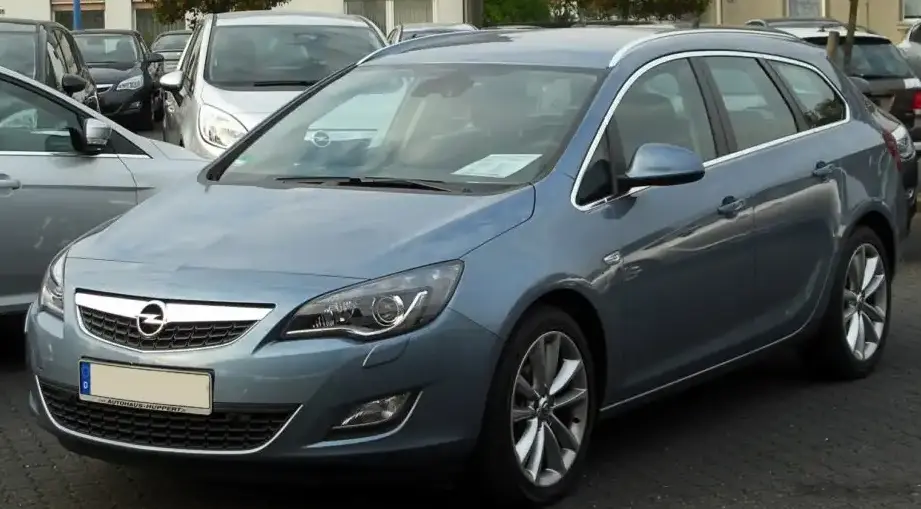
The Opel Astra J Sports Tourer 1.6 (115 hp) was a station wagon variant produced between 2010 and 2012, falling within the J generation of the Astra. Positioned as an entry-to-mid-range offering, it aimed to provide practicality and reasonable fuel economy for families and individuals needing versatile cargo space. It was a key model in Opel’s European lineup, competing with other compact estate cars like the Ford Focus Estate and Volkswagen Golf Variant. This specific configuration, pairing the 1.6-liter engine with a manual transmission, represented a balance between affordability and usability, targeting buyers who didn’t require the performance of higher-spec engines.
Technical Specifications
| Brand | Opel |
| Model | Astra |
| Generation | Astra J Sports Tourer |
| Type (Engine) | 1.6 (115 Hp) |
| Start of production | 2010 |
| End of production | 2012 |
| Powertrain Architecture | Internal Combustion engine |
| Body type | Station wagon (estate) |
| Seats | 5 |
| Doors | 5 |
| Fuel consumption (urban) | 8.6 l/100 km (27.4 US mpg) |
| Fuel consumption (extra urban) | 5.1 l/100 km (46.1 US mpg) |
| Fuel consumption (combined) | 6.4 l/100 km (36.8 US mpg) |
| CO2 emissions | 149 g/km |
| Fuel Type | Petrol (Gasoline) |
| Acceleration 0 – 100 km/h | 12.3 sec |
| Acceleration 0 – 62 mph | 12.3 sec |
| Acceleration 0 – 60 mph | 11.7 sec |
| Maximum speed | 185 km/h (114.95 mph) |
| Emission standard | Euro 5 |
| Weight-to-power ratio | 11.7 kg/Hp |
| Weight-to-torque ratio | 8.6 kg/Nm |
| Power | 115 Hp @ 6000 rpm |
| Torque | 155 Nm @ 4000 rpm (114.32 lb.-ft. @ 4000 rpm) |
| Engine layout | Front, Transverse |
| Engine Model/Code | A16XER |
| Engine displacement | 1598 cm3 (97.52 cu. in.) |
| Number of cylinders | 4 |
| Engine configuration | Inline |
| Cylinder Bore | 79 mm (3.11 in.) |
| Piston Stroke | 81.5 mm (3.21 in.) |
| Compression ratio | 10.8:1 |
| Number of valves per cylinder | 4 |
| Fuel injection system | Multi-port manifold injection |
| Engine aspiration | Naturally aspirated engine |
| Valvetrain | DOHC |
| Engine oil capacity | 4.5 l (4.76 US qt | 3.96 UK qt) |
| Coolant capacity | 5.6 l (5.92 US qt | 4.93 UK qt) |
| Kerb Weight | 1340-1980 kg (2954.19 – 4365.15 lbs.) |
| Max. weight | 1980 kg (4365.15 lbs.) |
| Max load | 640 kg (1410.96 lbs.) |
| Trunk (boot) space – minimum | 550 l (19.42 cu. ft.) |
| Trunk (boot) space – maximum | 1550 l (54.74 cu. ft.) |
| Fuel tank capacity | 56 l (14.79 US gal | 12.32 UK gal) |
| Length | 4698 mm (184.96 in.) |
| Width | 1814 mm (71.42 in.) |
| Width including mirrors | 2013 mm (79.25 in.) |
| Height | 1535 mm (60.43 in.) |
| Wheelbase | 2685 mm (105.71 in.) |
| Front track | 1544 mm (60.79 in.) |
| Rear track | 1558 mm (61.34 in.) |
| Front overhang | 974 mm (38.35 in.) |
| Rear overhang | 1039 mm (40.91 in.) |
| Ride height (ground clearance) | 117 mm (4.61 in.) |
| Drag coefficient (Cd) | 0.33 |
| Drivetrain Architecture | ICE, Front wheel drive |
| Drive wheel | Front wheel drive |
| Number of gears | 6 gears, manual transmission |
| Front suspension | Independent type McPherson |
| Rear suspension | Semi-independent, coil spring |
| Front brakes | Ventilated discs |
| Rear brakes | Disc |
| Assisting systems | ABS (Anti-lock braking system) |
| Steering type | Steering rack and pinion |
| Power steering | Electric Steering |
| Tires size | 215/50 R17 |
| Wheel rims size | 17 |
Powertrain & Engine Architecture
The Astra J Sports Tourer 1.6 (115 hp) was powered by the A16XER engine, a 1.6-liter inline-four cylinder gasoline engine. This engine was a common choice in the Opel/Vauxhall range during this period. It featured multi-point fuel injection and a double overhead camshaft (DOHC) valvetrain. The A16XER is a naturally aspirated engine, meaning it doesn’t utilize a turbocharger or supercharger. Its 1598cc displacement and 10.8:1 compression ratio were designed for a balance of efficiency and reasonable power output. The engine’s 115 horsepower at 6000 rpm and 155 Nm (114 lb-ft) of torque at 4000 rpm were adequate for everyday driving, but didn’t offer particularly sporty performance. The engine was paired with a six-speed manual transmission, which provided a good spread of gears for both fuel economy and acceleration.
Driving Characteristics
The 1.6-liter engine and manual transmission combination in the Astra J Sports Tourer delivered a practical, if not exhilarating, driving experience. Acceleration from 0-60 mph took around 11.7 seconds, and top speed was approximately 115 mph. The gear ratios were tuned for fuel efficiency, meaning the engine needed to be revved to access its full power. Compared to the more powerful 1.4 Turbo or 1.6 Turbo variants, the 1.6-liter naturally aspirated engine felt less responsive, particularly when overtaking or climbing hills. However, the manual transmission allowed drivers to maintain control over the engine’s power band. The suspension setup, while comfortable for everyday use, wasn’t particularly sporty, resulting in some body roll during cornering. Overall, the driving experience was geared towards practicality and comfort rather than performance.
Equipment & Trim Levels
The 1.6-liter Astra J Sports Tourer typically came with a reasonable level of standard equipment. This included air conditioning, electric front windows, a CD/radio system, and ABS brakes. Higher trim levels, such as ‘Enjoy’ or ‘Cosmo’, added features like alloy wheels, cruise control, automatic headlights and rain sensors, and upgraded interior trim. Interior upholstery was typically cloth, with options for upgraded materials on higher trims. Optional extras included a panoramic sunroof, parking sensors, and a more advanced infotainment system. The dashboard layout was functional and user-friendly, with a clear instrument cluster and logically placed controls.
Chassis & Braking
The Astra J Sports Tourer featured a McPherson strut front suspension and a semi-independent coil spring rear suspension. This setup provided a comfortable ride quality, suitable for everyday driving. The front brakes were ventilated discs, while the rear brakes were solid discs. ABS (Anti-lock Braking System) was standard, providing enhanced braking performance and stability. The steering was electrically assisted, offering light and precise control. The chassis was designed to balance handling with ride comfort, prioritizing stability over sporty dynamics. Stabilizer bars were included to reduce body roll during cornering, but the overall handling characteristics were more focused on practicality than performance.
Market Reception & Comparison
The Opel Astra J Sports Tourer 1.6 (115 hp) was generally well-received by critics as a practical and affordable estate car. It was praised for its spacious interior, large cargo area, and reasonable fuel economy. However, some reviewers noted that the 1.6-liter engine lacked the punch of the turbocharged alternatives. Compared to the 1.4 Turbo, the 1.6-liter offered lower running costs but less performance. The 1.6-liter also tended to be more reliable than some of the early turbocharged engines, as it had fewer potential failure points. Fuel economy figures of around 36.8 US mpg combined were competitive for its class.
Legacy
The A16XER engine, while not known for being particularly exciting, proved to be a relatively reliable unit. Common issues included occasional oil leaks and sensor failures, but these were generally not major or expensive to repair. In the used car market, the Astra J Sports Tourer 1.6 (115 hp) represents a good value proposition for buyers seeking a practical and affordable estate car. Its lower purchase price and reasonable running costs make it an attractive option for families and individuals on a budget. While it may not offer the performance or refinement of higher-spec models, it remains a capable and dependable vehicle.

