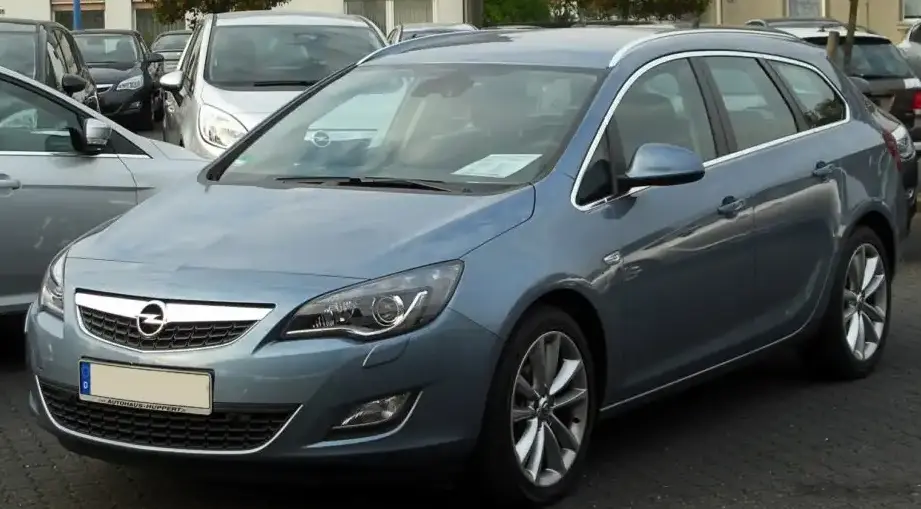
The Opel Astra J Sports Tourer 1.6 Turbo (180 hp) Automatic, produced between 2010 and 2012, represents a compelling blend of practicality and performance within the Astra J range. As a station wagon (estate) variant of the J generation, it aimed to provide a more versatile option for families and those requiring increased cargo capacity compared to the hatchback model. This particular configuration, pairing a turbocharged 1.6-liter engine with a six-speed automatic transmission, occupied a mid-range position in the Astra J Sports Tourer lineup, offering a step up in power and refinement from the base engine options while remaining more accessible than the higher-performance variants.
Technical Specifications
| Brand | Opel |
| Model | Astra |
| Generation | Astra J Sports Tourer |
| Type (Engine) | 1.6 Turbo (180 Hp) Automatic |
| Start of production | 2010 |
| End of production | 2012 |
| Powertrain Architecture | Internal Combustion engine |
| Body type | Station wagon (estate) |
| Seats | 5 |
| Doors | 5 |
| Fuel consumption (urban) | 10.1 l/100 km (23.3 US mpg, 28 UK mpg, 9.9 km/l) |
| Fuel consumption (extra urban) | 5.8 l/100 km (40.6 US mpg, 48.7 UK mpg, 17.2 km/l) |
| Fuel consumption (combined) | 7.4 l/100 km (31.8 US mpg, 38.2 UK mpg, 13.5 km/l) |
| CO2 emissions | 174 g/km |
| Fuel Type | Petrol (Gasoline) |
| Acceleration 0 – 100 km/h | 9 sec |
| Acceleration 0 – 62 mph | 9 sec |
| Acceleration 0 – 60 mph | 8.6 sec |
| Maximum speed | 211 km/h (131.11 mph) |
| Emission standard | Euro 5 |
| Weight-to-power ratio | 7.7 kg/Hp, 129.5 Hp/tonne |
| Weight-to-torque ratio | 6 kg/Nm, 165.5 Nm/tonne |
| Power | 180 Hp @ 5500 rpm |
| Power per litre | 112.6 Hp/l |
| Torque | 230 Nm @ 2200-5400 rpm (169.64 lb.-ft. @ 2200-5400 rpm) |
| Engine layout | Front, Transverse |
| Engine Model/Code | A16LET |
| Engine displacement | 1598 cm3 (97.52 cu. in.) |
| Number of cylinders | 4 |
| Engine configuration | Inline |
| Cylinder Bore | 79 mm (3.11 in.) |
| Piston Stroke | 81.5 mm (3.21 in.) |
| Compression ratio | 8.8:1 |
| Number of valves per cylinder | 4 |
| Fuel injection system | Direct injection |
| Engine aspiration | Turbocharger, Intercooler |
| Valvetrain | DOHC |
| Engine oil capacity | 4.5 l (4.76 US qt | 3.96 UK qt) |
| Coolant | 5.6 l (5.92 US qt | 4.93 UK qt) |
| Kerb Weight | 1390 kg (3064.43 lbs.) |
| Max. weight | 2030 kg (4475.38 lbs.) |
| Max load | 640 kg (1410.96 lbs.) |
| Trunk (boot) space – minimum | 550 l (19.42 cu. ft.) |
| Trunk (boot) space – maximum | 1550 l (54.74 cu. ft.) |
| Fuel tank capacity | 56 l (14.79 US gal | 12.32 UK gal) |
| Length | 4698 mm (184.96 in.) |
| Width | 1814 mm (71.42 in.) |
| Width including mirrors | 2013 mm (79.25 in.) |
| Height | 1535 mm (60.43 in.) |
| Wheelbase | 2685 mm (105.71 in.) |
| Front track | 1544 mm (60.79 in.) |
| Rear (Back) track | 1558 mm (61.34 in.) |
| Front overhang | 974 mm (38.35 in.) |
| Rear overhang | 1039 mm (40.91 in.) |
| Ride height (ground clearance) | 117 mm (4.61 in.) |
| Drag coefficient (Cd) | 0.33 |
| Drivetrain Architecture | The Internal combustion engine (ICE) drives the front wheels of the vehicle. |
| Drive wheel | Front wheel drive |
| Number of gears and type of gearbox | 6 gears, automatic transmission |
| Front brakes | Ventilated discs |
| Rear brakes | Disc |
| Assisting systems | ABS (Anti-lock braking system) |
| Steering type | Steering rack and pinion |
| Power steering | Electric Steering |
| Tires size | 215/50 R17 |
| Wheel rims size | 17 |
INTRODUCTION
The Opel Astra J Sports Tourer, launched in 2010, was the wagon variant of Opel’s popular Astra J compact car. Built on the GM Delta II platform (also known as the 1HX0/A3 platform), it aimed to offer the practicality of a station wagon without sacrificing the driving dynamics and modern features of the Astra J hatchback. The 1.6 Turbo (180 hp) Automatic trim level was positioned as a strong all-rounder, appealing to buyers who desired a balance of performance, fuel efficiency, and convenience. It served as a step up from the base 1.4-liter engine options, offering noticeably more power for highway cruising and overtaking, while the automatic transmission provided ease of use in urban environments.
Powertrain & Engine Architecture
At the heart of the Astra J Sports Tourer 1.6 Turbo Automatic lies the A16LET engine, a 1.6-liter inline-four cylinder gasoline engine equipped with a turbocharger and direct fuel injection. This engine is a member of Opel’s ‘Family 1’ engine family. The direct injection system, coupled with the turbocharger, allowed for a high compression ratio of 8.8:1, contributing to both power and efficiency. The engine utilizes a dual overhead camshaft (DOHC) valvetrain with four valves per cylinder, optimizing airflow for improved performance. The turbocharger, along with an intercooler, helps to increase air density entering the engine, boosting power output. The six-speed automatic transmission, sourced from Aisin, was chosen for its smooth shifting characteristics and efficiency. It features adaptive shift patterns, adjusting to the driver’s style and road conditions.
Driving Characteristics
The 180 hp output and 230 Nm of torque delivered by the 1.6 Turbo engine provided a noticeable improvement in performance compared to the lower-powered Astra J Sports Tourer variants. Acceleration from 0 to 60 mph took approximately 8.6 seconds, and the car could reach a top speed of 211 km/h (131.11 mph). The automatic transmission, while offering convenience, did slightly diminish the sense of driver engagement compared to the manual transmission options. However, the gear ratios were well-chosen to provide adequate acceleration in most driving situations. The turbocharger did exhibit some lag at lower engine speeds, but power delivery became more linear and responsive as the engine revved higher. Overall, the driving experience was comfortable and refined, making it well-suited for both daily commuting and longer journeys.
Equipment & Trim Levels
The Astra J Sports Tourer 1.6 Turbo Automatic typically came equipped with a respectable level of standard features. These included air conditioning, power windows, power mirrors, a CD/MP3 stereo system, and alloy wheels. Higher trim levels offered additional features such as leather upholstery, a sunroof, parking sensors, and a more advanced infotainment system. Safety features included ABS, electronic stability control, and multiple airbags. Optional extras often included navigation systems, upgraded audio systems, and various styling enhancements.
Chassis & Braking
The Astra J Sports Tourer featured a MacPherson strut front suspension and a multi-link rear suspension, providing a good balance of ride comfort and handling. The suspension was tuned to offer a compliant ride without sacrificing stability. The braking system consisted of ventilated discs at the front and solid discs at the rear, providing adequate stopping power for the vehicle’s weight and performance. ABS (Anti-lock Braking System) was standard, enhancing safety during emergency braking situations.
Market Reception & Comparison
The Astra J Sports Tourer 1.6 Turbo Automatic was generally well-received by automotive critics. It was praised for its spacious interior, comfortable ride, and efficient engine. However, some reviewers noted that the automatic transmission could feel slightly sluggish at times, and the turbo lag was occasionally noticeable. Compared to the 1.4-liter turbo variants, the 1.6-liter offered a significant performance boost. When compared to the diesel-powered Astra J Sports Tourer models (such as the 1.7 CDTI), the 1.6 Turbo offered a more refined driving experience but typically achieved lower fuel economy.
Legacy
The Opel Astra J Sports Tourer 1.6 Turbo Automatic has proven to be a relatively reliable vehicle in the used car market. The A16LET engine is generally considered to be durable, although regular maintenance is crucial to prevent issues such as turbocharger wear and carbon buildup. The Aisin automatic transmission is also known for its robustness. While not a particularly rare or collectible vehicle, the Astra J Sports Tourer 1.6 Turbo Automatic remains a practical and affordable option for buyers seeking a versatile and well-equipped station wagon.