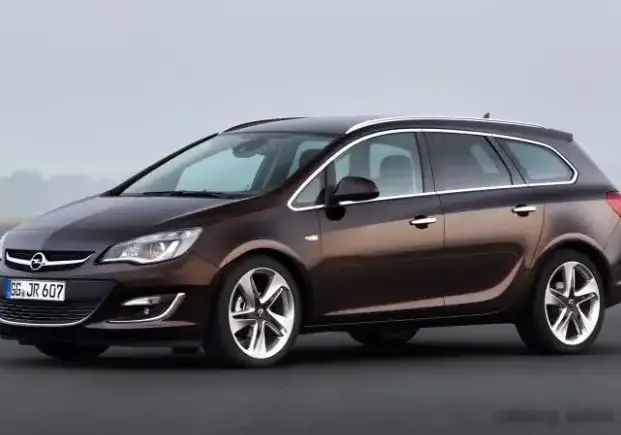
The Opel Astra J Sports Tourer (facelift, introduced in 2012) 1.3 CDTI, producing 95 horsepower, represented an entry-level diesel option within the broader Astra J Sports Tourer range. Positioned as a fuel-efficient and practical choice, this variant catered to buyers prioritizing economy and space over outright performance. Production of this specific configuration spanned from 2012 to 2013, falling within the lifecycle of the J series, which utilized the GM Delta platform (specifically, a variant adapted for Opel/Vauxhall). The Sports Tourer body style, a station wagon or estate, was a key offering for European markets where practicality and cargo capacity were highly valued.
Technical Specifications
| Brand | Opel |
| Model | Astra |
| Generation | Astra J Sports Tourer (facelift 2012) |
| Type (Engine) | 1.3 CDTI (95 Hp) Ecotec |
| Start of production | 2012 |
| End of production | 2013 |
| Powertrain Architecture | Internal Combustion engine |
| Body type | Station wagon (estate) |
| Seats | 5 |
| Doors | 5 |
| Fuel consumption (urban) | 5.3 l/100 km (44.4 US mpg, 53.3 UK mpg, 18.9 km/l) |
| Fuel consumption (extra urban) | 3.7 l/100 km (63.6 US mpg, 76.3 UK mpg, 27 km/l) |
| Fuel consumption (combined) | 4.3 l/100 km (54.7 US mpg, 65.7 UK mpg, 23.3 km/l) |
| CO2 emissions | 113 g/km |
| Fuel Type | Diesel |
| Acceleration 0 – 100 km/h | 14.6 sec |
| Acceleration 0 – 62 mph | 14.6 sec |
| Acceleration 0 – 60 mph | 13.9 sec |
| Maximum speed | 174 km/h (108.12 mph) |
| Emission standard | Euro 5 |
| Weight-to-power ratio | 14 kg/Hp, 71.3 Hp/tonne |
| Weight-to-torque ratio | 7 kg/Nm, 142.5 Nm/tonne |
| Power | 95 Hp @ 4000 rpm |
| Power per litre | 76.1 Hp/l |
| Torque | 190 Nm @ 1750-3250 rpm (140.14 lb.-ft. @ 1750-3250 rpm) |
| Engine layout | Front, Transverse |
| Engine Model/Code | A13DTE |
| Engine displacement | 1248 cm3 (76.16 cu. in.) |
| Number of cylinders | 4 |
| Engine configuration | Inline |
| Cylinder Bore | 69.6 mm (2.74 in.) |
| Piston Stroke | 82 mm (3.23 in.) |
| Number of valves per cylinder | 4 |
| Fuel injection system | Diesel Commonrail |
| Engine aspiration | Turbocharger, Intercooler |
| Engine oil capacity | 3.5 l (3.7 US qt | 3.08 UK qt) |
| Coolant | 6.8 l (7.19 US qt | 5.98 UK qt) |
| Kerb Weight | 1333 kg (2938.76 lbs.) |
| Max. weight | 1960 kg (4321.06 lbs.) |
| Max load | 627 kg (1382.3 lbs.) |
| Trunk (boot) space – minimum | 500 l (17.66 cu. ft.) |
| Trunk (boot) space – maximum | 1550 l (54.74 cu. ft.) |
| Fuel tank capacity | 56 l (14.79 US gal | 12.32 UK gal) |
| Max. roof load | 100 kg (220.46 lbs.) |
| Permitted trailer load with brakes (12%) | 1200 kg (2645.55 lbs.) |
| Permitted trailer load without brakes | 710 kg (1565.28 lbs.) |
| Length | 4698 mm (184.96 in.) |
| Width | 1814 mm (71.42 in.) |
| Width with mirrors folded | 1831 mm (72.09 in.) |
| Width including mirrors | 2013 mm (79.25 in.) |
| Height | 1535 mm (60.43 in.) |
| Wheelbase | 2685 mm (105.71 in.) |
| Front track | 1544 mm (60.79 in.) |
| Rear (Back) track | 1558 mm (61.34 in.) |
| Ride height (ground clearance) | 165 mm (6.5 in.) |
| Minimum turning circle (turning diameter) | 11.4 m (37.4 ft.) |
| Drivetrain Architecture | Front wheel drive |
| Drive wheel | Front wheel drive |
| Number of gears and type of gearbox | 5 gears, manual transmission |
| Front brakes | Ventilated discs |
| Assisting systems | ABS (Anti-lock braking system) |
| Steering type | Steering rack and pinion |
| Power steering | Electric Steering |
| Tires size | 215/50 R17 |
| Wheel rims size | 17 |
Powertrain & Engine Architecture
The heart of this Astra variant is the A13DTE engine, a 1.3-liter inline-four cylinder diesel. This engine is part of Opel’s ‘Ecotec’ family, emphasizing fuel efficiency and reduced emissions. It utilizes a common rail direct injection system, delivering fuel directly into the combustion chamber at extremely high pressure for optimized combustion. A turbocharger with an intercooler is employed to boost power output, overcoming the inherent limitations of a small-displacement engine. The engine features four valves per cylinder, contributing to improved breathing and efficiency. The 5-speed manual transmission was the standard offering, chosen for its simplicity and contribution to fuel economy. While an automatic transmission was available on other Astra J models, it wasn’t typically paired with this specific 1.3 CDTI engine.
Driving Characteristics
The 95 horsepower and 190 Nm (140 lb-ft) of torque produced by the 1.3 CDTI engine resulted in modest, but adequate, performance. Acceleration from 0-60 mph took around 13.9 seconds, and top speed was limited to 174 km/h (108 mph). The engine’s torque peak, available from 1750-3250 rpm, provided reasonable responsiveness for everyday driving situations. However, compared to higher-output Astra J variants, such as those equipped with the 1.6-liter turbo petrol or 2.0-liter CDTI engines, the 1.3 CDTI felt noticeably slower, particularly when fully loaded or tackling inclines. The 5-speed gearbox was well-matched to the engine’s characteristics, offering a usable spread of ratios, but didn’t provide the close ratios found in performance-oriented transmissions. The focus was clearly on maximizing fuel economy rather than providing a sporty driving experience.
Equipment & Trim Levels
The 1.3 CDTI Sports Tourer typically occupied a base or mid-range position within the Astra J lineup. Standard equipment generally included air conditioning, electric front windows, a basic audio system with USB connectivity, and ABS brakes. Safety features like stability control (ESP) were also commonly included. Interior upholstery was typically cloth, and the dashboard featured a functional, if somewhat utilitarian, design. Optional extras included alloy wheels, upgraded audio systems, parking sensors, and a navigation system. Trim levels varied slightly depending on the specific market, but the core focus remained on providing a practical and affordable family vehicle.
Chassis & Braking
The Astra J Sports Tourer utilized a MacPherson strut front suspension and a torsion beam rear suspension. This setup provided a reasonable balance between ride comfort and handling. The torsion beam rear suspension was a cost-effective solution, but didn’t offer the same level of sophistication as a multi-link setup found on some higher-spec Astra models. Front brakes were ventilated discs, providing adequate stopping power, while rear brakes were typically drum brakes, a cost-saving measure for this entry-level variant. Electric power steering was standard, offering light and easy steering feel.
Market Reception & Comparison
The Astra J Sports Tourer 1.3 CDTI was generally well-received by critics as a practical and economical choice. Its fuel efficiency was a major selling point, and it offered a good amount of space for passengers and luggage. However, its performance was often criticized as being underwhelming, particularly when compared to more powerful alternatives. Compared to the 1.7 CDTI variant, the 1.3 offered slightly better fuel economy but less power. The petrol-powered 1.4-liter turbo offered more responsive performance but at the cost of increased fuel consumption. The 1.3 CDTI appealed to buyers prioritizing running costs and practicality over driving excitement.
Legacy
The A13DTE engine, while not known for being particularly exciting, proved to be a relatively reliable unit. Common issues, when they arose, often related to the diesel particulate filter (DPF) requiring regeneration, particularly on vehicles used primarily for short journeys. The Astra J Sports Tourer, in general, has maintained a reasonable reputation for durability, and well-maintained examples continue to be a popular choice on the used car market. The 1.3 CDTI variant remains an affordable option for those seeking a fuel-efficient and spacious estate car, though potential buyers should be aware of the potential for DPF-related issues and ensure the vehicle has been properly serviced.