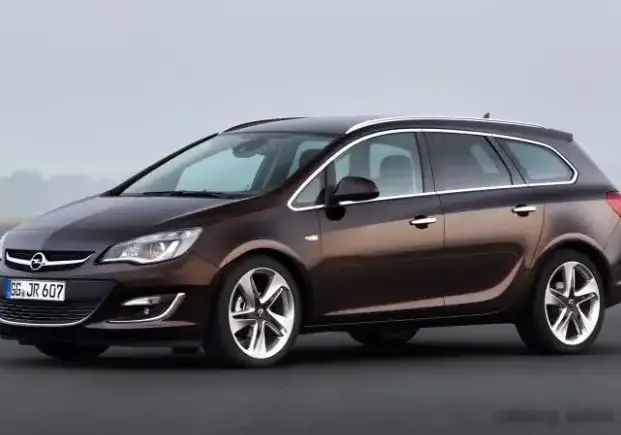
The Opel Astra J Sports Tourer (facelift, introduced in 2012) 1.4 LPG (140 hp) Ecotec represents a unique offering within the broader Astra J range. Produced from 2012 to 2015, this variant combined the practicality of a station wagon (estate) body style with a dual-fuel petrol/LPG powertrain. It was positioned as an economical alternative for buyers seeking lower running costs, particularly in European markets where LPG infrastructure was well-established. The facelift brought styling updates and revised equipment levels to the Astra J, enhancing its appeal against competitors like the Ford Focus Estate and Volkswagen Golf Variant.
| Brand | Opel |
| Model | Astra |
| Generation | Astra J Sports Tourer (facelift 2012) |
| Type (Engine) | 1.4 LPG (140 Hp) Ecotec |
| Start of production | 2012 |
| End of production | 2015 |
| Powertrain Architecture | Internal Combustion engine |
| Body type | Station wagon (estate) |
| Seats | 5 |
| Doors | 5 |
| Fuel consumption (economy) – urban | 8.1 l/100 km (29 US mpg, 34.9 UK mpg, 12.3 km/l) |
| Fuel consumption (economy) – urban (LPG) | 11.1 l/100 km |
| Fuel consumption (economy) – extra urban | 5.0 l/100 km (47 US mpg, 56.5 UK mpg, 20 km/l) |
| Fuel consumption (economy) – extra urban (LPG) | 7.1 l/100 km |
| Fuel consumption (economy) – combined | 6.1 l/100 km (38.6 US mpg, 46.3 UK mpg, 16.4 km/l) |
| Fuel consumption (economy) – combined (LPG) | 8.5 l/100 km |
| CO2 emissions | 152 g/km |
| CO2 emissions (LPG) | 132 g/km |
| Fuel Type | Petrol / LPG |
| Acceleration 0 – 100 km/h | 10.8 sec |
| Acceleration 0 – 62 mph | 10.8 sec |
| Acceleration 0 – 60 mph | 10.3 sec |
| Maximum speed | 200 km/h (124.27 mph) |
| Emission standard | Euro 5 |
| Weight-to-power ratio | 10.1 kg/Hp, 99.3 Hp/tonne |
| Weight-to-torque ratio | 7.1 kg/Nm, 141.8 Nm/tonne |
| Power | 140 Hp @ 4900-6000 rpm |
| Power per litre | 102.6 Hp/l |
| Torque | 200 Nm @ 1850-4900 rpm (147.51 lb.-ft. @ 1850-4900 rpm) |
| Engine layout | Front, Transverse |
| Engine Model/Code | A14NET |
| Engine displacement | 1364 cm3 (83.24 cu. in.) |
| Number of cylinders | 4 |
| Engine configuration | Inline |
| Cylinder Bore | 72.5 mm (2.85 in.) |
| Piston Stroke | 82.6 mm (3.25 in.) |
| Number of valves per cylinder | 4 |
| Fuel injection system | Multi-port manifold injection |
| Engine aspiration | Naturally aspirated engine |
| Engine oil capacity | 4 l (4.23 US qt, 3.52 UK qt) |
| Coolant | 6.2 l (6.55 US qt, 5.46 UK qt) |
| Kerb Weight | 1410 kg (3108.52 lbs.) |
| Max. weight | 1955 kg (4310.04 lbs.) |
| Max load | 545 kg (1201.52 lbs.) |
| Trunk (boot) space – minimum | 500 l (17.66 cu. ft.) |
| Trunk (boot) space – maximum | 1550 l (54.74 cu. ft.) |
| Fuel tank capacity | 56 l (14.79 US gal, 12.32 UK gal) |
| Fuel tank capacity (LPG) | 32.80 l |
| Max. roof load | 100 kg (220.46 lbs.) |
| Permitted trailer load with brakes (12%) | 1200 kg (2645.55 lbs.) |
| Permitted trailer load without brakes | 710 kg (1565.28 lbs.) |
| Length | 4698 mm (184.96 in.) |
| Width | 1814 mm (71.42 in.) |
| Width with mirrors folded | 1831 mm (72.09 in.) |
| Width including mirrors | 2013 mm (79.25 in.) |
| Height | 1535 mm (60.43 in.) |
| Wheelbase | 2685 mm (105.71 in.) |
| Front track | 1541 mm (60.67 in.) |
| Rear (Back) track | 1551 mm (61.06 in.) |
| Ride height (ground clearance) | 165 mm (6.5 in.) |
| Minimum turning circle (turning diameter) | 11.4 m (37.4 ft.) |
| Drivetrain Architecture | The Internal combustion engine (ICE) drives the front wheels of the vehicle. |
| Drive wheel | Front wheel drive |
| Number of gears and type of gearbox | 6 gears, manual transmission |
| Front brakes | Ventilated discs |
| Assisting systems | ABS (Anti-lock braking system) |
| Steering type | Steering rack and pinion |
| Power steering | Electric Steering |
| Tires size | 205/60 R16; 215/50 R17 |
| Wheel rims size | 16; 17 |
Powertrain & Engine Architecture
The heart of this Astra variant is the A14NET engine, a 1.4-liter inline-four cylinder petrol engine modified for dual-fuel operation. This engine belongs to Opel’s Ecotec family, known for its focus on efficiency and refinement. The A14NET utilizes multi-port fuel injection and a naturally aspirated design, producing 140 horsepower at 4900-6000 rpm and 200 Nm (147.51 lb-ft) of torque between 1850-4900 rpm. The LPG system operates as a secondary fuel source, injecting gas into the intake manifold. The engine’s architecture is relatively simple, contributing to its reliability. The 6-speed manual transmission was standard, providing a good balance between fuel economy and driver engagement. While an automatic transmission was available on other Astra J models, it was not offered with the 1.4 LPG engine.
Driving Characteristics
The 1.4 LPG variant offered a noticeably different driving experience compared to higher-powered Astra J models like the 1.6 Turbo or the diesel variants. Acceleration from 0-100 km/h (0-62 mph) took approximately 10.8 seconds, making it adequate for everyday driving but not particularly sporty. The engine felt responsive enough in petrol mode, but power delivery was somewhat subdued when running on LPG. The manual transmission’s gear ratios were tuned for fuel efficiency, meaning frequent downshifts were often required for overtaking or climbing hills. The suspension setup, typical for the Astra J, provided a comfortable ride, but handling was not as sharp as some competitors. The added weight of the LPG tank, usually located in the spare wheel well, did slightly impact handling and reduced available trunk space.
Equipment & Trim Levels
The 1.4 LPG Sports Tourer typically came with a moderate level of equipment. Standard features generally included air conditioning, electric front windows, a basic audio system with USB connectivity, and ABS brakes. Higher trim levels, such as ‘Enjoy’ or ‘Cosmo’, added features like alloy wheels, cruise control, a more advanced infotainment system, and parking sensors. Interior upholstery was typically cloth, with options for upgraded materials. The dashboard layout was consistent with other Astra J models, featuring a clean and functional design. Optional extras included a panoramic sunroof, leather seats, and a navigation system.
Chassis & Braking
The Astra J Sports Tourer utilized a MacPherson strut front suspension and a multi-link rear suspension, providing a good balance of ride comfort and handling. The 1.4 LPG variant typically featured ventilated disc brakes at the front and drum brakes at the rear. ABS (Anti-lock Braking System) was standard. The steering was electrically assisted, offering light and precise control. Stabilizer bars were fitted to both the front and rear axles to reduce body roll during cornering. The suspension components were generally robust and reliable, although the added weight of the LPG system could put slightly more stress on the rear suspension.
Market Reception & Comparison
The Astra J Sports Tourer 1.4 LPG was primarily targeted at cost-conscious buyers in countries with established LPG infrastructure. Critics generally praised its fuel economy and low running costs, but noted its modest performance. Compared to the petrol-only 1.4-liter version, the LPG variant offered similar performance but with significantly lower fuel bills. Against diesel alternatives, it lacked the low-end torque and overall fuel efficiency of the diesel engines, but offered a quieter and smoother driving experience. The LPG version was often seen as a compromise – a practical and economical choice, but not a particularly exciting one.
Legacy
The Opel Astra J Sports Tourer 1.4 LPG has proven to be a relatively reliable vehicle in the used car market. The A14NET engine is known for its durability, and the LPG system, when properly maintained, can add many years of service. However, potential buyers should be aware of the need for regular LPG system servicing, including valve adjustments and filter replacements. The availability of LPG filling stations is a key consideration for owners. Today, these Astra variants represent an affordable and economical option for those seeking a practical estate car with low running costs, particularly in regions where LPG remains a viable fuel source.