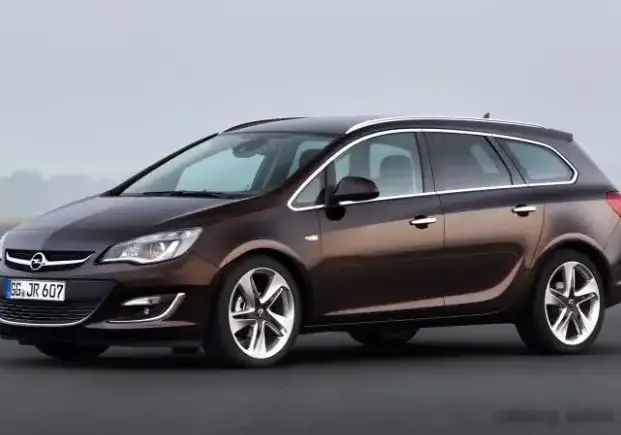
The Opel Astra J Sports Tourer (facelift, produced 2012-2015) 1.6 (115 hp) Ecotec Automatic was a mainstream, family-oriented station wagon positioned as a practical and fuel-efficient option within the broader Astra J range. Introduced as part of the facelift for the J generation, this variant aimed to provide a balance between affordability, usability, and reasonable performance. It competed directly with other compact estate cars like the Ford Focus Estate, Volkswagen Golf Variant, and Peugeot 308 SW in the European market. The Sports Tourer body style, Opel’s designation for a station wagon, offered increased cargo capacity compared to the hatchback version, making it a popular choice for families and those requiring versatile load-carrying capabilities.
Technical Specifications
| Brand | Opel |
| Model | Astra |
| Generation | Astra J Sports Tourer (facelift 2012) |
| Type (Engine) | 1.6 (115 Hp) Ecotec Automatic |
| Start of production | 2012 |
| End of production | 2015 |
| Powertrain Architecture | Internal Combustion engine |
| Body type | Station wagon (estate) |
| Seats | 5 |
| Doors | 5 |
| Fuel consumption (urban) | 10.0-10.2 l/100 km (23.5 – 23.1 US mpg) |
| Fuel consumption (extra urban) | 5.6-6.0 l/100 km (42 – 39.2 US mpg) |
| Fuel consumption (combined) | 7.2-7.5 l/100 km (32.7 – 31.4 US mpg) |
| CO2 emissions | 169-177 g/km |
| Fuel Type | Petrol (Gasoline) |
| Acceleration 0 – 100 km/h | 13.9 sec |
| Acceleration 0 – 62 mph | 13.9 sec |
| Acceleration 0 – 60 mph | 13.2 sec |
| Maximum speed | 180 km/h (111.85 mph) |
| Emission standard | Euro 5 |
| Weight-to-power ratio | 11.6 kg/Hp |
| Weight-to-torque ratio | 8.6 kg/Nm |
| Power | 115 Hp @ 6000 rpm |
| Torque | 155 Nm @ 4000 rpm (114.32 lb.-ft. @ 4000 rpm) |
| Engine layout | Front, Transverse |
| Engine Model/Code | A16XER |
| Engine displacement | 1598 cm3 (97.52 cu. in.) |
| Number of cylinders | 4 |
| Engine configuration | Inline |
| Cylinder Bore | 79 mm (3.11 in.) |
| Piston Stroke | 81.5 mm (3.21 in.) |
| Number of valves per cylinder | 4 |
| Fuel injection system | Multi-port manifold injection |
| Engine aspiration | Naturally aspirated engine |
| Engine oil capacity | 4.5 l (4.76 US qt | 3.96 UK qt) |
| Coolant | 5.6 l (5.92 US qt | 4.93 UK qt) |
| Kerb Weight | 1333 kg (2938.76 lbs.) |
| Max. weight | 1975 kg (4354.13 lbs.) |
| Max load | 642 kg (1415.37 lbs.) |
| Trunk (boot) space – minimum | 500 l (17.66 cu. ft.) |
| Trunk (boot) space – maximum | 1550 l (54.74 cu. ft.) |
| Fuel tank capacity | 56 l (14.79 US gal | 12.32 UK gal) |
| Max. roof load | 100 kg (220.46 lbs.) |
| Permitted trailer load with brakes (12%) | 1000 kg (2204.62 lbs.) |
| Permitted trailer load without brakes | 700 kg (1543.24 lbs.) |
| Length | 4698 mm (184.96 in.) |
| Width | 1814 mm (71.42 in.) |
| Width with mirrors folded | 1831 mm (72.09 in.) |
| Width including mirrors | 2013 mm (79.25 in.) |
| Height | 1535 mm (60.43 in.) |
| Wheelbase | 2685 mm (105.71 in.) |
| Front track | 1541 mm (60.67 in.) |
| Rear (Back) track | 1551 mm (61.06 in.) |
| Ride height (ground clearance) | 165 mm (6.5 in.) |
| Minimum turning circle | 11.4 m (37.4 ft.) |
| Drivetrain Architecture | Front wheel drive |
| Number of gears and type of gearbox | 6 gears, automatic transmission |
| Front brakes | Ventilated discs |
| Assisting systems | ABS (Anti-lock braking system) |
| Steering type | Steering rack and pinion |
| Power steering | Electric Steering |
| Tires size | 205/60 R16; 215/50 R17 |
| Wheel rims size | 16; 17 |
INTRODUCTION
The Opel Astra J Sports Tourer 1.6 (115 hp) Ecotec Automatic, produced from 2012 to 2015, represented a key offering in Opel’s lineup. Built on the 1HX0/A3 platform shared with other General Motors and Stellantis vehicles, the Sports Tourer variant provided a practical alternative to the hatchback, catering to buyers needing more cargo space. This specific engine and transmission combination was positioned as an entry-to-mid-range option, appealing to customers prioritizing fuel economy and ease of driving over outright performance. It served as a workhorse for families and individuals seeking a reliable and versatile vehicle for everyday use.
Powertrain & Engine Architecture
At the heart of this Astra variant lies the A16XER engine, a 1.6-liter inline-four cylinder petrol engine. This engine is naturally aspirated and utilizes a multi-port fuel injection system. The A16XER is known for its relatively simple design and reasonable reliability. It features a dual overhead camshaft (DOHC) valvetrain with four valves per cylinder, contributing to its efficiency. The 115 horsepower output is achieved at 6000 rpm, while the peak torque of 155 Nm (114.32 lb.-ft.) is delivered at 4000 rpm. Paired with this engine is a six-speed automatic transmission. This transmission, while providing convenience, wasn’t known for particularly rapid shifts or sporty responsiveness. It was primarily geared towards smooth operation and fuel efficiency. The engine’s design prioritized fuel economy and emissions compliance, aligning with European regulations at the time.
Driving Characteristics
The driving experience in the Astra J Sports Tourer 1.6 Automatic is best described as comfortable and undemanding. With 115 hp and a relatively modest torque output, acceleration is not its strong suit. The 0-100 km/h (0-62 mph) time of 13.9 seconds reflects this. The automatic transmission, while smooth, contributes to a somewhat leisurely pace. Gear ratios are optimized for fuel efficiency rather than performance, meaning the engine often operates at lower revolutions during cruising. Compared to the more powerful 1.4 Turbo or diesel variants, this 1.6L automatic feels noticeably slower, especially when fully loaded or tackling inclines. However, for everyday commuting and relaxed highway driving, the powertrain provides adequate performance. The steering is light and precise, making it easy to maneuver in urban environments.
Equipment & Trim Levels
The Astra J Sports Tourer 1.6 Automatic typically came equipped with a reasonable level of standard features. These generally included air conditioning, electric front windows, a basic audio system with USB connectivity, and ABS brakes. Higher trim levels, such as ‘Enjoy’ or ‘Cosmo’, added features like alloy wheels, cruise control, automatic headlights and rain sensors, and more advanced infotainment systems. Interior upholstery was typically cloth, with options for upgraded materials on higher trims. Optional extras included a panoramic sunroof, parking sensors, and a navigation system. The dashboard layout was functional and user-friendly, although the interior design wasn’t particularly luxurious.
Chassis & Braking
The Astra J Sports Tourer’s chassis is based on a MacPherson strut front suspension and a torsion beam rear suspension. This setup provides a good balance between ride comfort and handling. The torsion beam rear suspension is a cost-effective solution commonly found in vehicles of this class. Braking duties are handled by ventilated discs on the front wheels and drum brakes on the rear wheels. ABS (Anti-lock Braking System) is standard, providing enhanced safety during emergency braking. Stabilizer bars are fitted to both the front and rear axles to reduce body roll during cornering. The suspension tuning is geared towards comfort, resulting in a relatively soft ride quality.
Market Reception & Comparison
The Astra J Sports Tourer 1.6 Automatic received generally positive reviews for its practicality, fuel efficiency, and comfortable ride. Critics noted that it wasn’t the most exciting car to drive, but it fulfilled its role as a sensible family vehicle effectively. Compared to the more powerful Astra variants, the 1.6L automatic offered lower running costs but sacrificed performance. The 1.4 Turbo, for example, provided significantly more power and a more engaging driving experience, but at a higher price point and with slightly lower fuel economy. The diesel variants (like the 1.7 CDTI) offered even better fuel economy but came with the typical diesel engine noise and potential maintenance concerns. The 1.6 Automatic appealed to buyers who prioritized affordability and ease of use over sporty driving dynamics.
Legacy
The Opel Astra J Sports Tourer 1.6 Automatic has proven to be a relatively reliable vehicle in the used car market. The A16XER engine is generally considered durable, although regular maintenance is crucial. Common issues include occasional oil leaks and potential problems with the timing chain. The automatic transmission, while generally reliable, can sometimes exhibit harsh shifting if not properly serviced. Today, these Astras represent an affordable and practical option for buyers seeking a spacious and fuel-efficient estate car. Their relatively low purchase price and reasonable running costs make them a popular choice for first-time car owners and those on a budget. While not a performance icon, the Astra J Sports Tourer 1.6 Automatic remains a testament to Opel’s commitment to providing practical and dependable transportation.