Technical Specifications
| Brand | Opel |
| Model | Astra |
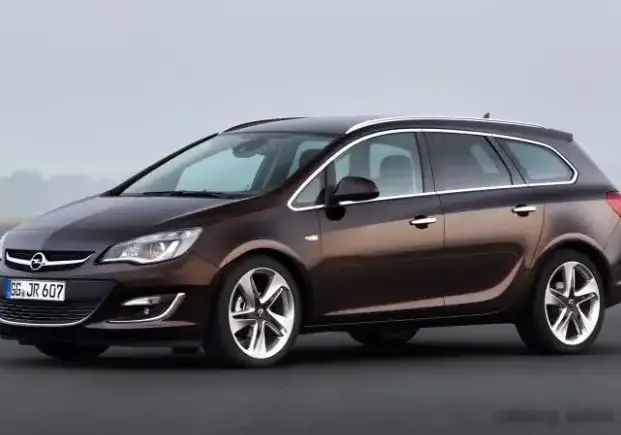
| Generation | Astra J Sports Tourer (facelift 2012) |
| Type (Engine) | 1.6 CDTI (110 Hp) Ecotec start/stop |
| Start of production | 2012 |
| End of production | 2015 |
| Powertrain Architecture | Internal Combustion engine |
| Body type | Station wagon (estate) |
| Seats | 5 |
| Doors | 5 |
| Fuel consumption (urban) | 3.9-4.2 l/100 km (60.3 – 56 US mpg, 72.4 – 67.3 UK mpg, 25.6 – 23.8 km/l) |
| Fuel consumption (extra urban) | 3.5-3.6 l/100 km (67.2 – 65.3 US mpg, 80.7 – 78.5 UK mpg, 28.6 – 27.8 km/l) |
| Fuel consumption (combined) | 3.7-3.8 l/100 km (63.6 – 61.9 US mpg, 76.3 – 74.3 UK mpg, 27 – 26.3 km/l) |
| CO2 emissions | 97-100 g/km |
| Fuel Type | Diesel |
| Acceleration 0 – 100 km/h | 12 sec |
| Acceleration 0 – 62 mph | 12 sec |
| Acceleration 0 – 60 mph | 11.4 sec |
| Maximum speed | 186 km/h (115.58 mph) |
| Emission standard | Euro 5 |
| Power | 110 Hp @ 3500 rpm |
| Power per litre | 68.8 Hp/l |
| Torque | 300 Nm @ 1750-2000 rpm (221.27 lb.-ft. @ 1750-2000 rpm) |
| Engine layout | Front, Transverse |
| Engine Model/Code | B16DTL |
| Engine displacement | 1598 cm3 (97.52 cu. in.) |
| Number of cylinders | 4 |
| Engine configuration | Inline |
| Cylinder Bore | 79.7 mm (3.14 in.) |
| Piston Stroke | 80.1 mm (3.15 in.) |
| Number of valves per cylinder | 4 |
| Fuel injection system | Diesel Commonrail |
| Engine aspiration | Turbocharger, Intercooler |
| Engine oil capacity | 5 l (5.28 US qt | 4.4 UK qt) |
| Coolant capacity | 6.2 l (6.55 US qt | 5.46 UK qt) |
| Trunk (boot) space – minimum | 500 l (17.66 cu. ft.) |
| Trunk (boot) space – maximum | 1550 l (54.74 cu. ft.) |
| Fuel tank capacity | 56 l (14.79 US gal | 12.32 UK gal) |
| Max. roof load | 100 kg (220.46 lbs.) |
| Permitted trailer load with brakes (12%) | 1300 kg (2866.01 lbs.) |
| Permitted trailer load without brakes | 730 kg (1609.37 lbs.) |
| Length | 4698 mm (184.96 in.) |
| Width | 1814 mm (71.42 in.) |
| Width with mirrors folded | 1831 mm (72.09 in.) |
| Width including mirrors | 2013 mm (79.25 in.) |
| Height | 1535 mm (60.43 in.) |
| Wheelbase | 2685 mm (105.71 in.) |
| Front track | 1541 mm (60.67 in.) |
| Rear track | 1551 mm (61.06 in.) |
| Ride height (ground clearance) | 165 mm (6.5 in.) |
| Minimum turning circle | 11.4 m (37.4 ft.) |
| Drivetrain Architecture | Front wheel drive |
| Number of gears | 6 |
| Gearbox type | Manual transmission |
| Front brakes | Ventilated discs |
| Assisting systems | ABS (Anti-lock braking system) |
| Steering type | Steering rack and pinion |
| Power steering | Electric Steering |
| Tires size | 215/50 R17 |
| Wheel rims size | 17 |
The Opel Astra J Sports Tourer 1.6 CDTI (110 hp) Ecotec start/stop, launched after the 2012 facelift, was a significant offering in the European compact estate market. Built on the 1HX0/A3 platform shared with other Vauxhall/Opel and Chevrolet models, the Sports Tourer variant provided increased cargo capacity compared to the hatchback. This particular engine and transmission combination aimed to deliver a balance of fuel efficiency, practicality, and affordability, targeting families and individuals needing a versatile vehicle for everyday use. The ‘Ecotec’ branding signified Opel’s efforts to improve engine efficiency through technologies like start/stop functionality and optimized combustion.
Powertrain & Engine Architecture
At the heart of this Astra variant lies the 1.6-liter (1598 cc) B16DTL four-cylinder diesel engine. This engine is part of Opel’s ‘CDTI’ (Common-rail Diesel Injection) family. The B16DTL utilizes a turbocharger with intercooling to boost power output to 110 hp (82 kW) at 3500 rpm and 300 Nm (221 lb-ft) of torque between 1750 and 2000 rpm. The engine employs a common-rail direct injection system, delivering fuel directly into the combustion chamber at high pressure for improved efficiency and reduced emissions. It features four valves per cylinder and a timing belt. The engine was paired with a six-speed manual transmission, optimized for fuel economy and smooth operation. The start/stop system automatically shuts off the engine when the vehicle is stationary (e.g., at traffic lights) to further reduce fuel consumption and emissions.
Driving Characteristics
The 1.6 CDTI 110 hp engine, coupled with the six-speed manual gearbox, provided adequate, though not exhilarating, performance. Acceleration from 0-60 mph took around 11.4 seconds, and top speed was approximately 115.58 mph. The engine’s torque delivery was its strong suit, offering good pulling power at lower revs, making it suitable for everyday driving and carrying loads. Compared to higher-output Astra J variants, such as those with the 2.0 CDTI engine, this version felt less responsive, particularly during overtaking maneuvers. However, the manual transmission allowed drivers to maintain control and optimize fuel efficiency. The gear ratios were tuned for economy, meaning the engine often needed to be worked harder on inclines or when fully loaded. The ride quality was generally comfortable, typical of the Astra J, but the suspension was tuned for practicality rather than sporty handling.
Equipment & Trim Levels
The 1.6 CDTI Sports Tourer typically came equipped with a reasonable level of standard features. These included air conditioning, electric front windows, a CD/MP3 stereo system, and ABS brakes. Higher trim levels, such as ‘Sportive’ or ‘SE’, added features like alloy wheels, cruise control, rear parking sensors, and upgraded interior trim. Interior upholstery was typically cloth, with options for leather upgrades. The dashboard layout was functional and user-friendly, with a clear instrument cluster. Optional extras included a touchscreen infotainment system with navigation, heated seats, and a panoramic sunroof.
Chassis & Braking
The Astra J Sports Tourer utilized a MacPherson strut front suspension and a torsion beam rear suspension. This setup provided a good balance between ride comfort and handling. The front brakes were ventilated discs, while the rear brakes were typically solid discs on higher trims, but drums on base models. ABS (Anti-lock Braking System) was standard, enhancing braking performance and safety. The steering was electrically assisted, providing light and precise control. The chassis was designed to maximize interior space and cargo capacity while maintaining a reasonable level of stability.
Market Reception & Comparison
The Astra J Sports Tourer 1.6 CDTI (110 hp) was generally well-received by automotive critics as a practical and fuel-efficient estate car. It was praised for its spacious interior, large boot capacity, and low running costs. However, some reviewers noted that the engine lacked outright performance compared to more powerful alternatives. Compared to the 2.0 CDTI variants, the 1.6 CDTI offered significantly better fuel economy (around 3.7-3.8 l/100 km combined) but at the expense of acceleration and overall refinement. Against competitors like the Ford Focus Estate and Volkswagen Golf Estate, the Astra J offered a competitive package in terms of price, space, and fuel efficiency.
Legacy
The 1.6 CDTI engine, while not without its issues (some early versions experienced DPF – Diesel Particulate Filter – problems), proved to be generally reliable when properly maintained. The Astra J Sports Tourer 1.6 CDTI remains a popular choice in the used car market, particularly for buyers seeking an affordable and practical estate car. Its fuel efficiency and relatively low maintenance costs make it an attractive option for those covering high mileages. However, potential buyers should be aware of the potential for DPF issues and ensure the vehicle has a full service history. The Astra J Sports Tourer, in this configuration, represents a solid and dependable family vehicle that continues to offer good value for money.