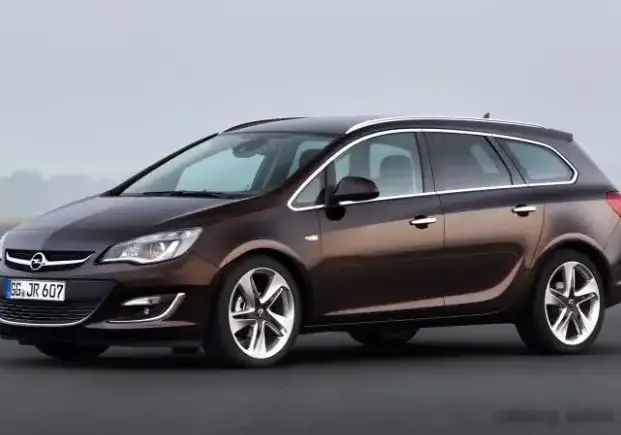
The Opel Astra J Sports Tourer, specifically the 2.0 CDTI (165 hp) Ecotec Automatic variant produced from 2012 to 2015, represents a significant offering within the broader Astra J generation (2009-2015). This model, a facelifted version of the original J series, aimed to combine the practicality of a station wagon (estate) with a reasonably efficient and powerful diesel engine paired with the convenience of an automatic transmission. Positioned as a mid-range to upper-mid-range trim, it catered to buyers seeking a versatile family vehicle with a balance of performance and economy. The Astra J Sports Tourer competed directly with other European estate cars like the Ford Focus Estate, Volkswagen Golf Variant, and Peugeot 308 SW.
Technical Specifications
| Brand | Opel |
| Model | Astra |
| Generation | Astra J Sports Tourer (facelift 2012) |
| Type (Engine) | 2.0 CDTI (165 Hp) Ecotec Automatic |
| Start of production | 2012 |
| End of production | 2015 |
| Powertrain Architecture | Internal Combustion engine |
| Body type | Station wagon (estate) |
| Seats | 5 |
| Doors | 5 |
| Fuel consumption (urban) | 7.9-8.0 l/100 km (29.8 – 29.4 US mpg) |
| Fuel consumption (extra urban) | 4.7-4.8 l/100 km (50 – 49 US mpg) |
| Fuel consumption (combined) | 5.8-6.0 l/100 km (40.6 – 39.2 US mpg) |
| CO2 emissions | 154-158 g/km |
| Fuel Type | Diesel |
| Acceleration 0 – 100 km/h | 9.8 sec |
| Acceleration 0 – 62 mph | 9.8 sec |
| Acceleration 0 – 60 mph | 9.3 sec |
| Maximum speed | 207 km/h (128.62 mph) |
| Emission standard | Euro 5 |
| Power | 165 Hp @ 4000 rpm |
| Torque | 350 Nm @ 1750-2500 rpm (258.15 lb.-ft. @ 1750-2500 rpm) |
| Engine layout | Front, Transverse |
| Engine Model/Code | A20DTH |
| Engine displacement | 1956 cm3 (119.36 cu. in.) |
| Number of cylinders | 4 |
| Engine configuration | Inline |
| Cylinder Bore | 83 mm (3.27 in.) |
| Piston Stroke | 90.4 mm (3.56 in.) |
| Number of valves per cylinder | 4 |
| Fuel injection system | Diesel Commonrail |
| Engine aspiration | Turbocharger, Intercooler |
| Engine oil capacity | 4.5 l (4.76 US qt | 3.96 UK qt) |
| Coolant capacity | 6.9 l (7.29 US qt | 6.07 UK qt) |
| Trunk (boot) space – minimum | 500 l (17.66 cu. ft.) |
| Trunk (boot) space – maximum | 1550 l (54.74 cu. ft.) |
| Fuel tank capacity | 56 l (14.79 US gal | 12.32 UK gal) |
| Max. roof load | 100 kg (220.46 lbs.) |
| Length | 4698 mm (184.96 in.) |
| Width | 1814 mm (71.42 in.) |
| Width with mirrors folded | 1831 mm (72.09 in.) |
| Width including mirrors | 2013 mm (79.25 in.) |
| Height | 1535 mm (60.43 in.) |
| Wheelbase | 2685 mm (105.71 in.) |
| Front track | 1541 mm (60.67 in.) |
| Rear track | 1551 mm (61.06 in.) |
| Ride height (ground clearance) | 165 mm (6.5 in.) |
| Minimum turning circle | 11.4 m (37.4 ft.) |
| Drivetrain Architecture | Front wheel drive |
| Number of gears | 6 |
| Gearbox type | Automatic transmission |
| Front brakes | Ventilated discs |
| Assisting systems | ABS (Anti-lock braking system) |
| Steering type | Steering rack and pinion |
| Power steering | Electric Steering |
| Tires size | 215/50 R17 |
| Wheel rims size | 17 |
Powertrain & Engine Architecture
At the heart of the Astra J Sports Tourer 2.0 CDTI lies the A20DTH engine, a 1.956-liter inline-four cylinder diesel. This engine is a member of Opel/Vauxhall’s Ecotec family, known for its focus on efficiency and refinement. The A20DTH utilizes a common rail direct injection system, delivering fuel at extremely high pressures for optimized combustion. A turbocharger with an intercooler further enhances performance by forcing more air into the cylinders. The engine produces 165 horsepower at 4,000 rpm and a substantial 350 Nm (258 lb-ft) of torque between 1,750 and 2,500 rpm. This torque output is a key characteristic of diesel engines, providing strong pulling power at lower engine speeds. The engine also incorporates a diesel particulate filter (DPF) to reduce harmful emissions, meeting Euro 5 standards. The automatic transmission is a six-speed unit, designed to provide smooth and efficient gear changes. While not a dual-clutch transmission, it offers a comfortable driving experience, particularly in urban environments.
Driving Characteristics
The 2.0 CDTI automatic powertrain delivers a composed and comfortable driving experience. The readily available torque makes overtaking and merging onto highways relatively effortless. While not a sports car, the Astra J Sports Tourer 2.0 CDTI offers adequate acceleration, reaching 0-60 mph in approximately 9.3 seconds. The automatic transmission is well-matched to the engine’s characteristics, providing smooth shifts and preventing the engine from feeling strained. Compared to the 1.4-liter turbocharged petrol versions, the 2.0 CDTI offers significantly more torque and better fuel economy, albeit with slightly less peak horsepower. Against the 1.7 CDTI variant, the 2.0 CDTI provides a noticeable performance boost, justifying its position as a higher-trim option. The gear ratios are tuned for fuel efficiency, meaning the engine doesn’t rev excessively at highway speeds.
Equipment & Trim Levels
The 2.0 CDTI Automatic trim typically included a generous level of standard equipment. This often encompassed features like air conditioning, electric windows and mirrors, a CD/MP3 stereo system with auxiliary input, and alloy wheels. Higher-spec versions could be equipped with options such as leather upholstery, a panoramic sunroof, parking sensors, and a navigation system. Interior upholstery was generally cloth, with leather available as an upgrade. The dashboard layout was functional and modern, with a focus on ergonomics. Trim levels varied slightly depending on the specific market, but generally, the 2.0 CDTI Automatic represented a well-equipped and comfortable package.
Chassis & Braking
The Astra J Sports Tourer utilizes a MacPherson strut front suspension and a multi-link rear suspension, providing a good balance between ride comfort and handling. The suspension was tuned to prioritize comfort, making it well-suited for long journeys. The front brakes are ventilated discs, offering good stopping power, while the rear brakes are typically solid discs. Anti-lock Braking System (ABS) is standard, enhancing safety during emergency braking situations. Stabilizer bars are fitted to both the front and rear axles to reduce body roll during cornering. The steering is electrically assisted, providing a light and precise feel.
Market Reception & Comparison
The Astra J Sports Tourer 2.0 CDTI Automatic was generally well-received by automotive critics. It was praised for its comfortable ride, spacious interior, and fuel efficiency. The diesel engine was considered a strong performer, offering ample torque for everyday driving. However, some critics noted that the automatic transmission could occasionally feel hesitant, and the overall driving experience wasn’t as engaging as some of its rivals. Compared to the petrol-powered Astra J models, the 2.0 CDTI offered superior fuel economy and torque, making it a popular choice for drivers covering long distances. Its fuel economy figures of around 40 mpg combined were competitive within its class. Reliability reports suggest the A20DTH engine is generally robust, although DPF issues can occur with infrequent long journeys.
Legacy
The Opel Astra J Sports Tourer 2.0 CDTI Automatic remains a relatively common sight on used car markets today. The A20DTH engine has proven to be reasonably durable, provided it has been properly maintained. Regular servicing, including oil changes and DPF regeneration, is crucial for long-term reliability. While not a particularly exciting car, it represents a practical and economical choice for families seeking a spacious and comfortable estate car. Its blend of fuel efficiency, practicality, and reasonable performance continues to make it a viable option for budget-conscious buyers.