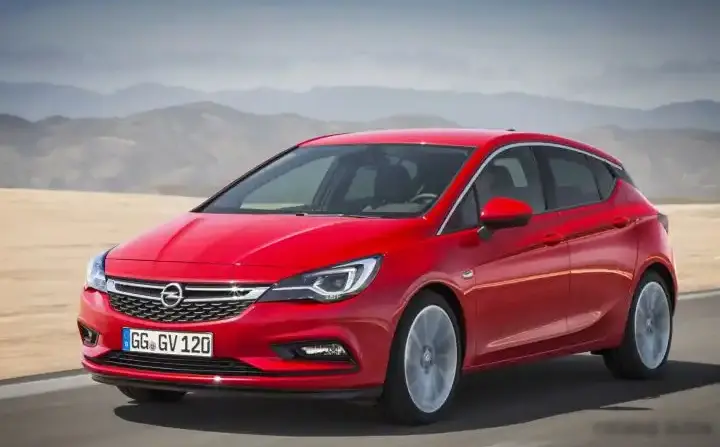
The Opel Astra K 1.0 EcoTec (105 hp) ecoFLEX Easytronic start&stop was a variant of the Astra K, produced between 2015 and 2018. Positioned as an entry-level to mid-range offering, it aimed to provide fuel efficiency and affordability within the broader Astra K lineup, which utilized the GM’s 1HX0/A3 platform. This model was primarily marketed in Europe, where compact hatchbacks are highly popular, and represented Opel’s attempt to cater to buyers seeking lower running costs without sacrificing practicality.
Technical Specifications
| Brand | Opel |
| Model | Astra |
| Generation | Astra K |
| Type (Engine) | 1.0 EcoTec (105 Hp) ecoFLEX Easytronic start&stop |
| Start of production | 2015 |
| End of production | 2018 |
| Powertrain Architecture | Internal Combustion engine |
| Body type | Hatchback |
| Seats | 5 |
| Doors | 5 |
| Fuel consumption (urban) | 5.2-5.1 l/100 km (45.2 – 46.1 US mpg, 54.3 – 55.4 UK mpg, 19.2 – 19.6 km/l) |
| Fuel consumption (extra urban) | 3.8-3.7 l/100 km (61.9 – 63.6 US mpg, 74.3 – 76.3 UK mpg, 26.3 – 27 km/l) |
| Fuel consumption (combined) | 4.3-4.2 l/100 km (54.7 – 56 US mpg, 65.7 – 67.3 UK mpg, 23.3 – 23.8 km/l) |
| CO2 emissions | 99-96 g/km |
| Fuel Type | Petrol (Gasoline) |
| Acceleration 0 – 100 km/h | 12.7 sec |
| Acceleration 0 – 62 mph | 12.7 sec |
| Acceleration 0 – 60 mph | 12.1 sec |
| Maximum speed | 200 km/h (124.27 mph) |
| Emission standard | Euro 6 |
| Weight-to-power ratio | 11.4 kg/Hp, 87.6 Hp/tonne |
| Weight-to-torque ratio | 7 kg/Nm, 141.9 Nm/tonne |
| Power | 105 Hp @ 5500 rpm |
| Power per litre | 105.1 Hp/l |
| Torque | 170 Nm @ 1800-4250 rpm (125.39 lb.-ft. @ 1800-4250 rpm) |
| Engine layout | Front, Transverse |
| Engine Model/Code | B10XFL |
| Engine displacement | 999 cm3 (60.96 cu. in.) |
| Number of cylinders | 3 |
| Engine configuration | Inline |
| Cylinder Bore | 74 mm (2.91 in.) |
| Piston Stroke | 77.4 mm (3.05 in.) |
| Compression ratio | 10.5:1 |
| Number of valves per cylinder | 4 |
| Fuel injection system | Direct injection |
| Engine aspiration | Turbocharger, Intercooler |
| Engine oil capacity | 4 l (4.23 US qt | 3.52 UK qt) |
| Kerb Weight | 1198 kg (2641.14 lbs.) |
| Max. weight | 1790 kg (3946.27 lbs.) |
| Max load | 592 kg (1305.14 lbs.) |
| Trunk (boot) space – minimum | 370 l (13.07 cu. ft.) |
| Trunk (boot) space – maximum | 1210 l (42.73 cu. ft.) |
| Fuel tank capacity | 47 l (12.42 US gal | 10.34 UK gal) |
| Permitted trailer load with brakes (12%) | 1230 kg (2711.69 lbs.) |
| Permitted trailer load without brakes | 610 kg (1344.82 lbs.) |
| Length | 4370 mm (172.05 in.) |
| Width | 1809 mm (71.22 in.) |
| Width with mirrors folded | 1871 mm (73.66 in.) |
| Width including mirrors | 2042 mm (80.39 in.) |
| Height | 1485 mm (58.46 in.) |
| Wheelbase | 2662 mm (104.8 in.) |
| Front track | 1544 mm (60.79 in.) |
| Rear (Back) track | 1558 mm (61.34 in.) |
| Front overhang | 960 mm (37.8 in.) |
| Rear overhang | 748 mm (29.45 in.) |
| Ride height (ground clearance) | 150 mm (5.91 in.) |
| Drag coefficient (Cd) | 0.31 |
| Minimum turning circle (turning diameter) | 11.05 m (36.25 ft.) |
| Drivetrain Architecture | The Internal combustion engine (ICE) drives the front wheels of the vehicle. |
| Drive wheel | Front wheel drive |
| Number of gears and type of gearbox | 5 gears, automatic transmission Easytronic |
| Front brakes | Ventilated discs |
| Rear brakes | Disc |
| Assisting systems | ABS (Anti-lock braking system) |
| Steering type | Steering rack and pinion |
| Tires size | 205/55 R16 |
| Wheel rims size | 6J x 15 |
Powertrain & Engine Architecture
The heart of this Astra K variant is the B10XFL, a 1.0-liter, three-cylinder turbocharged gasoline engine. This engine is part of Opel’s ‘EcoTec’ family, designed for efficiency and reduced emissions. The B10XFL utilizes direct fuel injection, a technology that improves combustion efficiency and power output. The engine also features an intercooler to cool the intake air, further enhancing performance. The valvetrain employs four valves per cylinder, optimizing gas flow. Paired with this engine is the Easytronic 5-speed automatic transmission. This isn’t a traditional torque-converter automatic; instead, it’s a five-speed manual gearbox with automated clutch and shifting. It operates in both fully automatic and semi-automatic modes, allowing for some driver control. The start&stop system further contributes to fuel savings by automatically shutting off the engine when the vehicle is stationary.
Driving Characteristics
The 105 hp output and 170 Nm of torque, combined with the Easytronic transmission, resulted in a driving experience focused on fuel economy rather than outright performance. Acceleration from 0-100 km/h (0-62 mph) took approximately 12.7 seconds. The Easytronic transmission, while offering convenience, wasn’t known for its particularly swift or smooth shifts compared to conventional automatics or more modern dual-clutch transmissions. Gear ratios were tuned for efficiency, meaning the engine often operated at higher RPMs during acceleration. Compared to higher-output Astra K variants, such as those with the 1.4-liter turbo engine, this 1.0-liter version felt noticeably less powerful, especially when fully loaded or tackling inclines. However, for everyday commuting and urban driving, the power was generally adequate.
Equipment & Trim Levels
The 1.0 EcoTec Easytronic typically came with a reasonable level of standard equipment. This included air conditioning, power windows, a basic audio system with USB connectivity, and stability control. Interior upholstery was usually cloth, and the dashboard featured a relatively simple design. Optional extras included alloy wheels, a touchscreen infotainment system with navigation, parking sensors, and cruise control. Trim levels varied by market, but this engine/transmission combination generally sat in the lower to mid-range of the Astra K lineup.
Chassis & Braking
The Astra K’s chassis was designed to balance comfort and handling. The front suspension utilized MacPherson struts, while the rear suspension employed a torsion beam setup. This configuration was typical for vehicles in this class, offering a good compromise between ride quality and handling. Braking consisted of ventilated discs on the front wheels and solid discs on the rear. ABS (Anti-lock Braking System) was standard. The weight of the vehicle (around 1198 kg / 2641 lbs) was relatively light, contributing to its fuel efficiency.
Market Reception & Comparison
The Astra K 1.0 EcoTec Easytronic was generally well-received by critics as a practical and economical choice. Its fuel economy figures were a major selling point, and it offered a competitive price point. However, the Easytronic transmission received mixed reviews, with some testers finding it jerky and slow to respond. Compared to other Astra K trims, such as the 1.6 diesel or 1.4 turbo petrol, this variant offered lower performance but significantly better fuel economy. Its reliability was generally considered good, although the Easytronic transmission was sometimes reported to require maintenance.
Legacy
The Opel Astra K 1.0 EcoTec Easytronic remains a relatively common sight on the used car market. The B10XFL engine has proven to be reasonably durable, although regular maintenance is crucial. The Easytronic transmission, while not universally loved, can provide years of service with proper care. This variant represents a key step in Opel’s efforts to improve fuel efficiency and reduce emissions, and it continues to offer an affordable and practical option for buyers seeking a compact hatchback.