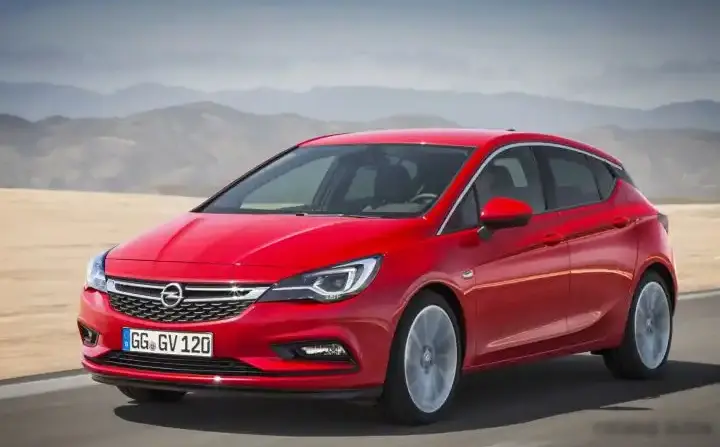
The Opel Astra K 1.4 Turbo (150 hp) Automatic, produced from 2018 to April 2019, represented a mid-range offering within the broader Astra K generation (launched in 2015). Positioned as a balance between fuel efficiency and performance, this variant aimed to appeal to drivers seeking a comfortable and practical hatchback with a touch more power than the base engine options. It utilized Opel’s then-current 1.4-liter turbocharged gasoline engine paired with a six-speed automatic transmission, and was a key model in the European market, competing with rivals like the Volkswagen Golf, Ford Focus, and Peugeot 308. The Astra K itself was a significant model for Opel, representing a substantial redesign and a move towards lighter weight construction and more modern technology.
Technical Specifications
| Brand | Opel |
| Model | Astra |
| Generation | Astra K |
| Type (Engine) | 1.4 Turbo (150 Hp) Automatic |
| Start of production | 2018 |
| End of production | April, 2019 |
| Powertrain Architecture | Internal Combustion engine |
| Body type | Hatchback |
| Seats | 5 |
| Doors | 5 |
| Fuel consumption (urban) | 7.3-7.5 l/100 km (32.2 – 31.4 US mpg) |
| Fuel consumption (extra urban) | 4.7-5.2 l/100 km (50 – 45.2 US mpg) |
| Fuel consumption (combined) | 5.7-6.1 l/100 km (41.3 – 38.6 US mpg) |
| CO2 emissions | 130-139 g/km |
| Fuel Type | Petrol (Gasoline) |
| Acceleration 0 – 100 km/h | 8.7 sec |
| Acceleration 0 – 62 mph | 8.7 sec |
| Acceleration 0 – 60 mph | 8.3 sec |
| Maximum speed | 210 km/h (130.49 mph) |
| Emission standard | Euro 6d-Temp |
| Weight-to-power ratio | 8.2 kg/Hp |
| Weight-to-torque ratio | 5.4 kg/Nm |
| Power | 150 Hp @ 5000-5600 rpm |
| Torque | 230 Nm @ 2000-4000 rpm (169.64 lb.-ft. @ 2000-4000 rpm) |
| Engine layout | Front, Transverse |
| Engine Model/Code | D14XFT |
| Engine displacement | 1399 cm3 (85.37 cu. in.) |
| Number of cylinders | 4 |
| Engine configuration | Inline |
| Cylinder Bore | 74 mm (2.91 in.) |
| Piston Stroke | 81.3 mm (3.2 in.) |
| Compression ratio | 10:1 |
| Number of valves per cylinder | 4 |
| Fuel injection system | Direct injection |
| Engine aspiration | Turbocharger, Intercooler |
| Engine oil capacity | 4 l (4.23 US qt | 3.52 UK qt) |
| Coolant capacity | 5.1 l (5.39 US qt | 4.49 UK qt) |
| Kerb Weight | 1233 kg (2718.3 lbs.) |
| Max. weight | 1845 kg (4067.53 lbs.) |
| Max load | 612 kg (1349.23 lbs.) |
| Trunk (boot) space – minimum | 370 l (13.07 cu. ft.) |
| Trunk (boot) space – maximum | 1210 l (42.73 cu. ft.) |
| Fuel tank capacity | 48 l (12.68 US gal | 10.56 UK gal) |
| Max. roof load | 75 kg (165.35 lbs.) |
| Permitted trailer load with brakes (12%) | 1420 kg (3130.56 lbs.) |
| Permitted trailer load without brakes | 620 kg (1366.87 lbs.) |
| Length | 4370 mm (172.05 in.) |
| Width | 1809 mm (71.22 in.) |
| Width with mirrors folded | 1871 mm (73.66 in.) |
| Width including mirrors | 2042 mm (80.39 in.) |
| Height | 1485 mm (58.46 in.) |
| Wheelbase | 2662 mm (104.8 in.) |
| Front track | 1554 mm (61.18 in.) |
| Rear track | 1558 mm (61.34 in.) |
| Minimum turning circle | 11.05 m (36.25 ft.) |
| Drivetrain Architecture | Front wheel drive |
| Number of gears and type of gearbox | 6 gears, automatic transmission |
| Front brakes | Disc |
| Rear brakes | Disc |
| Tires size | 205/55 R16; 225/40 R18 |
| Wheel rims size | 6.5 x 16; 7J x 16; 7.5J x 18 |
Powertrain & Engine Architecture
The heart of the Astra K 1.4 Turbo Automatic is the D14XFT engine, a 1.4-liter inline-four cylinder gasoline engine featuring direct injection and a turbocharger with intercooling. This engine is part of Opel’s Small Displacement Gasoline (SDG) family, designed for efficiency and reduced emissions. Direct injection allows for precise fuel delivery, optimizing combustion and boosting power. The turbocharger, coupled with the intercooler, increases air density entering the engine, further enhancing performance. The engine produces 150 horsepower at 5000-5600 rpm and 230 Nm (169.64 lb-ft) of torque between 2000 and 4000 rpm. The six-speed automatic transmission, sourced from Aisin, was chosen for its smooth shifting and responsiveness. It features adaptive shift patterns, adjusting to driving style and conditions.
Driving Characteristics
The 1.4 Turbo Automatic offered a comfortable and refined driving experience. While not a performance-oriented variant, the 150 hp engine provided adequate power for everyday driving and overtaking maneuvers. Acceleration from 0 to 100 km/h (0-62 mph) took approximately 8.7 seconds. The automatic transmission, while smooth, could sometimes feel hesitant during quick downshifts. Compared to the more powerful 1.6 Turbo models, the 1.4 Turbo felt less eager to rev, but offered better fuel economy. The gear ratios were tuned for efficiency, prioritizing fuel savings over outright acceleration. The front-wheel-drive configuration provided predictable handling, although it lacked the all-weather capability of all-wheel-drive options available on other Astra K trims.
Equipment & Trim Levels
The 1.4 Turbo Automatic typically came equipped with a respectable level of standard features. These included air conditioning, power windows and mirrors, a touchscreen infotainment system with Bluetooth connectivity, and a suite of safety features such as ABS, ESP (Electronic Stability Program), and multiple airbags. Higher trim levels, such as ‘Sport’ or ‘Elite’, added features like alloy wheels, a more advanced infotainment system with navigation, heated seats, and parking sensors. Interior upholstery was typically cloth, with leather options available as an upgrade. Dashboard configuration was consistent across the range, featuring a clean and modern design.
Chassis & Braking
The Astra K utilized a MacPherson strut front suspension and a torsion beam rear suspension. This setup provided a good balance between ride comfort and handling. The 1.4 Turbo Automatic models generally featured disc brakes on all four wheels, providing adequate stopping power. ABS (Anti-lock Braking System) and ESP (Electronic Stability Program) were standard, enhancing safety and stability. Stabilizer bars were fitted to both the front and rear axles to reduce body roll during cornering. The suspension tuning was geared towards comfort, making it well-suited for everyday driving.
Market Reception & Comparison
The Astra K 1.4 Turbo Automatic was generally well-received by automotive critics. It was praised for its comfortable ride, fuel efficiency, and well-equipped interior. However, some reviewers noted that the automatic transmission could be slow to respond at times, and that the engine lacked the punch of more powerful alternatives. Compared to the 1.6 Turbo models, the 1.4 Turbo offered better fuel economy (around 5.7-6.1 l/100 km combined) but slower acceleration. The diesel-powered Astra K models (e.g., 1.6 CDTI) offered even better fuel economy but came with a higher purchase price and potential maintenance costs associated with diesel particulate filters.
Legacy
The Opel Astra K 1.4 Turbo Automatic has proven to be a relatively reliable powertrain in the used car market. The 1.4-liter turbo engine, while not without its potential issues (such as occasional turbocharger failures), is generally considered durable when properly maintained. The Aisin automatic transmission is also known for its robustness. Common maintenance items include regular oil changes, timing chain inspection (although less frequent than belt replacements), and monitoring of the turbocharger for any signs of wear. Today, these Astra K models represent a good value proposition for buyers seeking a practical, fuel-efficient, and well-equipped hatchback.