
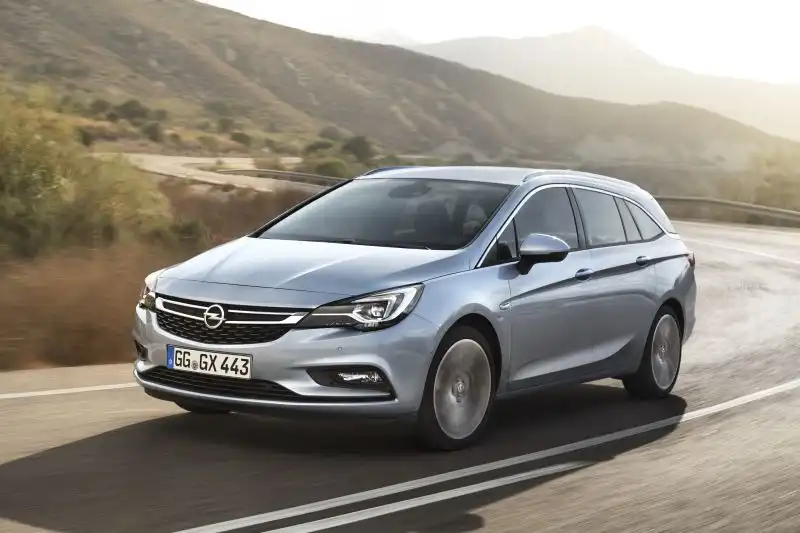
The Opel Astra K Sports Tourer 1.0 EcoTec (105 hp) was a station wagon variant produced between 2018 and July 2019. It represented an entry-level offering within the broader Astra K Sports Tourer range, which spanned various engine options and trim levels. Positioned as a fuel-efficient and practical choice, this model aimed to appeal to buyers prioritizing economy and versatility over outright performance. It was part of the K generation of the Astra, built on the GM’s 11th generation global compact vehicle platform.
Technical Specifications
| Brand | Opel |
| Model | Astra |
| Generation | Astra K Sports Tourer |
| Type (Engine) | 1.0 EcoTec (105 Hp) |
| Start of production | 2018 |
| End of production | July, 2019 |
| Powertrain Architecture | Internal Combustion engine |
| Body type | Station wagon (estate) |
| Seats | 5 |
| Doors | 5 |
| Fuel consumption (urban) | 5.5-5.9 l/100 km (42.8 – 39.9 US mpg) |
| Fuel consumption (extra urban) | 4.1-4.5 l/100 km (57.4 – 52.3 US mpg) |
| Fuel consumption (combined) | 4.6-5.0 l/100 km (51.1 – 47 US mpg) |
| CO2 emissions | 107-114 g/km |
| Fuel Type | Petrol (Gasoline) |
| Acceleration 0 – 100 km/h | 11.8 sec |
| Acceleration 0 – 62 mph | 11.8 sec |
| Acceleration 0 – 60 mph | 11.2 sec |
| Maximum speed | 195 km/h (121.17 mph) |
| Emission standard | Euro 6d-Temp |
| Weight-to-power ratio | 11.6 kg/Hp |
| Weight-to-torque ratio | 7.1 kg/Nm |
| Power | 105 Hp @ 4300-6000 rpm |
| Torque | 170 Nm @ 1800-4300 rpm (125.39 lb.-ft.) |
| Engine layout | Front, Transverse |
| Engine Model/Code | D10XFL |
| Engine displacement | 999 cm3 (60.96 cu. in.) |
| Number of cylinders | 3 |
| Engine configuration | Inline |
| Cylinder Bore | 74 mm (2.91 in.) |
| Piston Stroke | 77.4 mm (3.05 in.) |
| Compression ratio | 10.5:1 |
| Number of valves per cylinder | 4 |
| Fuel injection system | Direct injection |
| Engine aspiration | Turbocharger, Intercooler |
| Engine oil capacity | 4 l (4.23 US qt | 3.52 UK qt) |
| Kerb Weight | 1213 kg (2674.21 lbs.) |
| Max. weight | 1860 kg (4100.6 lbs.) |
| Max load | 647 kg (1426.39 lbs.) |
| Trunk (boot) space – minimum | 540 l (19.07 cu. ft.) |
| Trunk (boot) space – maximum | 1630 l (57.56 cu. ft.) |
| Fuel tank capacity | 48 l (12.68 US gal | 10.56 UK gal) |
| Max. roof load | 75 kg (165.35 lbs.) |
| Permitted trailer load with brakes (12%) | 1150 kg (2535.32 lbs.) |
| Permitted trailer load without brakes | 620 kg (1366.87 lbs.) |
| Length | 4702 mm (185.12 in.) |
| Width | 1809 mm (71.22 in.) |
| Width with mirrors folded | 1871 mm (73.66 in.) |
| Width including mirrors | 2042 mm (80.39 in.) |
| Height | 1510 mm (59.45 in.) |
| Wheelbase | 2662 mm (104.8 in.) |
| Front track | 1544 mm (60.79 in.) |
| Rear (Back) track | 1558 mm (61.34 in.) |
| Minimum turning circle | 11.05 m (36.25 ft.) |
| Drivetrain Architecture | Front wheel drive |
| Drive wheel | Front wheel drive |
| Number of gears and type of gearbox | 5 gears, manual transmission |
| Front brakes | Disc |
| Rear brakes | Disc |
| Assisting systems | ABS (Anti-lock braking system) |
| Steering type | Steering rack and pinion |
| Power steering | Electric Steering |
| Tires size | 205/55 R16 |
| Wheel rims size | 6.5J x 16; 7J x 16 |
INTRODUCTION
The Opel Astra K Sports Tourer 1.0 EcoTec (105 hp) was introduced in 2018 as part of the Astra K series, a generation known for its weight reduction and improved efficiency. The Sports Tourer body style, Opel’s designation for a station wagon, offered increased cargo capacity compared to the hatchback version. This particular variant, powered by a 1.0-liter turbocharged three-cylinder engine, was designed to provide a balance between affordability, fuel economy, and practicality for European drivers. It occupied the lower end of the Astra K Sports Tourer lineup, serving as an accessible entry point into the model range.
Powertrain & Engine Architecture
The heart of this Astra variant is the D10XFL engine, a 999cc turbocharged three-cylinder petrol engine. This engine is part of Opel’s ‘EcoTec’ family, emphasizing fuel efficiency and reduced emissions. It features direct fuel injection, a technology that improves combustion efficiency and power output. The engine utilizes a single-scroll turbocharger and intercooler to boost performance. The valvetrain employs four valves per cylinder, contributing to improved breathing and power delivery. The engine is transversely mounted at the front of the vehicle. The 105 hp version of this engine was paired with a five-speed manual transmission, sending power to the front wheels. The transmission was chosen for its simplicity and contribution to overall fuel economy.
Driving Characteristics
The 1.0 EcoTec engine, while not delivering blistering performance, provided adequate power for everyday driving. With 105 hp and 170 Nm of torque, acceleration from 0 to 62 mph took approximately 11.8 seconds. The engine’s torque curve was relatively flat, offering usable power across a wide rev range, making it suitable for both urban and highway driving. The five-speed manual transmission was geared to prioritize fuel efficiency, meaning higher gears were engaged at lower speeds. Compared to higher-output Astra K variants, such as those with 1.4-liter or 1.6-liter engines, this version felt less responsive, particularly during overtaking maneuvers. However, its lighter weight and efficient engine contributed to better fuel economy.
Equipment & Trim Levels
The 1.0 EcoTec (105 hp) Sports Tourer typically came with a standard equipment level focused on practicality and essential features. Standard features generally included air conditioning, power windows, a basic audio system with Bluetooth connectivity, and stability control. Interior upholstery was typically cloth. Optional extras included alloy wheels, a touchscreen infotainment system with navigation, parking sensors, and a rearview camera. Trim levels varied slightly depending on the market, but generally offered incremental upgrades in terms of interior comfort and technology.
Chassis & Braking
The Astra K Sports Tourer utilized a MacPherson strut front suspension and a torsion beam rear suspension. This setup provided a good balance between ride comfort and handling. The torsion beam rear suspension was a cost-effective solution that minimized weight and complexity. Braking duties were handled by disc brakes on all four wheels, providing adequate stopping power for the vehicle’s weight and performance. Anti-lock Braking System (ABS) was standard, enhancing safety during emergency braking situations. The steering system was an electric power-assisted rack and pinion system, offering light and precise steering feel.
Market Reception & Comparison
The Astra K Sports Tourer 1.0 EcoTec (105 hp) was generally well-received by critics as a sensible and economical choice. Reviewers praised its fuel efficiency and practicality, but noted its lack of outright performance. Compared to other Astra K variants, such as the 1.4 Turbo, this version offered a lower price point but sacrificed some driving excitement. Against competitors like the Ford Focus Estate and Volkswagen Golf Estate, the Astra K Sports Tourer 1.0 EcoTec offered a competitive fuel economy and a spacious interior. However, some competitors offered more refined interiors or more powerful engine options.
Legacy
The 1.0 EcoTec engine proved to be a relatively reliable unit, although, like any turbocharged engine, it required regular maintenance and quality oil changes. The Astra K Sports Tourer, in general, has maintained a reasonable reputation for reliability in the used car market. The 1.0-liter variant remains a popular choice for buyers seeking an affordable and fuel-efficient station wagon. Its simplicity and relatively low running costs make it an attractive option for those prioritizing practicality and economy over performance.

