
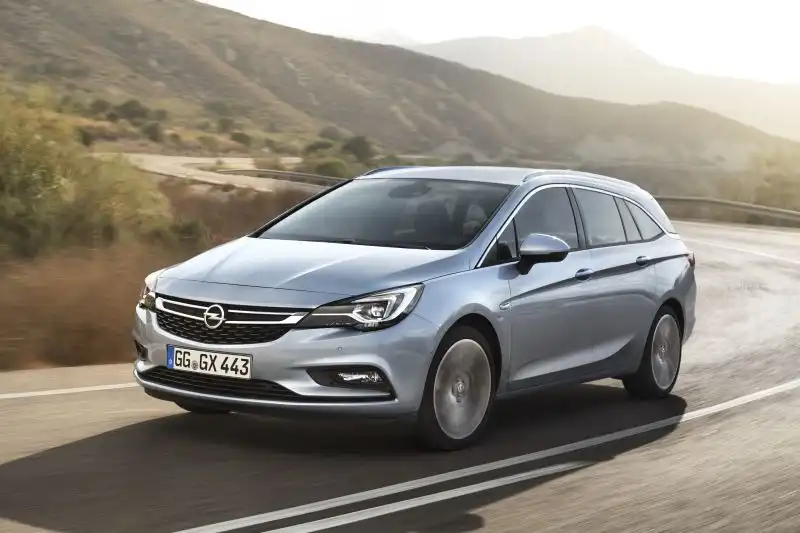
Technical Specifications
| Brand | Opel |
| Model | Astra |
| Generation | Astra K Sports Tourer |
| Type (Engine) | 1.6 BiTurbo (150 Hp) |
| Start of production | 2018 |
| End of production | July, 2019 |
| Powertrain Architecture | Internal Combustion engine |
| Body type | Station wagon (estate) |
| Seats | 5 |
| Doors | 5 |
| Fuel consumption (urban) | 6.3-6.6 l/100 km (37.3 – 35.6 US mpg, 44.8 – 42.8 UK mpg, 15.9 – 15.2 km/l) |
| Fuel consumption (extra urban) | 4.2-4.4 l/100 km (56 – 53.5 US mpg, 67.3 – 64.2 UK mpg, 23.8 – 22.7 km/l) |
| Fuel consumption (combined) | 5.0-5.2 l/100 km (47 – 45.2 US mpg, 56.5 – 54.3 UK mpg, 20 – 19.2 km/l) |
| CO2 emissions | 131-137 g/km |
| Fuel Type | Diesel |
| Acceleration 0 – 100 km/h | 9.2 sec |
| Acceleration 0 – 62 mph | 9.2 sec |
| Acceleration 0 – 60 mph | 8.7 sec |
| Maximum speed | 222 km/h (137.94 mph) |
| Emission standard | Euro 6d-Temp |
| Weight-to-power ratio | 9.1 kg/Hp, 109.8 Hp/tonne |
| Weight-to-torque ratio | 3.9 kg/Nm, 256.2 Nm/tonne |
| Power | 150 Hp @ 4000 rpm |
| Power per litre | 93.9 Hp/l |
| Torque | 350 Nm @ 1500-2250 rpm (258.15 lb.-ft. @ 1500-2250 rpm) |
| Engine layout | Front, Transverse |
| Engine Model/Code | D16DTR |
| Engine displacement | 1598 cm3 (97.52 cu. in.) |
| Number of cylinders | 4 |
| Engine configuration | Inline |
| Cylinder Bore | 79.7 mm (3.14 in.) |
| Piston Stroke | 80.1 mm (3.15 in.) |
| Compression ratio | 16:1 |
| Number of valves per cylinder | 4 |
| Fuel injection system | Diesel Commonrail |
| Engine aspiration | Turbocharger, Intercooler |
| Engine oil capacity | 5 l (5.28 US qt | 4.4 UK qt) |
| Coolant | 5.9 l (6.23 US qt | 5.19 UK qt) |
| Kerb Weight | 1366 kg (3011.51 lbs.) |
| Max. weight | 1985 kg (4376.18 lbs.) |
| Max load | 619 kg (1364.66 lbs.) |
| Trunk (boot) space – minimum | 540 l (19.07 cu. ft.) |
| Trunk (boot) space – maximum | 1630 l (57.56 cu. ft.) |
| Fuel tank capacity | 48 l (12.68 US gal | 10.56 UK gal) |
| Max. roof load | 75 kg (165.35 lbs.) |
| Permitted trailer load with brakes (12%) | 1700 kg (3747.86 lbs.) |
| Permitted trailer load without brakes | 700 kg (1543.24 lbs.) |
| Length | 4702 mm (185.12 in.) |
| Width | 1809 mm (71.22 in.) |
| Width with mirrors folded | 1871 mm (73.66 in.) |
| Width including mirrors | 2042 mm (80.39 in.) |
| Height | 1510 mm (59.45 in.) |
| Wheelbase | 2662 mm (104.8 in.) |
| Front track | 1544 mm (60.79 in.) |
| Rear (Back) track | 1558 mm (61.34 in.) |
| Minimum turning circle | 11.05 m (36.25 ft.) |
| Drivetrain Architecture | The Internal combustion engine (ICE) drives the front wheels of the vehicle. |
| Drive wheel | Front wheel drive |
| Number of gears and type of gearbox | 6 gears, manual transmission |
| Front brakes | Disc |
| Rear brakes | Disc |
| Assisting systems | ABS (Anti-lock braking system) |
| Steering type | Steering rack and pinion |
| Power steering | Electric Steering |
| Tires size | 205/55 R16; 225/40 R18 |
| Wheel rims size | 7J x 16; 7.5J x 18 |
The Opel Astra K Sports Tourer 1.6 BiTurbo, produced from 2018 to July 2019, represents a compelling blend of practicality and performance within the Astra K generation (2015-2021). Positioned as a mid-range offering in the Sports Tourer (estate/wagon) body style, this variant aimed to provide a more engaging driving experience than the lower-powered diesel options while remaining more economical than the flagship petrol engines. It occupied a space between the entry-level 1.0L turbo and the more potent, but pricier, 1.4L turbo models. The Astra K series, built on the GM Delta platform, was a significant model for Opel, representing a move towards lighter construction and improved efficiency.
Powertrain & Engine Architecture
The heart of the Astra K Sports Tourer 1.6 BiTurbo is the D16DTR engine, a 1.6-liter inline-four cylinder diesel. This engine utilizes a sequential twin-turbocharger setup, hence the “BiTurbo” designation. The smaller turbocharger spools up quickly at low RPMs to minimize turbo lag, while the larger turbocharger provides increased boost at higher engine speeds for sustained power. This configuration delivers a broad torque curve, peaking at 350 Nm (258 lb-ft) between 1500 and 2250 rpm. Fuel is delivered via a common rail direct injection system, operating at a high pressure of 1600 bar to ensure efficient combustion. The engine also features a diesel particulate filter (DPF) to meet stringent Euro 6d-Temp emission standards. The 6-speed manual transmission was standard, offering precise shifts and contributing to the car’s overall driving engagement.
Driving Characteristics
The 1.6 BiTurbo engine provides a noticeable step up in performance compared to the lower-powered Astra K diesel variants. The twin-turbo setup effectively mitigates turbo lag, resulting in strong acceleration from low speeds. The 0-60 mph sprint takes approximately 8.7 seconds, and the car feels responsive in everyday driving situations. While not a sports car, the 150 hp output and 350 Nm of torque provide ample power for overtaking and highway cruising. The manual transmission allows for greater driver control, and the gear ratios are well-matched to the engine’s powerband. Compared to the 1.0L petrol, the 1.6 BiTurbo offers significantly more torque, making it more effortless to drive when fully loaded or towing. However, it lacks the outright top-end punch of the 1.4L turbo petrol models.
Equipment & Trim Levels
The 1.6 BiTurbo Sports Tourer typically came equipped with a generous level of standard features. These included air conditioning, a touchscreen infotainment system with Bluetooth connectivity, alloy wheels, and a suite of safety features such as ABS, ESP (Electronic Stability Program), and multiple airbags. Higher trim levels, such as ‘Elite’ or ‘Ultimate’, added features like leather upholstery, heated seats, a panoramic sunroof, and advanced driver-assistance systems like adaptive cruise control and lane departure warning. Interior upholstery was generally cloth on the base trims, with leather options available on higher-spec models. The dashboard layout was modern and functional, with a focus on ergonomics.
Chassis & Braking
The Astra K Sports Tourer features a MacPherson strut front suspension and a multi-link rear suspension, providing a good balance between ride comfort and handling. The chassis was designed to be lightweight, contributing to the car’s agility. Braking duties are handled by disc brakes on all four wheels, providing ample stopping power. ABS (Anti-lock Braking System) is standard, enhancing safety in emergency braking situations. Stabilizer bars are fitted to both the front and rear axles to reduce body roll during cornering.
Market Reception & Comparison
The Astra K Sports Tourer 1.6 BiTurbo was generally well-received by automotive critics. It was praised for its strong performance, good fuel economy, and comfortable ride. Compared to the 1.0L petrol, the 1.6 BiTurbo offered a more refined driving experience and superior fuel efficiency, particularly on longer journeys. However, it was more expensive to purchase. Against the 1.4L turbo petrol, the 1.6 BiTurbo offered comparable performance but with lower running costs due to the diesel engine’s superior fuel economy. Reliability reports suggest that the D16DTR engine is generally robust, although the DPF can be prone to clogging if the vehicle is primarily used for short trips.
Legacy
The Opel Astra K Sports Tourer 1.6 BiTurbo remains a practical and capable estate car in the used car market. The D16DTR engine, while requiring careful maintenance of the DPF, is known for its longevity. These models offer a good balance of performance, economy, and practicality, making them a popular choice for families and those who require a versatile vehicle. The Astra K generation as a whole represented a significant step forward for Opel in terms of design, technology, and driving dynamics, and the 1.6 BiTurbo variant stands out as a particularly well-rounded offering.

