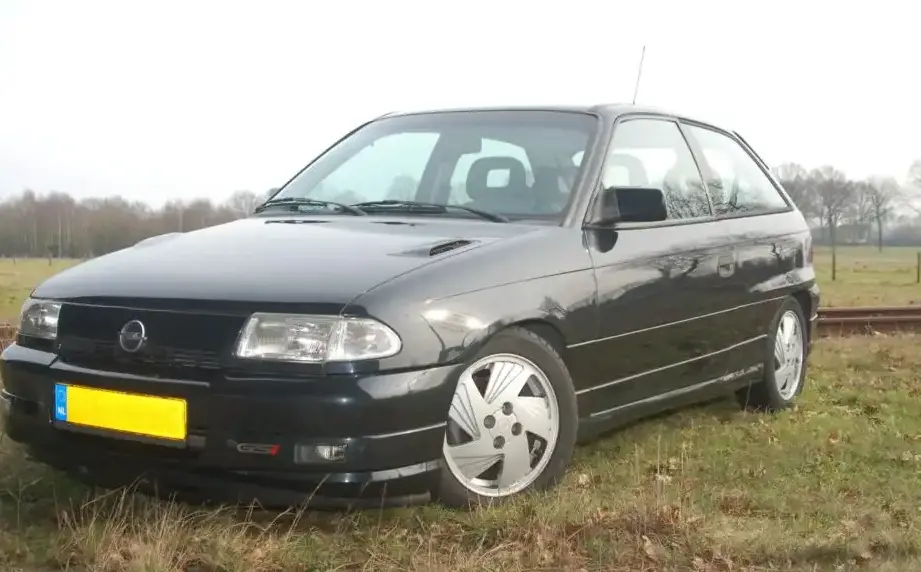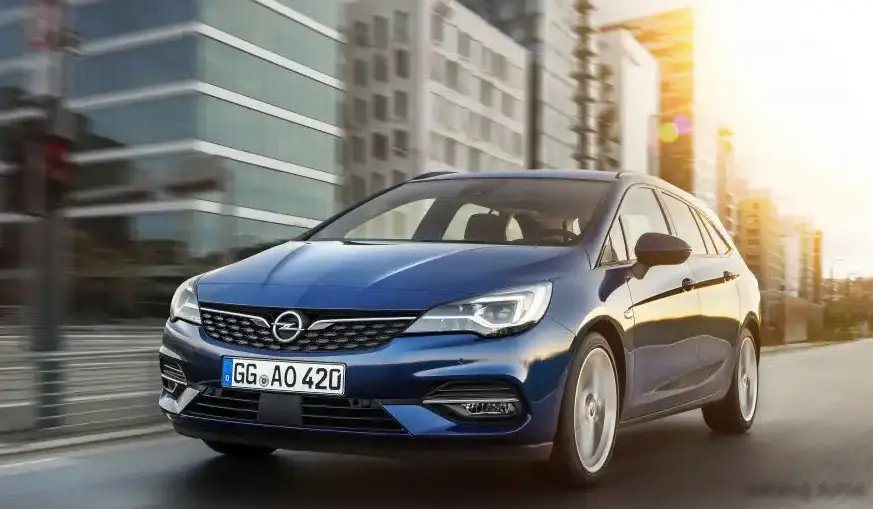
The Opel Astra K Sports Tourer (facelift, 2019) 1.2 Turbo, producing 130 horsepower, represents a key variant within the broader Astra K Sports Tourer range. Introduced in August 2019 and continuing through October 2021, this model aimed to provide a balance of fuel efficiency, practicality, and reasonable performance for the European market. Positioned as a mid-range offering, it slotted between the lower-powered 1.0-liter variants and the more potent 1.4-liter and diesel options. The facelift brought styling updates and revised technology, enhancing the Astra’s appeal in a competitive segment.
Technical Specifications
| Brand | Opel |
| Model | Astra |
| Generation | Astra K Sports Tourer (facelift 2019) |
| Type (Engine) | 1.2 Turbo (130 Hp) |
| Start of production | August, 2019 |
| End of production | October, 2021 |
| Powertrain Architecture | Internal Combustion engine |
| Body type | Station wagon (estate) |
| Seats | 5 |
| Doors | 5 |
| Fuel consumption (urban) | 5.4-5.5 l/100 km (43.6 – 42.8 US mpg) |
| Fuel consumption (extra urban) | 3.9-4.0 l/100 km (60.3 – 58.8 US mpg) |
| Fuel consumption (combined) | 4.5 l/100 km (52.3 US mpg) |
| CO2 emissions | 102-104 g/km |
| Fuel Type | Petrol (Gasoline) |
| Acceleration 0 – 100 km/h | 10.1 sec |
| Acceleration 0 – 62 mph | 10.1 sec |
| Acceleration 0 – 60 mph | 9.6 sec |
| Maximum speed | 215 km/h (133.59 mph) |
| Emission standard | Euro 6d |
| Weight-to-power ratio | 9.8 kg/Hp, 101.6 Hp/tonne |
| Weight-to-torque ratio | 5.7 kg/Nm, 175.8 Nm/tonne |
| Power | 130 Hp @ 5500 rpm |
| Power per litre | 108.4 Hp/l |
| Torque | 225 Nm @ 2000-3500 rpm (165.95 lb.-ft. @ 2000-3500 rpm) |
| Engine layout | Front, Transverse |
| Engine Model/Code | F12SHT |
| Engine displacement | 1199 cm3 (73.17 cu. in.) |
| Number of cylinders | 3 |
| Engine configuration | Inline |
| Cylinder Bore | 75 mm (2.95 in.) |
| Piston Stroke | 90.5 mm (3.56 in.) |
| Compression ratio | 10:1 |
| Number of valves per cylinder | 4 |
| Fuel injection system | Direct injection |
| Engine aspiration | Turbocharger, Intercooler |
| Engine oil capacity | 4 l (4.23 US qt | 3.52 UK qt) |
| Coolant | 5.4 l (5.71 US qt | 4.75 UK qt) |
| Kerb Weight | 1280 kg (2821.92 lbs.) |
| Max. weight | 1870 kg (4122.64 lbs.) |
| Max load | 590 kg (1300.73 lbs.) |
| Trunk (boot) space – minimum | 540 l (19.07 cu. ft.) |
| Trunk (boot) space – maximum | 1630 l (57.56 cu. ft.) |
| Fuel tank capacity | 48 l (12.68 US gal | 10.56 UK gal) |
| Max. roof load | 75 kg (165.35 lbs.) |
| Permitted trailer load with brakes (12%) | 1250 kg (2755.78 lbs.) |
| Permitted trailer load without brakes | 660 kg (1455.05 lbs.) |
| Length | 4702 mm (185.12 in.) |
| Width | 1809 mm (71.22 in.) |
| Width with mirrors folded | 1871 mm (73.66 in.) |
| Width including mirrors | 2042 mm (80.39 in.) |
| Height | 1510 mm (59.45 in.) |
| Wheelbase | 2662 mm (104.8 in.) |
| Front track | 1548 mm (60.94 in.) |
| Rear (Back) track | 1565 mm (61.61 in.) |
| Front overhang | 960 mm (37.8 in.) |
| Rear overhang | 1080 mm (42.52 in.) |
| Drag coefficient (Cd) | 0.26 |
| Minimum turning circle (turning diameter) | 11.05 m (36.25 ft.) |
| Drivetrain Architecture | The Internal combustion engine (ICE) drives the front wheels of the vehicle. |
| Drive wheel | Front wheel drive |
| Number of gears and type of gearbox | 6 gears, manual transmission |
| Front brakes | Disc |
| Rear brakes | Disc |
| Assisting systems | ABS (Anti-lock braking system) |
| Steering type | Steering rack and pinion |
| Power steering | Electric Steering |
| Tires size | 205/65 R16; 225/45 R17 |
| Wheel rims size | 6.5J x 16; 7J x 16; 7.5J x 17 |
Powertrain & Engine Architecture
The heart of this Astra variant is the F12SHT, a 1.2-liter turbocharged three-cylinder gasoline engine. This engine belongs to Opel’s Small Engine Family (SEF), designed for efficiency and modularity. It utilizes direct fuel injection, delivering fuel directly into the combustion chamber for improved combustion control and efficiency. The engine also features a turbocharger with an intercooler, boosting power output. The three-cylinder configuration, while inherently unbalanced, employs internal balancing shafts to minimize vibrations. The engine’s 130 horsepower peak is achieved at 5500 rpm, while its 225 Nm (165.95 lb-ft) of torque is available from 2000 to 3500 rpm. This broad torque band contributes to usable performance in everyday driving. The engine is paired with a 6-speed manual transmission, transmitting power to the front wheels.
Driving Characteristics
The 1.2 Turbo 130 hp Astra Sports Tourer offers a respectable driving experience. Acceleration from 0-100 km/h (0-62 mph) takes approximately 10.1 seconds, and 0-60 mph in 9.6 seconds. While not a performance-oriented model, the engine provides sufficient power for highway cruising and overtaking maneuvers. The turbocharger does introduce a slight delay in response, but once boosted, the engine delivers a linear power delivery. The manual transmission is well-matched to the engine, with gear ratios optimized for both fuel economy and responsiveness. Compared to the lower-powered 1.0-liter versions, the 1.2 Turbo offers a noticeable improvement in performance, particularly when fully loaded or tackling inclines. It doesn’t possess the outright punch of the larger 1.4-liter turbo or the diesel options, but it strikes a good balance between performance and efficiency.
Equipment & Trim Levels
The 1.2 Turbo 130 hp Sports Tourer typically came equipped with a reasonable level of standard features. These included air conditioning, a touchscreen infotainment system with Bluetooth connectivity, alloy wheels, and a suite of safety features such as ABS, ESP (Electronic Stability Program), and multiple airbags. Higher trim levels, such as ‘Sport’ or ‘Elite’, added features like automatic climate control, heated seats, parking sensors, and advanced driver-assistance systems like lane departure warning and adaptive cruise control. Interior upholstery was typically cloth, with options for leather upgrades on higher trims. The dashboard layout was modern and functional, with a focus on ergonomics.
Chassis & Braking
The Astra K Sports Tourer utilizes a MacPherson strut front suspension and a torsion beam rear suspension. This setup provides a good balance between ride comfort and handling. The torsion beam rear suspension is a cost-effective solution commonly found in vehicles of this class. Braking duties are handled by disc brakes on all four wheels, providing adequate stopping power. ABS (Anti-lock Braking System) is standard, enhancing safety during emergency braking situations. Steering is via a rack and pinion system with electric power assistance, offering a light and precise feel.
Market Reception & Comparison
The Opel Astra K Sports Tourer 1.2 Turbo 130 hp was generally well-received by automotive critics. It was praised for its fuel efficiency, comfortable ride, and spacious interior. However, some reviewers noted that the engine could feel strained when pushed hard, and the three-cylinder engine’s characteristic sound wasn’t to everyone’s taste. Compared to the 1.0-liter versions, the 1.2 Turbo offered a significant performance upgrade without a substantial penalty in fuel economy. Against the diesel models, it offered a lower purchase price but higher running costs due to the higher price of gasoline compared to diesel fuel in many European markets.
Legacy
The F12SHT engine has proven to be a relatively reliable unit, with few widespread issues reported. The Astra K Sports Tourer, in general, has a good reputation for build quality and durability. On the used car market, these models represent a good value proposition, offering a practical and efficient estate car at an affordable price. Regular maintenance, including oil changes and timing belt replacements (where applicable), is crucial for ensuring long-term reliability. The 1.2 Turbo engine’s fuel efficiency and reasonable performance continue to make it an attractive option for buyers seeking a versatile and economical family car.