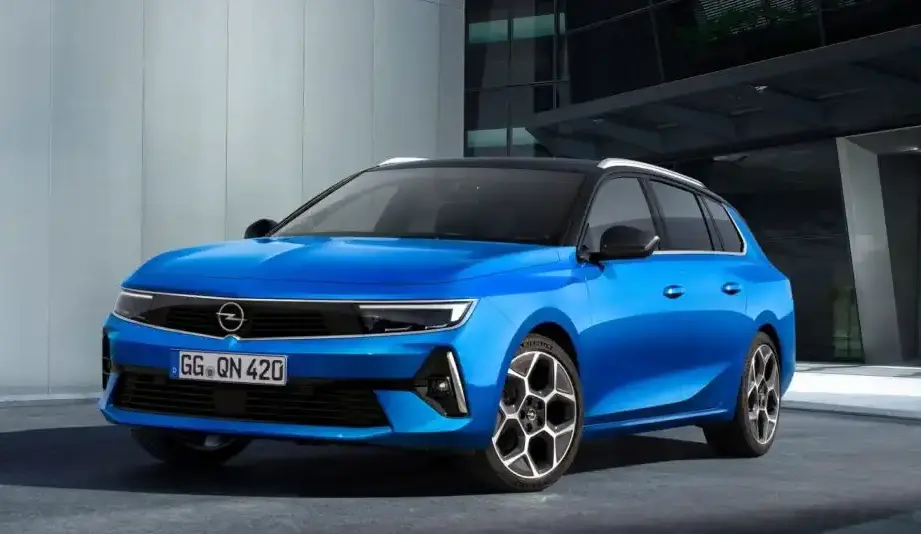
The Opel Astra L Sports Tourer 1.2 Turbo, producing 130 horsepower, is a front-wheel-drive, five-door station wagon that was introduced in February 2022 as part of the Astra L generation. Positioned as a mainstream offering within the Astra lineup, it aimed to provide a balance of fuel efficiency, practicality, and affordability for European buyers. Production is expected to continue through 2026. This variant represents a key component of Opel’s strategy to offer a diverse range of powertrain options within the Astra L series, catering to varying customer preferences and driving needs. It slots in as a mid-range option, offering more power than the base engine while remaining more accessible than the plug-in hybrid variants.
Technical Specifications
| Brand | Opel |
| Model | Astra |
| Generation | Astra L Sports Tourer |
| Type (Engine) | 1.2 Turbo (130 Hp) |
| Start of production | February, 2022 |
| End of production | 2026 |
| Powertrain Architecture | Internal Combustion engine |
| Body type | Station wagon (estate) |
| Seats | 5 |
| Doors | 5 |
| Fuel consumption at Low speed (WLTP) | 6.7-7 l/100 km (35.1 – 33.6 US mpg, 42.2 – 40.4 UK mpg, 14.9 – 14.3 km/l) |
| Fuel consumption at Medium speed (WLTP) | 5.6-5.8 l/100 km (42 – 40.6 US mpg, 50.4 – 48.7 UK mpg, 17.9 – 17.2 km/l) |
| Fuel consumption at high speed (WLTP) | 4.9-5.1 l/100 km (48 – 46.1 US mpg, 57.6 – 55.4 UK mpg, 20.4 – 19.6 km/l) |
| Fuel consumption at very high speed (WLTP) | 5.8-5.9 l/100 km (40.6 – 39.9 US mpg, 48.7 – 47.9 UK mpg, 17.2 – 16.9 km/l) |
| Combined fuel consumption (WLTP) | 5.6-5.8 l/100 km (42 – 40.6 US mpg, 50.4 – 48.7 UK mpg, 17.9 – 17.2 km/l) |
| CO2 emissions (WLTP) | 127-131 g/km |
| Fuel Type | Petrol (Gasoline) |
| Acceleration 0 – 100 km/h | 10 sec |
| Acceleration 0 – 62 mph | 10 sec |
| Acceleration 0 – 60 mph | 9.5 sec |
| Maximum speed | 210 km/h (130.49 mph) |
| Emission standard | Euro 6d |
| Weight-to-power ratio | 10.1 kg/Hp, 98.6 Hp/tonne |
| Weight-to-torque ratio | 5.7 kg/Nm, 174.4 Nm/tonne |
| Power | 130 Hp @ 5500 rpm |
| Power per litre | 108.4 Hp/l |
| Torque | 230 Nm @ 1750 rpm (169.64 lb.-ft. @ 1750 rpm) |
| Engine layout | Front, Transverse |
| Engine Model/Code | F12XHT |
| Engine displacement | 1199 cm3 (73.17 cu. in.) |
| Number of cylinders | 3 |
| Engine configuration | Inline |
| Number of valves per cylinder | 4 |
| Fuel injection system | Direct injection |
| Engine aspiration | Turbocharger, Intercooler |
| Engine oil capacity | 3.5 l (3.7 US qt | 3.08 UK qt) |
| Kerb Weight | 1319 kg (2907.9 lbs.) |
| Max. weight | 1880 kg (4144.69 lbs.) |
| Max load | 561 kg (1236.79 lbs.) |
| Trunk (boot) space – minimum | 597 l (21.08 cu. ft.) |
| Trunk (boot) space – maximum | 1634 l (57.7 cu. ft.) |
| Fuel tank capacity | 52 l (13.74 US gal | 11.44 UK gal) |
| Max. roof load | 80 kg (176.37 lbs.) |
| Permitted trailer load with brakes (12%) | 1200 kg (2645.55 lbs.) |
| Permitted trailer load without brakes | 690 kg (1521.19 lbs.) |
| Permitted towbar download | 75 kg (165.35 lbs.) |
| Length | 4642 mm (182.76 in.) |
| Width with mirrors folded | 1860 mm (73.23 in.) |
| Width including mirrors | 2062 mm (81.18 in.) |
| Height | 1443-1480 mm (56.81 – 58.27 in.) |
| Wheelbase | 2732 mm (107.56 in.) |
| Front track | 1551-1559 mm (61.06 – 61.38 in.) |
| Rear (Back) track | 1546-1554 mm (60.87 – 61.18 in.) |
| Front overhang | 906 mm (35.67 in.) |
| Rear overhang | 1004 mm (39.53 in.) |
| Minimum turning circle (turning diameter) | 10.7 m (35.1 ft.) |
| Drivetrain Architecture | The Internal combustion engine (ICE) drives the front wheels of the vehicle. |
| Drive wheel | Front wheel drive |
| Number of gears and type of gearbox | 6 gears, manual transmission |
| Front brakes | Ventilated discs |
| Rear brakes | Disc |
| Assisting systems | ABS (Anti-lock braking system) |
| Steering type | Steering rack and pinion |
| Power steering | Electric Steering |
| Tires size | 205/55 R16; 225/45 R17 |
| Wheel rims size | 7J x 16; 7.5J x 17 |
Powertrain & Engine Architecture
The Astra L Sports Tourer 1.2 Turbo utilizes the F12XHT engine, a 1.2-liter turbocharged three-cylinder gasoline engine. This engine is part of Opel’s (and now Stellantis’) Small Engine Family, designed for efficiency and reduced emissions. The engine employs direct fuel injection, delivering fuel directly into the combustion chamber for improved combustion control and power output. It also features a turbocharger with an intercooler, which forces more air into the engine, boosting power and torque. The engine’s valvetrain incorporates four valves per cylinder, optimizing gas flow for enhanced performance. The engine is transversely mounted at the front of the vehicle, driving the front wheels. The 6-speed manual transmission is designed to balance fuel economy and responsiveness.
Driving Characteristics
The 130 hp 1.2 Turbo engine in the Astra Sports Tourer provides adequate performance for everyday driving. Acceleration from 0-60 mph takes approximately 9.5 seconds, and top speed is rated at 130 mph. While not a particularly sporty setup, the turbocharger provides a noticeable boost in power during acceleration, making overtaking maneuvers manageable. The manual transmission offers precise shifts, and the gear ratios are well-suited for both city and highway driving. Compared to higher-output Astra variants, such as those with larger engines or plug-in hybrid systems, this version prioritizes fuel efficiency over outright performance. The lighter engine weight contributes to nimble handling, but the overall driving experience is more focused on comfort and practicality than dynamic driving enjoyment.
Equipment & Trim Levels
The 1.2 Turbo variant of the Astra L Sports Tourer typically comes with a respectable level of standard equipment. This includes features like air conditioning, a touchscreen infotainment system with smartphone integration (Apple CarPlay and Android Auto), LED headlights, and a suite of safety features such as automatic emergency braking and lane departure warning. Interior upholstery is typically cloth, with options for upgraded materials available. Higher trim levels add features like a larger touchscreen, navigation system, adaptive cruise control, and heated seats. Optional extras often include a panoramic sunroof, premium audio system, and parking assist features.
Chassis & Braking
The Astra L Sports Tourer utilizes a MacPherson strut front suspension and a torsion beam rear suspension. This setup provides a good balance of ride comfort and handling. The front brakes are ventilated discs, while the rear brakes are solid discs, providing adequate stopping power for the vehicle’s weight and performance. The electric power steering system offers light and precise steering feel. Stabilizer bars are fitted to both the front and rear axles to reduce body roll during cornering. The chassis is designed to minimize weight while maximizing rigidity, contributing to improved handling and safety.
Market Reception & Comparison
The Opel Astra L Sports Tourer 1.2 Turbo has been generally well-received by automotive critics. It’s praised for its fuel efficiency, practicality, and comfortable ride. However, some reviewers have noted that the engine can feel strained when fully loaded or driving uphill. Compared to other Astra variants, the 1.2 Turbo offers a more affordable entry point into the Astra L range. It competes with other compact station wagons in the European market, such as the Volkswagen Golf Variant and the Skoda Octavia Combi. In terms of fuel economy, the 1.2 Turbo performs competitively, offering similar figures to its rivals. Reliability has been generally good, with few reported issues with the engine or transmission.
Legacy
The 1.2 Turbo engine has become a mainstay in the Stellantis lineup, powering a wide range of vehicles across multiple brands. Its combination of efficiency, affordability, and reliability has made it a popular choice among consumers. The Astra L Sports Tourer 1.2 Turbo is likely to remain a common sight on European roads for years to come. As a used car, this variant offers a compelling value proposition, providing a practical and fuel-efficient station wagon at a reasonable price. The engine’s relatively simple design and widespread use should ensure that parts and service are readily available for the foreseeable future.