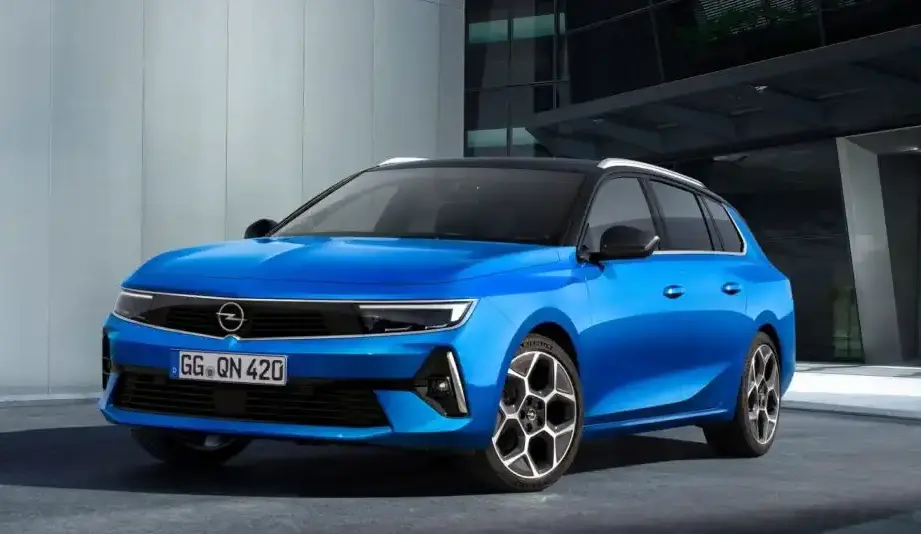
The Opel Astra L Sports Tourer 1.2 Turbo (136 hp) Mild Hybrid e-DCT is a station wagon introduced in March 2024 as part of the Astra L generation, internally designated as the 1HX0 series. Positioned as a mid-range offering within the Sports Tourer lineup, it combines a turbocharged three-cylinder gasoline engine with a 48-volt mild hybrid system and a dual-clutch transmission (e-DCT) to balance performance and fuel efficiency. Production continued through March 2025, catering to European markets seeking a practical and technologically advanced family vehicle.
Technical Specifications
| Brand | Opel |
| Model | Astra |
| Generation | Astra L Sports Tourer |
| Type (Engine) | 1.2 Turbo (136 Hp) Mild Hybrid e-DCT |
| Start of production | March, 2024 |
| End of production | March, 2025 |
| Powertrain Architecture | MHEV (Mild Hybrid Electric Vehicle) |
| Body type | Station wagon (estate) |
| Seats | 5 |
| Doors | 5 |
| Fuel consumption at Low speed (WLTP) | 4.9 l/100 km (48 US mpg, 57.6 UK mpg) |
| Fuel consumption at Medium speed (WLTP) | 5.1 l/100 km (46.1 US mpg, 55.4 UK mpg) |
| Fuel consumption at high speed (WLTP) | 4.5 l/100 km (52.3 US mpg, 62.8 UK mpg) |
| Fuel consumption at very high speed (WLTP) | 5.8 l/100 km (40.6 US mpg, 48.7 UK mpg) |
| Combined fuel consumption (WLTP) | 5.1 l/100 km (46.1 US mpg, 55.4 UK mpg) |
| CO2 emissions (WLTP) | 115 g/km |
| Fuel Type | Petrol (Gasoline) |
| Acceleration 0 – 100 km/h | 9.3 sec |
| Acceleration 0 – 62 mph | 9.3 sec |
| Acceleration 0 – 60 mph | 8.8 sec |
| Maximum speed | 210 km/h (130.49 mph) |
| Emission standard | Euro 6e |
| Weight-to-power ratio | 10.5 kg/Hp |
| Weight-to-torque ratio | 6.2 kg/Nm |
| Gross battery capacity | 0.89 kWh |
| Net (usable) battery capacity | 0.432 kWh |
| Battery voltage | 48 V |
| Battery technology | Lithium-ion (Li-Ion) |
| Battery location | Under the front seats |
| All-electric range | 1 km (0.62 mi) |
| Electric motor power | 28 Hp |
| Electric motor Torque | 55 Nm (40.57 lb.-ft.) |
| Electric motor location | Integrated into the transmission |
| Electric motor type | Synchronous |
| Power | 136 Hp @ 5500 rpm |
| Torque | 230 Nm @ 1750 rpm (169.64 lb.-ft. @ 1750 rpm) |
| Engine layout | Front, Transverse |
| Engine Model/Code | EB2LTDH2 |
| Engine displacement | 1199 cm3 (73.17 cu. in.) |
| Number of cylinders | 3 |
| Engine configuration | Inline |
| Cylinder Bore | 75 mm (2.95 in.) |
| Piston Stroke | 90.5 mm (3.56 in.) |
| Number of valves per cylinder | 4 |
| Fuel injection system | Direct injection |
| Engine aspiration | Turbocharger, Intercooler |
| Valvetrain | DOHC, VVT |
| Engine oil capacity | 3.5 l (3.7 US qt | 3.08 UK qt) |
| Kerb Weight | 1427 kg (3146 lbs.) |
| Max. weight | 1990 kg (4387.2 lbs.) |
| Max load | 563 kg (1241.2 lbs.) |
| Trunk (boot) space – minimum | 597 l (21.08 cu. ft.) |
| Trunk (boot) space – maximum | 1634 l (57.7 cu. ft.) |
| Fuel tank capacity | 52 l (13.74 US gal | 11.44 UK gal) |
| Max. roof load | 85 kg (187.39 lbs.) |
| Permitted trailer load with brakes (12%) | 1100 kg (2425.08 lbs.) |
| Permitted trailer load without brakes | 600 kg (1322.77 lbs.) |
| Permitted towbar download | 80 kg (176.37 lbs.) |
| Length | 4642 mm (182.76 in.) |
| Width with mirrors folded | 1860 mm (73.23 in.) |
| Width including mirrors | 2062 mm (81.18 in.) |
| Height | 1443-1480 mm (56.81 – 58.27 in.) |
| Wheelbase | 2732 mm (107.56 in.) |
| Front track | 1551-1559 mm (61.06 – 61.38 in.) |
| Rear (Back) track | 1546-1554 mm (60.87 – 61.18 in.) |
| Front overhang | 906 mm (35.67 in.) |
| Rear overhang | 1004 mm (39.53 in.) |
| Minimum turning circle | 10.7 m (35.1 ft.) |
| Drive wheel | Front wheel drive |
| Number of gears and type of gearbox | 6 gears, automatic transmission e-DCT |
| Front suspension | Independent, type McPherson with coil spring and anti-roll bar |
| Rear suspension | Coil spring, Torsion |
| Front brakes | Ventilated discs |
| Rear brakes | Disc |
| Tires size | 225/45 R17; 225/40 R18 |
| Wheel rims size | 7.5J x 17; 7.5J x 18; 8J x 18 |
INTRODUCTION
The Opel Astra L Sports Tourer 1.2 Turbo (136 hp) Mild Hybrid e-DCT represents Opel’s commitment to offering fuel-efficient and practical vehicles in the competitive European market. Introduced in 2024, this variant builds upon the foundation of the Astra L platform (1HX0), a generation known for its modern design, advanced technology, and improved driving dynamics. The Sports Tourer body style, or station wagon, provides increased cargo capacity compared to the hatchback version, making it a popular choice for families and those requiring versatile transportation. This specific powertrain combination aimed to deliver a balance between acceptable performance and reduced emissions, appealing to buyers prioritizing economy and environmental consciousness.
Powertrain & Engine Architecture
At the heart of the Astra L Sports Tourer 1.2 Turbo is the EB2LTDH2 engine, a 1.2-liter turbocharged three-cylinder gasoline engine. This engine is part of the PSA/Stellantis PureTech family, known for its compact size, lightweight construction, and efficiency. It utilizes direct fuel injection and a single-scroll turbocharger with an intercooler to maximize power output and torque. The engine produces 136 horsepower at 5500 rpm and 230 Nm (169.64 lb-ft) of torque at 1750 rpm. The mild hybrid system, a 48-volt setup, incorporates a small electric motor and battery pack located under the front seats. This system provides a power assist during acceleration, allowing for regenerative braking to recapture energy and improve fuel economy. The electric motor contributes an additional 28 hp. Power is transmitted to the front wheels via a six-speed e-DCT (efficient Dual-Clutch Transmission), offering quick and smooth gear changes. The e-DCT integrates the electric motor, enabling seamless transitions between gasoline and electric power.
Driving Characteristics
The 1.2 Turbo (136 hp) with the e-DCT delivers a comfortable and refined driving experience. While not overtly sporty, the powertrain provides adequate acceleration for everyday driving situations. The 0-100 km/h (0-62 mph) sprint takes approximately 9.3 seconds. The e-DCT contributes to smooth gear changes, and the mild hybrid system provides a noticeable boost during initial acceleration. The gear ratios are tuned for fuel efficiency, meaning the engine may need to be revved slightly higher during overtaking maneuvers. Compared to higher-output Astra variants, such as those with more powerful gasoline engines, this version prioritizes fuel economy over outright performance. The mild hybrid system helps to mitigate turbo lag, providing a more responsive feel at lower engine speeds. The steering is light and precise, making it easy to maneuver in urban environments.
Equipment & Trim Levels
The Astra L Sports Tourer 1.2 Turbo (136 hp) Mild Hybrid e-DCT typically came equipped with a generous array of standard features. These included a touchscreen infotainment system with Apple CarPlay and Android Auto compatibility, a digital instrument cluster, automatic climate control, and a suite of safety features such as lane departure warning, automatic emergency braking, and traffic sign recognition. Interior upholstery was typically cloth, with options for leather or premium fabric upgrades. Optional extras included a panoramic sunroof, adaptive cruise control, heated seats, and a premium sound system. Trim levels varied depending on the market, but generally offered progressive enhancements in terms of comfort, convenience, and styling.
Chassis & Braking
The Astra L Sports Tourer utilizes a McPherson strut front suspension and a torsion beam rear suspension. This setup provides a good balance between ride comfort and handling. The chassis is relatively lightweight, contributing to the car’s agility. Braking duties are handled by ventilated discs at the front and solid discs at the rear. ABS (Anti-lock Braking System) and electronic stability control are standard features. The steering system is an electric power steering setup, providing a light and responsive feel. Wheel sizes typically ranged from 17 to 18 inches, depending on the trim level.
Market Reception & Comparison
The Astra L Sports Tourer 1.2 Turbo (136 hp) Mild Hybrid e-DCT was generally well-received by automotive critics. It was praised for its fuel efficiency, comfortable ride, and spacious interior. However, some reviewers noted that the engine could feel strained when fully loaded or during demanding driving situations. Compared to other Astra variants, such as the 1.6 Diesel, this version offered lower running costs but slightly less torque. Against competitors like the Volkswagen Golf Estate and Skoda Octavia Combi, the Astra offered a compelling combination of value, technology, and practicality. Fuel economy figures of around 5.1 l/100 km (46.1 US mpg) were competitive within its segment.
Legacy
The Opel Astra L Sports Tourer 1.2 Turbo (136 hp) Mild Hybrid e-DCT represents a significant step towards electrification for the Astra model line. The powertrain, while not groundbreaking, proved to be reliable and efficient in real-world conditions. On the used car market, these models are becoming increasingly popular due to their low running costs and modern features. The mild hybrid system, while relatively simple, provides a tangible benefit in terms of fuel economy and emissions reduction. The e-DCT transmission is generally considered durable, but regular maintenance is crucial to ensure its longevity. Overall, this variant is likely to hold its value well and remain a practical and appealing choice for buyers seeking a fuel-efficient and versatile station wagon.