Technical Specifications
| Brand | Opel |
| Model | Calibra |
| Generation | Calibra (facelift 1994) |
| Type (Engine) | 2.0 8V (115 Hp) Automatic |
| Start of production | 1994 |
| End of production | 1996 |
| Powertrain Architecture | Internal Combustion engine |
| Body type | Coupe |
| Seats | 4 |
| Doors | 3 |
| Fuel consumption (urban) | 11.2 l/100 km (21 US mpg, 25.2 UK mpg, 8.9 km/l) |
| Fuel consumption (extra urban) | 5.8 l/100 km (40.6 US mpg, 48.7 UK mpg, 17.2 km/l) |
| Fuel consumption (combined) | 8.1 l/100 km (29 US mpg, 34.9 UK mpg, 12.3 km/l) |
| Fuel Type | Petrol (Gasoline) |
| Acceleration 0 – 100 km/h | 12 sec |
| Acceleration 0 – 62 mph | 12 sec |
| Acceleration 0 – 60 mph | 11.4 sec |
| Maximum speed | 200 km/h (124.27 mph) |
| Weight-to-power ratio | 10.8 kg/Hp, 92.4 Hp/tonne |
| Weight-to-torque ratio | 7.3 kg/Nm, 136.5 Nm/tonne |
| Power | 115 Hp @ 5200 rpm |
| Power per litre | 57.6 Hp/l |
| Torque | 170 Nm @ 2600 rpm (125.39 lb.-ft. @ 2600 rpm) |
| Engine layout | Front, Transverse |
| Engine Model/Code | C20NE |
| Engine displacement | 1998 cm3 (121.93 cu. in.) |
| Number of cylinders | 4 |
| Engine configuration | Inline |
| Cylinder Bore | 86 mm (3.39 in.) |
| Piston Stroke | 86 mm (3.39 in.) |
| Compression ratio | 9.2:1 |
| Number of valves per cylinder | 2 |
| Fuel injection system | Multi-port manifold injection |
| Engine aspiration | Naturally aspirated engine |
| Valvetrain | SOHC |
| Engine oil capacity | 4 l (4.23 US qt | 3.52 UK qt) |
| Coolant capacity | 7.4 l (7.82 US qt | 6.51 UK qt) |
| Kerb Weight | 1245 kg (2744.76 lbs.) |
| Max. weight | 1665 kg (3670.7 lbs.) |
| Max load | 420 kg (925.94 lbs.) |
| Trunk (boot) space – minimum | 300 l (10.59 cu. ft.) |
| Trunk (boot) space – maximum | 980 l (34.61 cu. ft.) |
| Fuel tank capacity | 63 l (16.64 US gal | 13.86 UK gal) |
| Length | 4492 mm (176.85 in.) |
| Width | 1688 mm (66.46 in.) |
| Height | 1320 mm (51.97 in.) |
| Wheelbase | 2600 mm (102.36 in.) |
| Front track | 1426 mm (56.14 in.) |
| Rear track | 1446 mm (56.93 in.) |
| Drag coefficient (Cd) | 0.26 |
| Minimum turning circle | 11.45 m (37.57 ft.) |
| Drivetrain Architecture | Front wheel drive |
| Number of gears | 4 |
| Gearbox type | Automatic transmission |
| Front suspension | Independent type McPherson, Transverse stabilizer |
| Rear suspension | Trailing arm, Transverse stabilizer |
| Front brakes | Ventilated discs |
| Rear brakes | Disc |
| Assisting systems | ABS (Anti-lock braking system) |
| Steering type | Steering rack and pinion |
| Power steering | Hydraulic Steering |
| Tires size | 195/60 R14 |
| Wheel rims size | 5.5J x 14 |
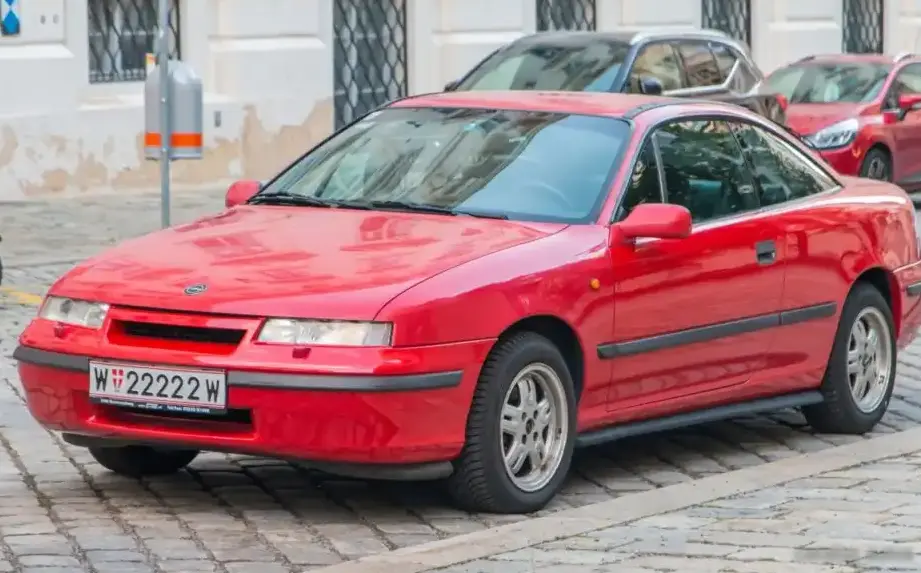
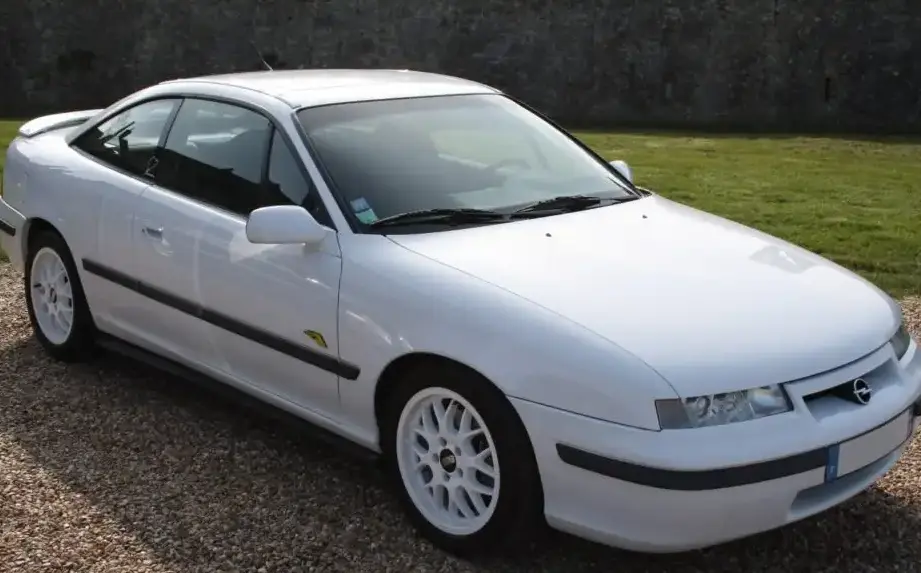
The Opel Calibra, launched in 1989, was a groundbreaking coupe designed to appeal to a younger, more style-conscious audience. The 1994 facelift brought subtle but important changes to the exterior and interior, enhancing its modern appeal. The 2.0 8V automatic variant, produced between 1994 and 1996, was a key part of the Calibra range. It utilized Opel’s C20NE engine, a reliable and relatively fuel-efficient unit, paired with a four-speed automatic transmission. This combination aimed to provide comfortable cruising and acceptable performance for everyday use. The Calibra was built on the GM 4100 platform, also known as the 1HX0/A3 platform, shared with the Opel Vectra and Opel Astra.
Powertrain & Engine Architecture
The heart of the Calibra 2.0 8V Automatic is the C20NE engine, an inline four-cylinder, naturally aspirated unit displacing 1998cc. This engine features a single overhead camshaft (SOHC) valvetrain operating two valves per cylinder. Fuel delivery is managed by a multi-port fuel injection system, providing precise fuel metering for improved efficiency and reduced emissions. The engine produces 115 horsepower at 5200 rpm and 170 Nm (125.39 lb-ft) of torque at 2600 rpm. The four-speed automatic transmission, a common GM unit of the era, was chosen for its ease of use and suitability for drivers prioritizing comfort over outright performance. While not known for its rapid shifts, it provided smooth and predictable gear changes. The transmission’s gear ratios were optimized for fuel economy and relaxed cruising, rather than aggressive acceleration.
Driving Characteristics
The Calibra 2.0 8V Automatic offered a comfortable and refined driving experience. Acceleration from 0 to 100 km/h (0-62 mph) took around 12 seconds, which was respectable for the time but noticeably slower than the manual transmission or 16V versions. The automatic transmission, while smooth, did sap some power from the engine, resulting in a less responsive feel. The gear ratios were spaced to prioritize fuel efficiency, meaning the engine often felt strained during quick overtaking maneuvers. However, for everyday driving and long-distance cruising, the combination proved perfectly adequate. The Calibra’s well-tuned suspension provided a good balance between ride comfort and handling, making it a pleasant car to drive on both smooth highways and winding roads.
Equipment & Trim Levels
The 2.0 8V Automatic Calibra typically came with a reasonable level of standard equipment. This included power steering, central locking, electric front windows, and an adjustable steering column. Interior upholstery was usually cloth, with a relatively simple dashboard layout. Optional extras included air conditioning, a sunroof, upgraded audio systems, and alloy wheels. The trim level could vary depending on the market, but generally, this variant was positioned as a mid-range offering, bridging the gap between the base models and the more luxurious or performance-oriented trims.
Chassis & Braking
The Calibra’s chassis featured independent McPherson strut suspension at the front and a trailing arm setup at the rear. A transverse stabilizer bar was fitted to both axles to reduce body roll during cornering. The braking system consisted of ventilated discs at the front and solid discs at the rear. Anti-lock braking system (ABS) was standard, enhancing safety and control, particularly in wet or slippery conditions. The Calibra’s suspension was tuned to provide a comfortable ride without sacrificing too much handling capability. The steering was hydraulic power-assisted, making it light and easy to maneuver at low speeds.
Market Reception & Comparison
The Calibra 2.0 8V Automatic received mixed reviews from automotive critics. While praised for its stylish design and comfortable ride, it was often criticized for its relatively slow acceleration and the lack of engagement offered by the automatic transmission. Compared to the 2.0 16V Calibra, the 8V version felt significantly less powerful and responsive. The 1.9 TDI diesel variant offered better fuel economy but lacked the refinement of the petrol engine. However, the 2.0 8V Automatic appealed to buyers who prioritized comfort, ease of driving, and a more affordable price point. Its fuel economy, averaging around 8.1 l/100 km (29 US mpg), was considered reasonable for a coupe of its size and performance.
Legacy
The Opel Calibra 2.0 8V Automatic, while not the most sought-after variant, has developed a loyal following among classic car enthusiasts. The C20NE engine is known for its reliability and relatively simple maintenance requirements. However, like all older vehicles, it is susceptible to age-related issues such as oil leaks and corrosion. Today, well-maintained examples of the Calibra 2.0 8V Automatic are becoming increasingly collectible, representing a nostalgic reminder of the 1990s coupe era. The car’s enduring appeal lies in its distinctive styling, comfortable driving experience, and relative affordability, making it an accessible entry point into the world of classic Opel ownership.