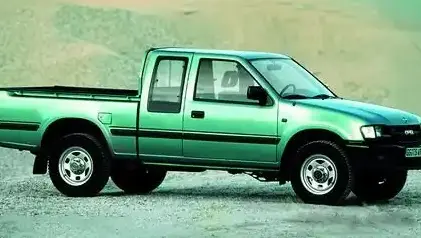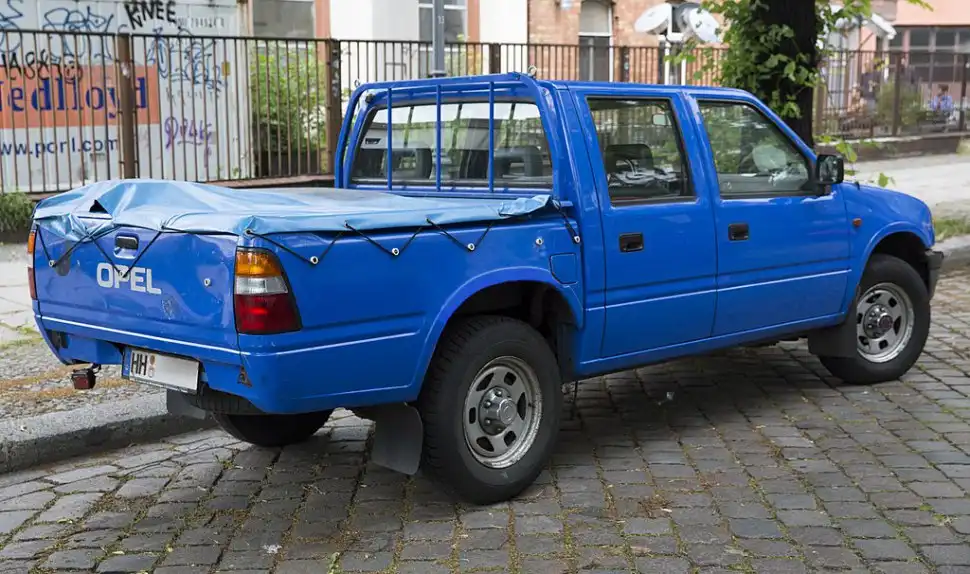
The Opel Campo Double Cab 2.5 DTI, produced from 1991 to December 2001, represented Opel’s entry into the increasingly popular compact pickup truck market, particularly in Europe and Latin America. This variant, equipped with the 2.5-liter turbocharged diesel engine producing 100 horsepower, was positioned as a workhorse offering practicality and affordability. It was a key model within the Campo range, providing a double-cab configuration that expanded its utility beyond basic hauling to include passenger transport. The Campo Double Cab aimed to bridge the gap between commercial vehicles and family transport, offering a versatile solution for both work and leisure.
Technical Specifications
| Brand | Opel |
| Model | Campo |
| Generation | Campo Double Cab |
| Type (Engine) | 2.5 DTI (100 Hp) |
| Start of production | 1991 |
| End of production | December, 2001 |
| Powertrain Architecture | Internal Combustion engine |
| Body type | Pick-up |
| Seats | 5 |
| Doors | 4 |
| Fuel consumption (combined) | 8.1 l/100 km (29 US mpg, 34.9 UK mpg, 12.3 km/l) |
| Fuel Type | Diesel |
| Acceleration 0 – 100 km/h | 18.3 sec |
| Acceleration 0 – 62 mph | 18.3 sec |
| Acceleration 0 – 60 mph | 17.4 sec |
| Maximum speed | 140 km/h (86.99 mph) |
| Power | 100 Hp @ 3800 rpm |
| Power per litre | 40 Hp/l |
| Torque | 226 Nm @ 2000 rpm (166.69 lb.-ft. @ 2000 rpm) |
| Engine Model/Code | 4JA1, 4JA1TC |
| Engine displacement | 2499 cm3 (152.5 cu. in.) |
| Number of cylinders | 4 |
| Engine configuration | Inline |
| Cylinder Bore | 93 mm (3.66 in.) |
| Piston Stroke | 92 mm (3.62 in.) |
| Engine aspiration | Turbocharger |
| Engine oil capacity | 4.3 l (4.54 US qt | 3.78 UK qt) |
| Coolant | 7 l (7.4 US qt | 6.16 UK qt) |
| Length | 4980 mm (196.06 in.) |
| Width | 1690 mm (66.54 in.) |
| Height | 1710 mm (67.32 in.) |
| Wheelbase | 3025 mm (119.09 in.) |
| Drivetrain Architecture | Rear wheel drive |
| Number of gears and type of gearbox | 5 gears, manual transmission |
| Front suspension | Independent coil spring |
| Front brakes | Ventilated discs |
Powertrain & Engine Architecture
The heart of the Campo Double Cab 2.5 DTI was the Isuzu-sourced 4JA1 (and later 4JA1TC) 2.5-liter inline-four diesel engine. This engine, known for its robustness and relatively simple design, featured indirect injection and a turbocharger to boost power output to 100 horsepower. The turbocharger, a key addition, significantly improved torque delivery, making the vehicle more capable of handling loads. The engine utilized a mechanical fuel injection pump, a common feature for diesel engines of this era, and a single overhead camshaft (SOHC) valvetrain. The 4JA1 engine was known for its durability, but also for its relatively noisy operation and modest refinement compared to gasoline engines. The five-speed manual transmission was the standard offering, providing a reasonable spread of gears for both on-road and off-road driving. The transmission was chosen for its durability and cost-effectiveness, aligning with the Campo’s overall utilitarian character.
Driving Characteristics
The Campo Double Cab 2.5 DTI, with its 100 horsepower and 226 Nm (166.69 lb-ft) of torque, offered adequate, but not exhilarating, performance. Acceleration was slow, taking approximately 18.3 seconds to reach 100 km/h (62 mph). However, the engine’s torque characteristics made it well-suited for hauling and towing. The gear ratios in the five-speed manual transmission were spaced to maximize fuel efficiency and provide sufficient pulling power. Compared to potential gasoline engine options (which were not widely available on this model), the diesel offered significantly better fuel economy, but at the expense of refinement and responsiveness. The driving experience was characterized by a firm ride, typical of a body-on-frame pickup truck, and noticeable engine noise. The rear-wheel-drive configuration provided good traction under normal conditions, but could become challenging on slippery surfaces.
Equipment & Trim Levels
The Campo Double Cab 2.5 DTI was generally offered with a fairly basic level of equipment, reflecting its work-oriented nature. Standard features typically included vinyl or cloth upholstery, a simple dashboard layout, and manual windows and door locks. Air conditioning was often an optional extra, as were power steering and central locking. The double-cab configuration provided seating for five passengers, although rear seat space was somewhat limited. The interior was designed for practicality and durability, with hard-wearing materials used throughout. Trim levels were relatively limited, with most variations focusing on optional extras rather than significant changes to the core specification.
Chassis & Braking
The Campo Double Cab utilized a traditional body-on-frame construction, providing a robust and durable chassis. The front suspension consisted of independent coil springs, offering a reasonable level of ride comfort. The rear suspension employed leaf springs, which were well-suited for carrying heavy loads. Braking was provided by ventilated discs on the front wheels and drum brakes on the rear. While adequate for the vehicle’s weight and intended use, the braking system lacked the sophistication of more modern setups. Steering was typically unassisted or hydraulically assisted, depending on the trim level. The overall chassis design prioritized durability and load-carrying capacity over sporty handling.
Market Reception & Comparison
The Opel Campo Double Cab 2.5 DTI was generally well-received in markets where compact pickup trucks were popular. Critics praised its practicality, affordability, and robust construction. However, it was also criticized for its lack of refinement, slow performance, and basic interior. Compared to other pickups in its class, such as the Toyota Hilux or Nissan Navara, the Campo offered a more affordable entry point, but lacked the same level of sophistication and brand recognition. Its fuel economy was competitive for a diesel engine of its era, and its reliability was generally considered to be good, although maintenance costs could be higher due to the age and complexity of the diesel engine.
Legacy
The Opel Campo Double Cab 2.5 DTI has become a relatively sought-after vehicle among enthusiasts and those seeking a practical and affordable workhorse. The 4JA1 engine, while not known for its power, is renowned for its durability and longevity. Finding well-maintained examples can be challenging, as many were used extensively for commercial purposes. However, the Campo’s simple design and robust construction make it relatively easy to repair and maintain. In the used car market, the Campo Double Cab 2.5 DTI represents a value proposition for those seeking a capable and affordable pickup truck, offering a unique blend of practicality and retro charm.