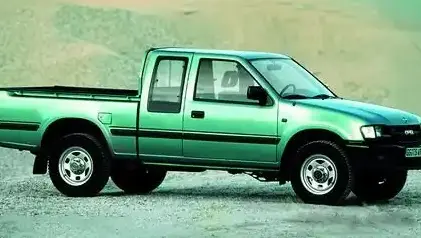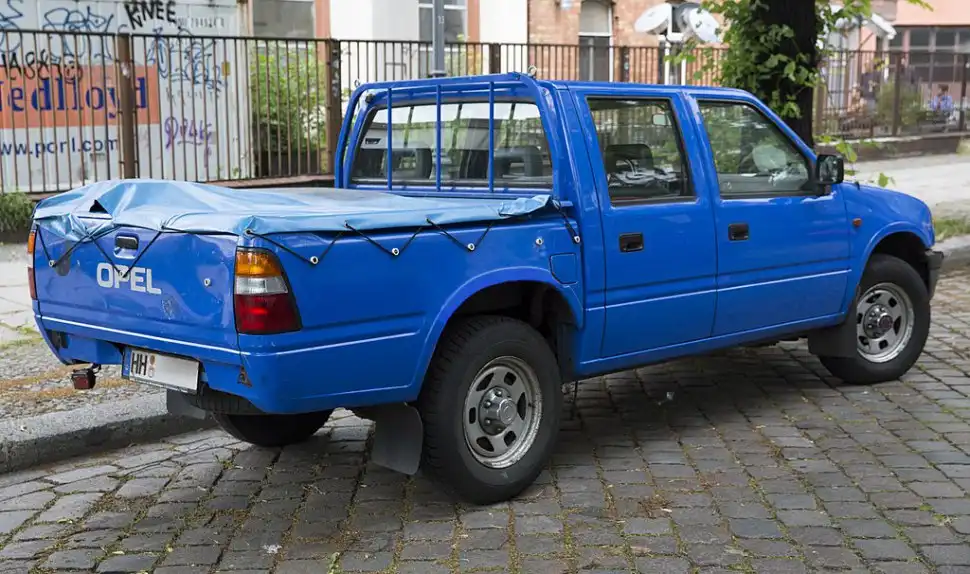
The Opel Campo Double Cab 2.5 TD, producing 76 horsepower, was a utilitarian pickup truck manufactured from 1991 to 2001. It represented a practical, no-frills transportation solution primarily aimed at commercial users and those needing a robust vehicle for work purposes. Positioned as the entry-level diesel offering within the Campo range, it provided a more affordable alternative to the gasoline-powered models and the higher-output diesel variants. The Campo itself was based on the Isuzu Faster platform, a result of collaboration between Opel and Isuzu, and was sold under various names across different markets, including the Holden Rodeo in Australia and New Zealand.
Technical Specifications
| Brand | Opel |
| Model | Campo |
| Generation | Campo Double Cab |
| Type (Engine) | 2.5 TD (76 Hp) |
| Start of production | 1991 |
| End of production | June, 2001 |
| Powertrain Architecture | Internal Combustion engine |
| Body type | Pick-up |
| Seats | 5 |
| Doors | 4 |
| Fuel consumption (combined) | 8.2 l/100 km (28.7 US mpg, 34.4 UK mpg, 12.2 km/l) |
| Fuel Type | Diesel |
| Acceleration 0 – 100 km/h | 23.4 sec |
| Acceleration 0 – 62 mph | 23.4 sec |
| Acceleration 0 – 60 mph | 22.2 sec |
| Maximum speed | 140 km/h (86.99 mph) |
| Power | 76 Hp @ 3800 rpm |
| Power per litre | 30.4 Hp/l |
| Torque | 160 Nm @ 2000 rpm (118.01 lb.-ft. @ 2000 rpm) |
| Engine Model/Code | 4JA1T |
| Engine displacement | 2499 cm3 (152.5 cu. in.) |
| Number of cylinders | 4 |
| Engine configuration | Inline |
| Cylinder Bore | 93 mm (3.66 in.) |
| Piston Stroke | 92 mm (3.62 in.) |
| Engine aspiration | Turbocharger |
| Engine oil capacity | 4.5 l (4.76 US qt | 3.96 UK qt) |
| Coolant | 9 l (9.51 US qt | 7.92 UK qt) |
| Length | 4980 mm (196.06 in.) |
| Width | 1690 mm (66.54 in.) |
| Height | 1710 mm (67.32 in.) |
| Wheelbase | 3025 mm (119.09 in.) |
| Drivetrain Architecture | Rear wheel drive |
| Number of gears and type of gearbox | 5 gears, manual transmission |
| Front suspension | Independent coil spring |
| Front brakes | Ventilated discs |
Powertrain & Engine Architecture
The heart of the Campo Double Cab 2.5 TD was the 4JA1T engine, a 2.5-liter inline-four cylinder diesel engine. This engine was sourced from Isuzu, reflecting the collaborative engineering between Opel and the Japanese manufacturer. The 4JA1T featured indirect injection, utilizing a mechanical fuel injection pump to deliver fuel to the cylinders. A turbocharger was incorporated to boost power output, bringing it to 76 horsepower at 3800 rpm and 160 Nm (118 lb-ft) of torque at 2000 rpm. The engine employed a simple, robust valvetrain with a single overhead camshaft operating two valves per cylinder. The five-speed manual transmission was the only gearbox option available with this engine, chosen for its durability and suitability for hauling and towing. The transmission was a conventional setup with synchromesh on all forward gears and reverse.
Driving Characteristics
The 2.5 TD engine in the Campo Double Cab prioritized torque over outright speed. Acceleration was decidedly slow, with a 0-100 km/h (0-62 mph) time of around 23.4 seconds. However, the engine’s torque delivery made it capable of handling moderate loads and navigating challenging terrain. The gear ratios were optimized for low-end pulling power, making it suitable for agricultural work or transporting goods. Compared to the gasoline-powered Campo models, the 2.5 TD offered significantly better fuel economy, but at the expense of performance. The manual transmission allowed for precise control, but required frequent shifting to maintain momentum, especially when loaded. It wasn’t a vehicle designed for spirited driving; its strengths lay in its practicality and dependability.
Equipment & Trim Levels
The Campo Double Cab 2.5 TD was typically offered with a basic level of equipment, reflecting its work-oriented nature. Standard features generally included a vinyl interior, basic instrumentation (speedometer, fuel gauge, temperature gauge), and a simple audio system. Power steering was often an optional extra. The double cab configuration provided seating for five passengers, making it a versatile option for crews or families. Optional extras could include upgraded interior trim, alloy wheels, and a more sophisticated audio system. The emphasis was on functionality rather than luxury.
Chassis & Braking
The Campo Double Cab featured a body-on-frame construction, providing a robust and durable chassis. The front suspension utilized independent coil springs, offering a reasonable level of ride comfort. The rear suspension employed leaf springs, chosen for their load-carrying capacity. Braking was handled by ventilated disc brakes at the front and drum brakes at the rear. The braking system was adequate for the vehicle’s weight and performance, but lacked the sophistication of more modern systems. Stabilizer bars were typically absent, contributing to a noticeable degree of body roll during cornering.
Market Reception & Comparison
The Opel Campo Double Cab 2.5 TD was generally well-received in markets where a practical and affordable pickup truck was needed. Critics praised its durability, fuel efficiency, and load-carrying capacity. However, its slow acceleration and basic interior were often noted as drawbacks. Compared to other diesel-powered pickups available at the time, such as the Toyota Hilux or Nissan Navara, the Campo offered a more affordable entry point, but lacked the refinement and performance of its competitors. The 2.5 TD engine was considered reliable, but required regular maintenance to ensure longevity. The manual transmission was also generally regarded as durable, but could be prone to wear and tear with heavy use.
Legacy
The Opel Campo Double Cab 2.5 TD has become a relatively sought-after vehicle among enthusiasts and those seeking a classic workhorse. The 4JA1T engine is known for its robustness and relatively simple mechanics, making it easier to maintain and repair. While finding parts can sometimes be a challenge, the engine’s durability means that many examples are still in service today. In the used car market, these vehicles are often valued for their practicality and affordability. They represent a bygone era of utilitarian vehicles, built to withstand hard work and provide reliable transportation. The Campo’s legacy lies in its simplicity, durability, and its role as a dependable workhorse for a generation of owners.