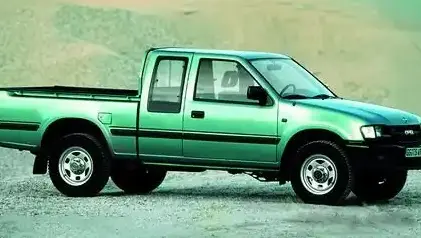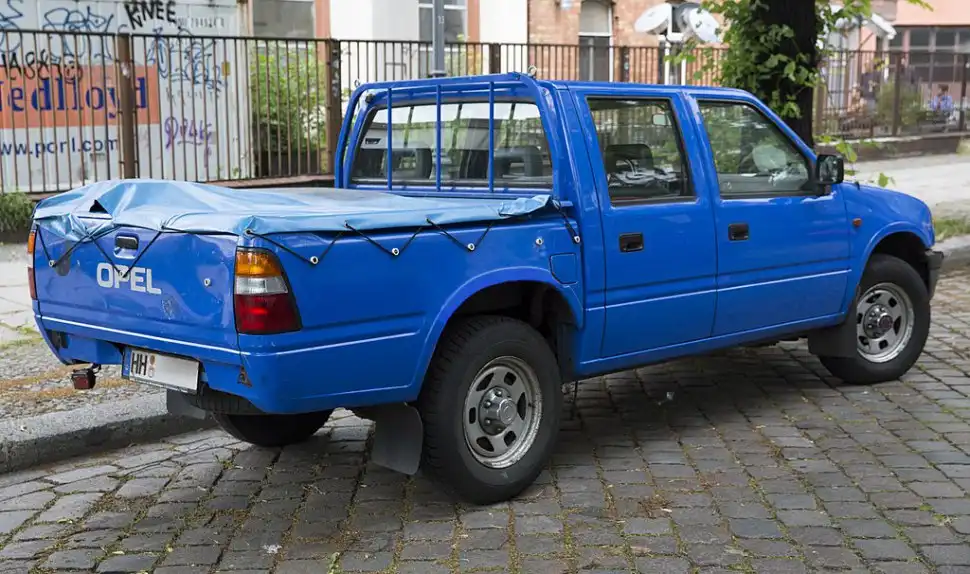
The Opel Campo Double Cab 3.1 TD, producing 109 horsepower, was a mid-size pickup truck manufactured by Opel from 1992 to 2001. It represented a significant offering in the European pickup market, providing a practical and relatively affordable option for both commercial and personal use. The Double Cab configuration, distinguishing it from standard single-cab pickups, offered seating for five passengers, enhancing its versatility. The Campo was based on the Isuzu D-Max platform, a result of collaboration between Opel and Isuzu, and played a role in Opel’s attempt to establish a stronger foothold in the light commercial vehicle segment.
Technical Specifications
| Brand | Opel |
| Model | Campo |
| Generation | Campo Double Cab |
| Type (Engine) | 3.1 TD (109 Hp) |
| Start of production | 1992 |
| End of production | June, 2001 |
| Powertrain Architecture | Internal Combustion engine |
| Body type | Pick-up |
| Seats | 5 |
| Doors | 4 |
| Fuel consumption (combined) | 12.1 l/100 km (19.4 US mpg, 23.3 UK mpg, 8.3 km/l) |
| Fuel Type | Diesel |
| Acceleration 0 – 100 km/h | 16.9 sec |
| Acceleration 0 – 62 mph | 16.9 sec |
| Acceleration 0 – 60 mph | 16.1 sec |
| Maximum speed | 155 km/h (96.31 mph) |
| Power | 109 Hp @ 3600 rpm |
| Power per litre | 35.6 Hp/l |
| Torque | 255 Nm @ 1900 rpm (188.08 lb.-ft. @ 1900 rpm) |
| Engine Model/Code | 4JG2T |
| Engine displacement | 3059 cm3 (186.67 cu. in.) |
| Number of cylinders | 4 |
| Engine configuration | Inline |
| Engine aspiration | Turbocharger |
| Engine oil capacity | 6 l (6.34 US qt | 5.28 UK qt) |
| Coolant | 9 l (9.51 US qt | 7.92 UK qt) |
| Length | 4980 mm (196.06 in.) |
| Width | 1690 mm (66.54 in.) |
| Height | 1710 mm (67.32 in.) |
| Wheelbase | 3025 mm (119.09 in.) |
| Drivetrain | Rear wheel drive |
| Number of gears | 5 gears, manual transmission |
Powertrain & Engine Architecture
The Opel Campo Double Cab 3.1 TD was powered by the Isuzu-sourced 4JG2T engine, a 3.1-liter inline-four cylinder diesel engine. This engine featured a turbocharger, which helped to boost power and torque output. The 4JG2T utilized indirect fuel injection, a common technology for diesel engines of that era. While not as refined as modern common-rail diesel systems, it provided reasonable performance and fuel efficiency. The engine’s 109 horsepower at 3600 rpm and 255 Nm (188 lb-ft) of torque at 1900 rpm were adequate for hauling and towing, but didn’t offer particularly brisk acceleration. The engine was known for its durability and relative simplicity, making it easier to maintain compared to more complex engine designs. The five-speed manual transmission was the only transmission option available with this engine, providing drivers with full control over gear selection.
Driving Characteristics
The driving experience in the Campo 3.1 TD was characterized by its workhorse nature. Acceleration was slow, with a 0-60 mph time of around 16.1 seconds. The engine delivered its peak torque at relatively low RPMs, making it suitable for hauling loads and navigating challenging terrain. However, the lack of power was noticeable when driving unloaded or at higher speeds. The five-speed manual transmission offered a reasonable spread of gears, allowing drivers to keep the engine in its optimal power band. The rear-wheel-drive configuration provided good traction in most conditions, but could become challenging on slippery surfaces. The suspension was tuned for practicality and durability rather than comfort, resulting in a somewhat firm ride.
Equipment & Trim Levels
The Opel Campo Double Cab 3.1 TD was generally offered with a fairly basic level of equipment, reflecting its utilitarian purpose. Standard features typically included power steering, a basic audio system, and vinyl or cloth upholstery. Air conditioning was often an optional extra. The Double Cab configuration provided seating for five passengers, with a rear bench seat that could be folded up to create additional cargo space. Interior trim levels were relatively sparse, with a focus on durability and ease of cleaning. Optional extras could include upgraded audio systems, alloy wheels, and exterior styling enhancements.
Chassis & Braking
The Campo Double Cab featured a body-on-frame construction, typical of pickup trucks of that era. This provided a robust and durable chassis capable of handling heavy loads. The suspension consisted of leaf springs in the rear and independent coil springs in the front. The braking system utilized disc brakes on the front wheels and drum brakes on the rear wheels. While adequate for most driving conditions, the braking performance was not particularly strong. The rear drum brakes were a cost-saving measure and limited the overall braking capability. A stabilizer bar was included in the front suspension to help reduce body roll during cornering.
Market Reception & Comparison
The Opel Campo Double Cab 3.1 TD was generally well-received in the European market as a practical and affordable pickup truck. Critics praised its durability, spaciousness, and load-carrying capacity. However, the engine’s lack of power and the somewhat basic interior were often cited as drawbacks. Compared to other pickups in its class, such as the Toyota Hilux and the Nissan Navara, the Campo offered a more affordable price point but lacked the refinement and performance of its competitors. The 3.1 TD engine was considered more reliable than some of the gasoline engine options available in the Campo lineup, but its fuel economy was not particularly impressive.
Legacy
The Opel Campo Double Cab 3.1 TD has become a relatively sought-after vehicle among enthusiasts and collectors. Its robust construction and simple mechanicals make it a relatively easy vehicle to maintain and repair. The 4JG2T engine is known for its longevity, and many examples are still in service today. While not a particularly fast or luxurious vehicle, the Campo Double Cab 3.1 TD represents a practical and durable workhorse that provided a valuable service to many owners. In the used car market, well-maintained examples command a reasonable price, reflecting their enduring appeal and reputation for reliability. The Campo’s legacy lies in its ability to provide a dependable and affordable transportation solution for those who needed a versatile pickup truck.