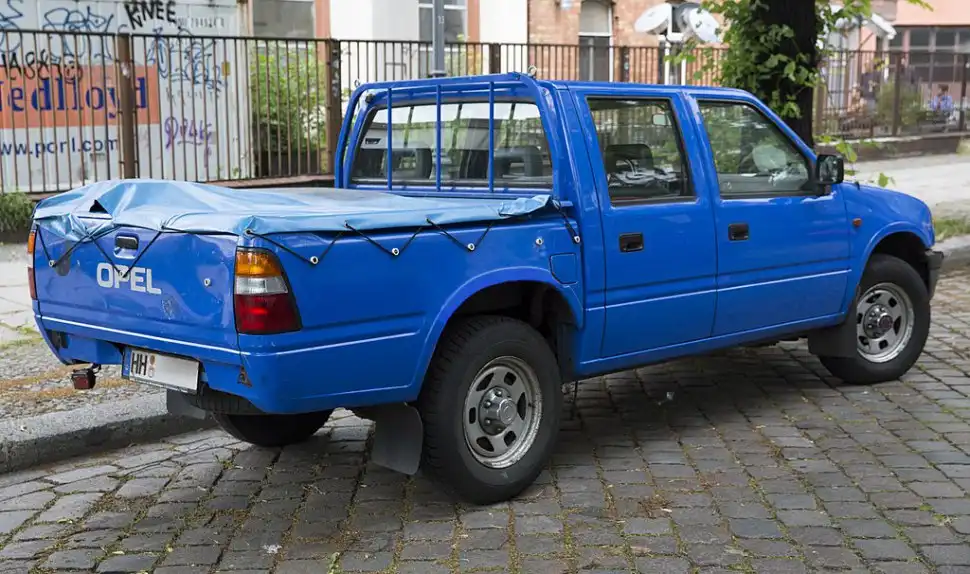
The Opel Campo Half Cab 2.5 TD 4×4, produced from 1991 to 2001, represents a utilitarian offering in the European pickup truck market. Positioned as a workhorse vehicle, the Campo aimed to provide affordable and durable transportation for both commercial and private use. The “Half Cab” designation refers to the vehicle’s body style, featuring a shortened cabin behind the front seats, maximizing cargo space. It was based on the Isuzu Faster platform, a result of collaboration between Opel and Isuzu, and served as a competitor to vehicles like the Ford Courier and Volkswagen Caddy in the compact pickup segment. This particular variant, equipped with the 2.5-liter turbocharged diesel engine producing 76 horsepower, was a common configuration, prioritizing fuel efficiency and reliability over outright performance.
Technical Specifications
| Brand | Opel |
| Model | Campo |
| Generation | Campo Half Cab |
| Type (Engine) | 2.5 TD (76 Hp) 4×4 |
| Start of production | 1991 |
| End of production | June, 2001 |
| Powertrain Architecture | Internal Combustion engine |
| Body type | Pick-up |
| Seats | 4 |
| Doors | 2 |
| Fuel Type | Diesel |
| Power | 76 Hp @ 3800 rpm |
| Power per litre | 30.4 Hp/l |
| Torque | 160 Nm @ 2000 rpm / 118.01 lb.-ft. @ 2000 rpm |
| Engine Model/Code | 4JA1T |
| Engine displacement | 2499 cm3 / 152.5 cu. in. |
| Number of cylinders | 4 |
| Engine configuration | Inline |
| Cylinder Bore | 93 mm / 3.66 in. |
| Piston Stroke | 92 mm / 3.62 in. |
| Engine aspiration | Turbocharger |
| Engine oil capacity | 4.5 l / 4.76 US qt | 3.96 UK qt |
| Coolant | 9 l / 9.51 US qt | 7.92 UK qt |
| Length | 4980 mm / 196.06 in. |
| Width | 1690 mm / 66.54 in. |
| Height | 1710 mm / 67.32 in. |
| Wheelbase | 3025 mm / 119.09 in. |
| Drive wheel | All wheel drive (4×4) |
| Number of gears and type of gearbox | 5 gears, manual transmission |
| Front suspension | Independent coil spring |
| Rear suspension | dependent spring suspension |
| Front brakes | Ventilated discs |
| Rear brakes | Drum |
Powertrain & Engine Architecture
The heart of the Campo Half Cab 2.5 TD 4×4 is the Isuzu-sourced 4JA1T 2.5-liter inline-four cylinder diesel engine. This engine, a common sight in light commercial vehicles of the era, is a naturally aspirated diesel boosted by a turbocharger. The 4JA1T utilizes indirect fuel injection, a system prevalent in diesels of the early 1990s. This system, while less efficient than direct injection, offered improved cold-starting performance and reduced noise levels. The engine features a single overhead camshaft (SOHC) valvetrain, operating two valves per cylinder. The turbocharger, a Garrett unit in many applications, provides a modest boost, contributing to the engine’s 76 horsepower and 160 Nm (118 lb-ft) of torque. The five-speed manual transmission was the only gearbox option available with this engine, chosen for its durability and suitability for off-road and load-carrying applications. The transmission is a conventional setup with a single dry plate clutch.
Driving Characteristics
The Campo 2.5 TD 4×4, with its 76 horsepower, wasn’t designed for speed. Acceleration is best described as leisurely, and overtaking requires careful planning. The engine’s torque, however, is readily available from low RPMs, making it well-suited for hauling loads and navigating challenging terrain. The five-speed manual transmission allows the driver to keep the engine within its optimal power band. The 4×4 system, typically part-time with selectable two-wheel drive, provides enhanced traction on slippery surfaces. The suspension, featuring independent coil springs at the front and leaf springs at the rear, offers a reasonable ride quality when unladen, but can become harsh when heavily loaded. Steering is typically unassisted, providing a direct feel but requiring more effort at low speeds.
Equipment & Trim Levels
The Opel Campo Half Cab was not a vehicle known for luxury. The 2.5 TD 4×4 variant was typically sparsely equipped, reflecting its utilitarian purpose. Standard features generally included a basic dashboard with essential gauges, vinyl upholstery, and a robust heating system. Power steering and electric windows were uncommon, often offered as optional extras. The interior was designed for practicality and ease of cleaning, with durable materials used throughout. Trim levels were minimal, with most variations stemming from optional equipment packages. A common upgrade was a more comfortable driver’s seat and a basic audio system.
Chassis & Braking
The Campo’s chassis is a body-on-frame construction, providing a robust and durable platform for carrying heavy loads. The front suspension utilizes independent coil springs, offering a degree of ride comfort and improved handling compared to a solid axle setup. The rear suspension employs leaf springs, chosen for their load-carrying capacity and simplicity. Braking is handled by ventilated discs at the front and drum brakes at the rear. The braking system, while adequate for the vehicle’s weight and performance, lacks the sophistication of more modern systems. The 4×4 system typically features a transfer case allowing the driver to switch between two-wheel drive and four-wheel drive, with a low-range gear for enhanced off-road capability.
Market Reception & Comparison
The Opel Campo Half Cab 2.5 TD 4×4 was generally well-received as a dependable and affordable workhorse. Critics praised its durability and fuel efficiency, but noted its lack of refinement and limited performance. Compared to other pickups in its class, such as the Ford Courier and Volkswagen Caddy, the Campo offered a more rugged and utilitarian experience. The 2.5 TD engine, while not powerful, provided adequate torque for most tasks. The manual transmission was preferred by many for its reliability and control. Fuel economy was a strong point, typically ranging from 30-35 mpg, making it an economical choice for commercial users. However, the Campo’s basic interior and lack of features placed it at the lower end of the market.
Legacy
The Opel Campo Half Cab, and specifically the 2.5 TD 4×4 variant, has developed a reputation for longevity and reliability. The Isuzu 4JA1T engine is known for its robustness and ability to withstand heavy use. While finding well-maintained examples today can be challenging, those that remain are often still in service. The Campo’s simple mechanical design makes it relatively easy to repair and maintain, appealing to DIY enthusiasts. In the used car market, the Campo 2.5 TD 4×4 represents an affordable and practical option for those seeking a basic, dependable pickup truck. Its enduring appeal lies in its simplicity, durability, and ability to perform its intended function without fuss.