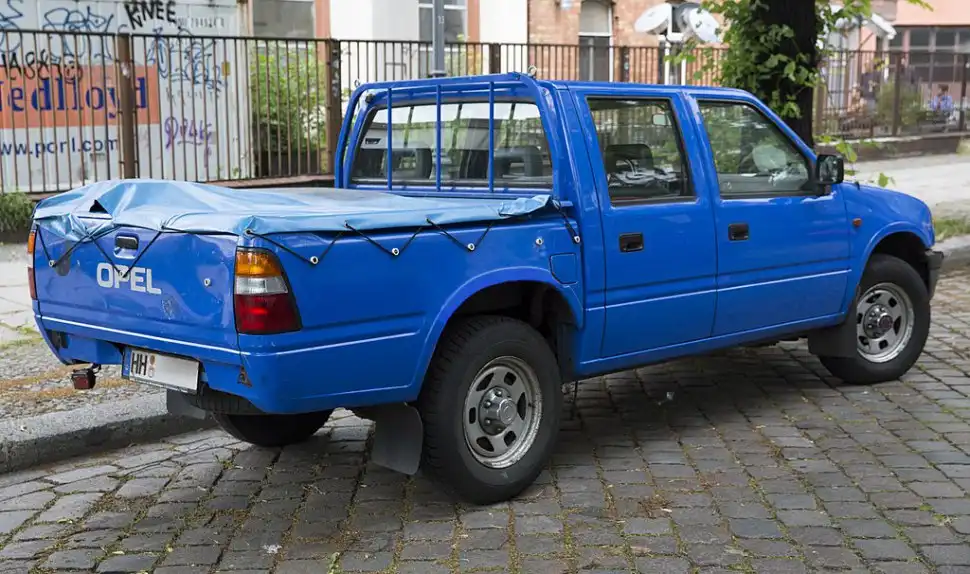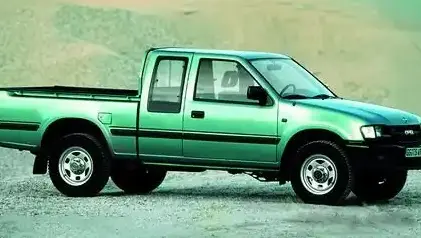
The Opel Campo Half Cab 3.1 TD, producing 109 horsepower, was a utilitarian pickup truck manufactured from 1992 to 2000. Positioned as a workhorse variant within the Campo range, it catered to buyers needing a robust and affordable vehicle for commercial or agricultural purposes. The “Half Cab” designation refers to its extended cab configuration, offering limited seating for passengers behind the driver and front passenger. It was primarily sold in European and South American markets, offering a practical alternative to more mainstream pickup trucks.
Technical Specifications
| Brand | Opel |
| Model | Campo |
| Generation | Campo Half Cab |
| Type (Engine) | 3.1 TD (109 Hp) |
| Start of production | 1992 |
| End of production | 2000 |
| Powertrain Architecture | Internal Combustion engine |
| Body type | Pick-up |
| Seats | 4 |
| Doors | 2 |
| Fuel consumption (combined) | 12.1 l/100 km (19.4 US mpg, 23.3 UK mpg, 8.3 km/l) |
| Fuel Type | Diesel |
| Acceleration 0 – 100 km/h | 16.9 sec |
| Acceleration 0 – 62 mph | 16.9 sec |
| Acceleration 0 – 60 mph | 16.1 sec |
| Maximum speed | 155 km/h (96.31 mph) |
| Power | 109 Hp @ 3600 rpm |
| Power per litre | 35.6 Hp/l |
| Torque | 255 Nm @ 1900 rpm (188.08 lb.-ft. @ 1900 rpm) |
| Engine Model/Code | 4JG2T |
| Engine displacement | 3059 cm3 (186.67 cu. in.) |
| Number of cylinders | 4 |
| Engine configuration | Inline |
| Engine aspiration | Turbocharger |
| Engine oil capacity | 6 l (6.34 US qt | 5.28 UK qt) |
| Coolant capacity | 9 l (9.51 US qt | 7.92 UK qt) |
| Length | 4980 mm (196.06 in.) |
| Width | 1690 mm (66.54 in.) |
| Height | 1710 mm (67.32 in.) |
| Wheelbase | 3025 mm (119.09 in.) |
| Drivetrain | Rear wheel drive |
| Number of gears | 5 |
| Gearbox type | Manual transmission |
Powertrain & Engine Architecture
The Campo Half Cab 3.1 TD was powered by the 4JG2T engine, a 3.1-liter inline-four cylinder diesel engine. This engine was sourced from Isuzu, a long-time partner of Opel. The 4JG2T featured a turbocharger, which significantly boosted power and torque output for its displacement. The engine utilized a direct injection system, common for diesel engines of the era, to improve fuel efficiency and reduce emissions. The engine’s valvetrain consisted of a single overhead camshaft (SOHC) operating two valves per cylinder. The 3.1-liter engine was known for its durability and relatively simple mechanical design, making it easier to maintain and repair. The five-speed manual transmission was the only gearbox option available with this engine, prioritizing robustness and cost-effectiveness over driver convenience.
Driving Characteristics
The 109 horsepower and 255 Nm (188 lb-ft) of torque delivered by the 3.1 TD engine provided adequate, but not exceptional, performance. Acceleration was slow, with a 0-60 mph time of around 16.1 seconds. The engine’s strength lay in its low-end torque, making it well-suited for hauling loads and navigating challenging terrain. The five-speed manual transmission allowed drivers to keep the engine in its optimal power band, but required frequent shifting. Compared to potential gasoline engine options (which were less common in this model), the diesel offered significantly better fuel economy, but at the expense of refinement and responsiveness. The rear-wheel-drive configuration provided good traction when unladen, but could struggle with heavy loads on slippery surfaces.
Equipment & Trim Levels
The Campo Half Cab 3.1 TD was generally sparsely equipped, reflecting its utilitarian purpose. Standard features typically included a basic dashboard with essential gauges, vinyl upholstery, and a robust heating system. Power steering was often included, but air conditioning and electric windows were typically optional extras. The “Half Cab” configuration featured a small rear bench seat, capable of accommodating two passengers, although legroom was limited. Trim levels were minimal, with most variations relating to optional equipment packages. The focus was on providing a functional and durable vehicle rather than luxury or comfort.
Chassis & Braking
The Campo Half Cab utilized a body-on-frame construction, providing a rugged and durable chassis. The suspension consisted of leaf springs at the rear and independent coil springs at the front. This setup prioritized load-carrying capacity and durability over ride comfort. Braking was typically accomplished with disc brakes at the front and drum brakes at the rear. The braking system was adequate for the vehicle’s weight and performance, but lacked the sophistication of more modern systems. A stabilizer bar was often included at the front to reduce body roll during cornering.
Market Reception & Comparison
The Opel Campo Half Cab 3.1 TD was well-received in markets where a robust and affordable pickup truck was needed. Critics praised its durability, fuel efficiency, and load-carrying capacity. However, it was often criticized for its slow acceleration, basic interior, and lack of refinement. Compared to other pickups in its class, such as the Toyota Hilux or Nissan Navara, the Campo offered a more affordable price point but lacked the same level of sophistication and reliability. The 3.1 TD engine offered better fuel economy than gasoline alternatives, but was generally less powerful. The manual transmission was preferred by many buyers for its durability and simplicity.
Legacy
The Opel Campo Half Cab 3.1 TD has developed a reputation as a reliable and durable workhorse. The 4JG2T engine is known for its longevity, and many examples are still in service today. However, finding parts can be challenging as the vehicle is no longer in production. On the used car market, the Campo Half Cab 3.1 TD is typically valued for its affordability and practicality. It remains a popular choice for those needing a simple and robust pickup truck for agricultural or commercial use. While not a collector’s item, well-maintained examples are increasingly sought after by enthusiasts who appreciate its rugged simplicity and durability.