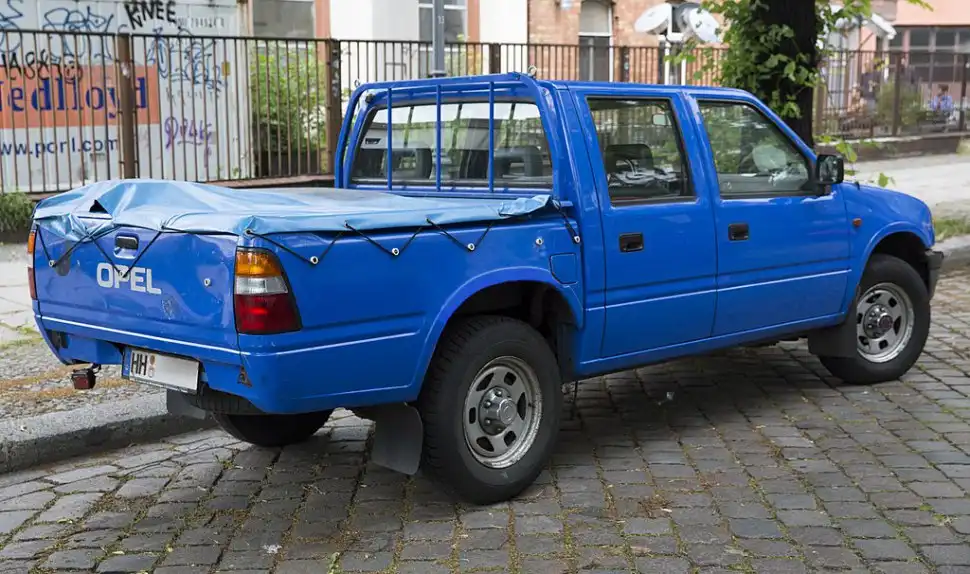
The Opel Campo Single Cab 2.3, produced between 1991 and 1995, was a utilitarian pickup truck aimed at commercial and light-duty applications. Representing Opel’s entry into the compact pickup segment, the Campo was primarily marketed in Europe, offering a relatively affordable and robust work vehicle. This specific 2.3-liter, 94 horsepower variant occupied the middle ground of the Campo lineup, positioned as a balance between cost and capability, slotting below the more powerful, though less common, diesel options.
Technical Specifications
| Brand | Opel |
| Model | Campo |
| Generation | Campo Single Cab |
| Type (Engine) | 2.3 (94 Hp) |
| Start of production | 1991 |
| End of production | 1995 |
| Powertrain Architecture | Internal Combustion engine |
| Body type | Pick-up |
| Seats | 2 |
| Doors | 2 |
| Fuel Type | Petrol (Gasoline) |
| Acceleration 0 – 100 km/h | 23.1 sec |
| Acceleration 0 – 62 mph | 23.1 sec |
| Acceleration 0 – 60 mph | 21.9 sec |
| Maximum speed | 135 km/h (83.89 mph) |
| Power | 94 Hp @ 5000 rpm |
| Power per litre | 41.7 Hp/l |
| Torque | 170 Nm @ 2600 rpm (125.39 lb.-ft. @ 2600 rpm) |
| Engine Model/Code | 4ZD1 |
| Engine displacement | 2255 cm3 (137.61 cu. in.) |
| Number of cylinders | 4 |
| Engine configuration | Inline |
| Cylinder Bore | 89.3 mm (3.52 in.) |
| Piston Stroke | 90 mm (3.54 in.) |
| Number of valves per cylinder | 2 |
| Engine aspiration | Naturally aspirated engine |
| Valvetrain | SOHC |
| Engine oil capacity | 3.5 l (3.7 US qt | 3.08 UK qt) |
| Coolant | 9 l (9.51 US qt | 7.92 UK qt) |
| Length | 4980 mm (196.06 in.) |
| Width | 1690 mm (66.54 in.) |
| Height | 1595 mm (62.8 in.) |
| Wheelbase | 3025 mm (119.09 in.) |
| Drivetrain Architecture | Rear wheel drive |
| Number of gears and type of gearbox | 5 gears, manual transmission |
| Front suspension | Independent coil spring |
| Rear suspension | dependent spring suspension |
| Front brakes | Ventilated discs |
| Rear brakes | Drum |
Powertrain & Engine Architecture
The Opel Campo 2.3 utilized the 4ZD1 engine, a 2.3-liter inline-four cylinder gasoline engine. This engine was a relatively simple design, featuring a single overhead camshaft (SOHC) valvetrain operating two valves per cylinder. Fuel delivery was managed by a carburetor system, common for the era, rather than more advanced fuel injection. This carburetor setup contributed to the engine’s straightforward maintenance requirements but also limited its overall efficiency and refinement compared to contemporary fuel-injected engines. The engine produced 94 horsepower at 5000 rpm and 170 Nm (125.39 lb-ft) of torque at 2600 rpm. The engine was mated to a five-speed manual transmission, delivering power to the rear wheels.
Driving Characteristics
The Campo 2.3, with its 94 horsepower and relatively low curb weight, offered adequate, though not exhilarating, performance. Acceleration from 0-100 km/h (0-62 mph) took approximately 23.1 seconds, and reaching 0-60 mph required around 21.9 seconds. Top speed was limited to around 135 km/h (83.89 mph). The five-speed manual transmission provided a reasonable spread of gears, allowing the driver to keep the engine within its optimal torque band for hauling or navigating hilly terrain. Compared to potential diesel variants, the 2.3-liter gasoline engine offered quicker acceleration and a more responsive feel, but at the cost of significantly lower fuel economy. The rear-wheel-drive configuration provided a traditional pickup truck driving experience, prioritizing load-carrying capacity over all-weather traction.
Equipment & Trim Levels
The Opel Campo Single Cab 2.3 was generally sparsely equipped, reflecting its utilitarian purpose. Standard features typically included a basic dashboard with essential gauges, vinyl upholstery, and a robust, though simple, interior. Power steering was not always standard, and air conditioning was often an optional extra. The Single Cab configuration offered seating for two occupants. Trim levels were minimal, with most variations stemming from optional equipment packages. Buyers could typically add features like upgraded audio systems, improved interior trim, and exterior enhancements such as bed liners or chrome accents.
Chassis & Braking
The Campo’s chassis was a body-on-frame construction, providing a durable and rugged platform for hauling and off-road use. Front suspension utilized independent coil springs, offering a degree of ride comfort, while the rear suspension employed a more traditional dependent leaf spring setup, prioritizing load-carrying capacity. Braking consisted of ventilated discs at the front and drum brakes at the rear. The braking system was adequate for the vehicle’s weight and performance, but lacked the sophistication of more modern braking technologies like ABS.
Market Reception & Comparison
The Opel Campo was generally well-received as a practical and affordable pickup truck in the European market. Critics acknowledged its robust construction and reasonable performance, but also noted its basic interior and lack of refinement compared to some competitors. The 2.3-liter gasoline engine offered a good balance between power and cost, but its fuel economy was a significant drawback compared to the available diesel options. Compared to other pickups in its class, such as the Volkswagen Caddy or the Fiat Strada, the Campo offered a more traditional pickup truck experience, with a larger bed and greater load-carrying capacity.
Legacy
The Opel Campo, while not a groundbreaking vehicle, served as a valuable entry point for Opel into the pickup truck market. The 2.3-liter gasoline engine, while not known for exceptional longevity, proved to be reasonably reliable with proper maintenance. Today, the Campo is a relatively rare sight on the roads, but it has gained a following among enthusiasts who appreciate its simplicity and ruggedness. Parts availability can be challenging, but the engine’s straightforward design makes it relatively easy to repair for those with mechanical skills. The Campo represents a bygone era of utilitarian vehicles, prioritizing functionality and affordability over luxury and refinement.