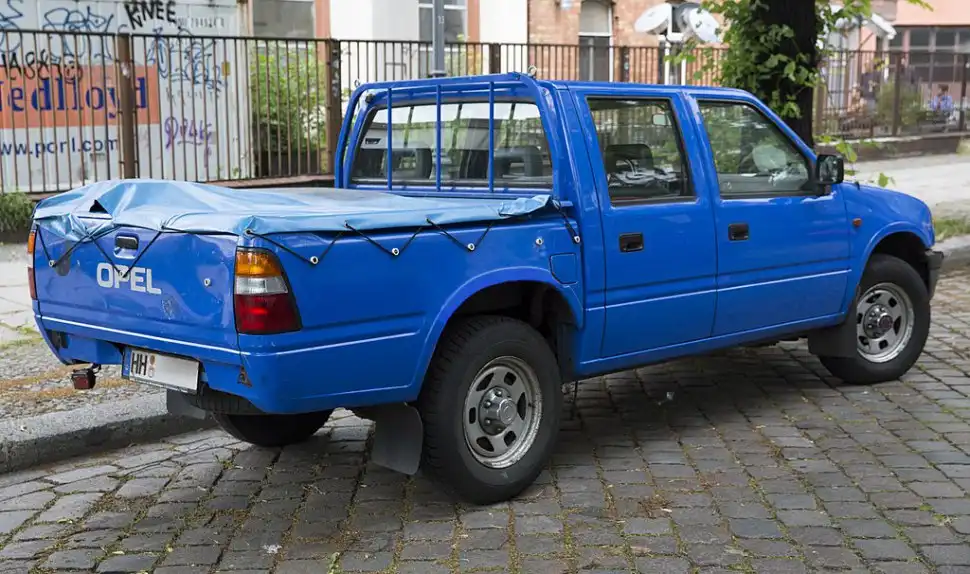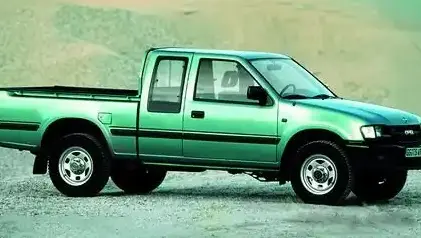
The Opel Campo Single Cab 2.3 (98 hp) 4×4 was a short-lived but notable addition to Opel’s commercial vehicle lineup during the mid-1990s. Produced from 1994 to 1995, it represented Opel’s entry into the compact 4×4 pickup truck segment, primarily aimed at utility and commercial users. This variant, equipped with the 2.3-liter gasoline engine and a five-speed manual transmission, occupied the base level of the Campo range, offering a more affordable and practical alternative to the more powerful or luxurious trims. The Campo itself was based on the Isuzu Faster platform, a result of collaboration between Opel and Isuzu, and was sold under various names across Europe, including Bedford in the UK.
Technical Specifications
| Brand | Opel |
| Model | Campo |
| Generation | Campo Single Cab |
| Type (Engine) | 2.3 (98 Hp) 4×4 |
| Start of production | 1994 |
| End of production | 1995 |
| Powertrain Architecture | Internal Combustion engine |
| Body type | Pick-up |
| Seats | 2 |
| Doors | 2 |
| Fuel Type | Petrol (Gasoline) |
| Power | 98 Hp @ 5000 rpm |
| Power per litre | 43.5 Hp/l |
| Engine Model/Code | 4ZD1 |
| Engine displacement | 2255 cm3 / 137.61 cu. in. |
| Number of cylinders | 4 |
| Engine configuration | Inline |
| Cylinder Bore | 89.3 mm / 3.52 in. |
| Piston Stroke | 90 mm / 3.54 in. |
| Number of valves per cylinder | 2 |
| Engine aspiration | Naturally aspirated engine |
| Valvetrain | SOHC |
| Engine oil capacity | 3.5 l / 3.7 US qt | 3.08 UK qt |
| Coolant | 9 l / 9.51 US qt | 7.92 UK qt |
| Length | 4980 mm / 196.06 in. |
| Width | 1690 mm / 66.54 in. |
| Height | 1595 mm / 62.8 in. |
| Wheelbase | 3025 mm / 119.09 in. |
| Drive wheel | All wheel drive (4×4) |
| Number of gears and type of gearbox | 5 gears, manual transmission |
| Front suspension | Independent coil spring |
| Front brakes | Ventilated discs |
Powertrain & Engine Architecture
The heart of the Campo Single Cab 2.3 4×4 was the 4ZD1 engine, a 2.3-liter inline-four cylinder gasoline engine. This engine, sourced from Isuzu as part of the collaborative agreement, was a relatively simple design featuring a single overhead camshaft (SOHC) valvetrain and two valves per cylinder. Fuel delivery was managed by a conventional throttle body injection system, which was typical for vehicles of this era and price point. While not particularly sophisticated, the 4ZD1 proved to be a durable and reliable engine, albeit lacking the power and refinement of more modern designs. The engine produced 98 horsepower at 5000 rpm and approximately 138 lb-ft of torque. The five-speed manual transmission was a standard unit, providing a reasonable spread of gears for both on-road and off-road driving. The 4×4 system was part-time, selectable via a lever inside the cabin, allowing the driver to switch between two-wheel drive and four-wheel drive as needed.
Driving Characteristics
The driving experience of the Opel Campo 2.3 4×4 was utilitarian rather than sporty. The 98 hp engine, while adequate for general use, provided only modest acceleration. The truck felt somewhat underpowered when fully loaded or tackling steep inclines. The five-speed manual transmission helped to keep the engine in its optimal power band, but frequent gear changes were often necessary. The part-time 4×4 system provided improved traction on loose surfaces, making it suitable for light off-road work and challenging weather conditions. The suspension, while independent at the front, was tuned for durability and load-carrying capacity rather than comfort. The ride quality was firm, and the handling was predictable but not particularly engaging. Compared to potential higher-output versions (which weren’t widely available in the European market), this variant prioritized fuel economy and affordability over outright performance.
Equipment & Trim Levels
The Campo Single Cab 2.3 4×4 was a fairly basic vehicle in terms of equipment. Standard features typically included a vinyl interior, basic instrumentation, and a robust cargo bed. Power steering was often included, but air conditioning, power windows, and central locking were usually optional extras. The interior was functional and durable, designed to withstand the rigors of commercial use. The dashboard layout was simple and straightforward, with easy-to-read gauges. Trim levels were minimal, with most variations stemming from optional equipment packages. The focus was on providing a practical and affordable work vehicle rather than a luxurious or feature-rich one.
Chassis & Braking
The Campo’s chassis was a body-on-frame construction, providing a robust and durable platform for carrying loads and tackling rough terrain. The front suspension featured independent coil springs, while the rear suspension utilized leaf springs. This configuration provided a good balance of load-carrying capacity and ride comfort. The braking system consisted of ventilated disc brakes at the front and drum brakes at the rear. While adequate for the vehicle’s weight and performance, the braking system lacked the sophistication of more modern setups. The steering was a recirculating ball system, providing a direct but somewhat heavy feel.
Market Reception & Comparison
The Opel Campo 2.3 4×4 received mixed reviews from automotive critics. It was generally praised for its durability, practicality, and affordability, but criticized for its lack of refinement and modest performance. Compared to other compact pickup trucks available in Europe at the time, such as the Toyota Hilux and the Nissan Datsun, the Campo offered a competitive price point but lacked the established reputation for reliability and resale value of its Japanese rivals. The 1.8L versions, when available, were even more budget-focused, sacrificing some power for improved fuel economy. The 2.3L offered a better balance for those needing to tow or carry heavier loads.
Legacy
The Opel Campo Single Cab 2.3 4×4, despite its short production run, has gained a modest following among enthusiasts and collectors. The 4ZD1 engine is known for its durability and relative simplicity, making it a relatively easy engine to maintain and repair. However, finding parts can be challenging due to the vehicle’s limited production numbers. Today, well-maintained examples of the Campo 2.3 4×4 are becoming increasingly rare and are sought after by those looking for a classic and capable workhorse. Its legacy lies in being a practical and affordable 4×4 pickup that offered a viable alternative to more established competitors in the European market.