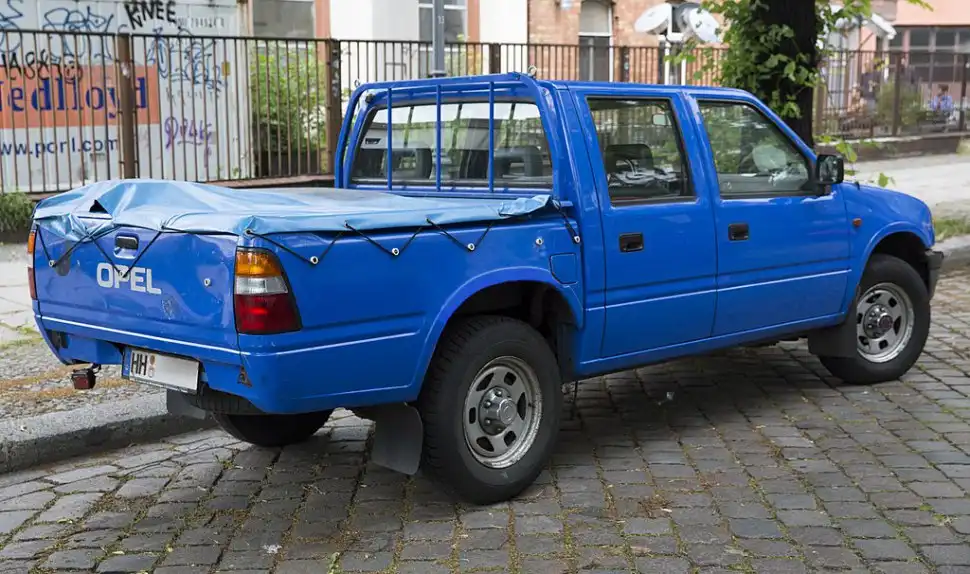
The Opel Campo Single Cab 2.5 TD 4×4, produced from 1991 to 2001, represents a utilitarian offering in the European pickup truck market. Positioned as a workhorse vehicle, the Campo aimed to provide affordable and durable transportation for commercial users and those requiring a robust vehicle for rural applications. It was based on the Isuzu Faster platform, a result of collaboration between Opel and Isuzu, and served as Opel’s entry into the increasingly popular compact pickup segment. The Single Cab configuration, as the name suggests, featured only two seats and a dedicated cargo bed, prioritizing functionality over passenger comfort. This variant, powered by the 2.5-liter turbodiesel engine, was a mainstay of the Campo lineup throughout its production run.
Technical Specifications
| Brand | Opel |
| Model | Campo |
| Generation | Campo Single Cab |
| Type (Engine) | 2.5 TD (76 Hp) 4×4 |
| Start of production | 1991 |
| End of production | June, 2001 |
| Powertrain Architecture | Internal Combustion engine |
| Body type | Pick-up |
| Seats | 2 |
| Doors | 2 |
| Fuel Type | Diesel |
| Power | 76 Hp @ 3800 rpm |
| Power per litre | 30.4 Hp/l |
| Torque | 160 Nm @ 2000 rpm / 118.01 lb.-ft. @ 2000 rpm |
| Engine Model/Code | 4JA1T |
| Engine displacement | 2499 cm3 / 152.5 cu. in. |
| Number of cylinders | 4 |
| Engine configuration | Inline |
| Cylinder Bore | 93 mm / 3.66 in. |
| Piston Stroke | 92 mm / 3.62 in. |
| Engine aspiration | Turbocharger |
| Engine oil capacity | 4.5 l / 4.76 US qt | 3.96 UK qt |
| Coolant | 9 l / 9.51 US qt | 7.92 UK qt |
| Length | 4980 mm / 196.06 in. |
| Width | 1690 mm / 66.54 in. |
| Height | 1595 mm / 62.8 in. |
| Wheelbase | 3025 mm / 119.09 in. |
| Drive wheel | All wheel drive (4×4) |
| Number of gears and type of gearbox | 5 gears, manual transmission |
| Front suspension | Independent coil spring |
| Rear suspension | dependent spring suspension |
| Front brakes | Ventilated discs |
| Rear brakes | Drum |
Powertrain & Engine Architecture
The heart of the Campo Single Cab 2.5 TD 4×4 is the Isuzu-sourced 4JA1T 2.5-liter inline-four turbodiesel engine. This engine, a common sight in various Isuzu and General Motors vehicles of the era, is known for its durability and relatively simple mechanical design. The 4JA1T utilizes indirect injection, a common feature of diesel engines of this period, employing a distributor-type fuel injection pump. This system, while less refined than modern common-rail direct injection, proved reliable and capable of delivering adequate power for the vehicle’s intended purpose. The turbocharger, a key component, significantly boosts torque output, making the vehicle suitable for hauling and towing. The engine features a cast iron block and head, contributing to its robustness. The five-speed manual transmission, also sourced from Isuzu, is a conventional design, providing straightforward gear changes. The transmission is geared towards maximizing torque delivery at lower engine speeds, prioritizing usability over outright performance.
Driving Characteristics
The Campo 2.5 TD 4×4, with its 76 horsepower and 160 Nm (118 lb-ft) of torque, wasn’t designed for speed. Acceleration is modest, and the engine requires diligent shifting to maintain momentum, especially when laden with cargo or navigating inclines. The turbocharger does provide a noticeable boost in power once spooled up, but there is a degree of turbo lag present. The manual transmission, while not particularly sporty, is robust and well-matched to the engine’s characteristics. The 4×4 system, typically selectable via a lever or button, provides enhanced traction on loose surfaces, making the Campo a capable off-road vehicle for basic tasks. Compared to potential higher-output variants (which were not commonly available in the European market for the Campo), this 2.5 TD version prioritized fuel economy and longevity over outright performance. The gear ratios are relatively low, aiding in off-road capability and towing, but at the expense of highway cruising comfort.
Equipment & Trim Levels
The Opel Campo Single Cab 2.5 TD 4×4 was a fairly spartan vehicle, reflecting its work-oriented nature. Standard equipment typically included basic steel wheels, vinyl upholstery, and a simple dashboard layout. Power steering was often an optional extra, as were features like a radio and upgraded interior trim. The Single Cab configuration meant limited interior space, with only two seats and minimal storage. The cargo bed, however, was the focal point, offering a practical load-carrying capacity. Trim levels were minimal; the focus was on providing a functional and affordable vehicle. Optional extras were generally limited to practical additions like a tow hitch, bed liner, or upgraded suspension components.
Chassis & Braking
The Campo’s chassis is a traditional body-on-frame construction, providing a robust and durable platform. The front suspension utilizes independent coil springs, offering a degree of ride comfort, while the rear suspension employs a dependent leaf spring setup, prioritizing load-carrying capacity. The braking system consists of ventilated discs on the front wheels and drum brakes on the rear. This configuration was common for vehicles in this class during the 1990s. The braking performance is adequate for the vehicle’s weight and intended use, but it lacks the sophistication of more modern braking systems. Stabilizer bars were typically absent, contributing to a somewhat pronounced body roll during cornering.
Market Reception & Comparison
The Opel Campo, and its Isuzu Faster sibling, received generally positive reviews for its durability and affordability. Critics acknowledged its utilitarian nature and its suitability for commercial applications. However, it was often criticized for its basic interior, lack of refinement, and modest performance. Compared to other pickups available in Europe at the time, such as the Toyota Hilux or Nissan Navara, the Campo offered a more affordable entry point, but at the expense of features and refinement. Fuel economy was a strong point for the 2.5 TD variant, making it an attractive option for users who prioritized running costs. Reliability was also generally good, thanks to the robust engine and simple mechanical design.
Legacy
The Opel Campo, while not a groundbreaking vehicle, established Opel as a player in the European pickup truck market. The 2.5 TD engine, in particular, proved to be a reliable and durable powerplant, with many examples still in use today. In the used car market, the Campo 2.5 TD 4×4 remains a relatively affordable option for those seeking a basic and dependable workhorse vehicle. Maintenance is generally straightforward, and parts availability is reasonable, although some components may be becoming increasingly difficult to source. The Campo’s simplicity and robustness have earned it a loyal following among those who appreciate a no-frills, utilitarian vehicle.