
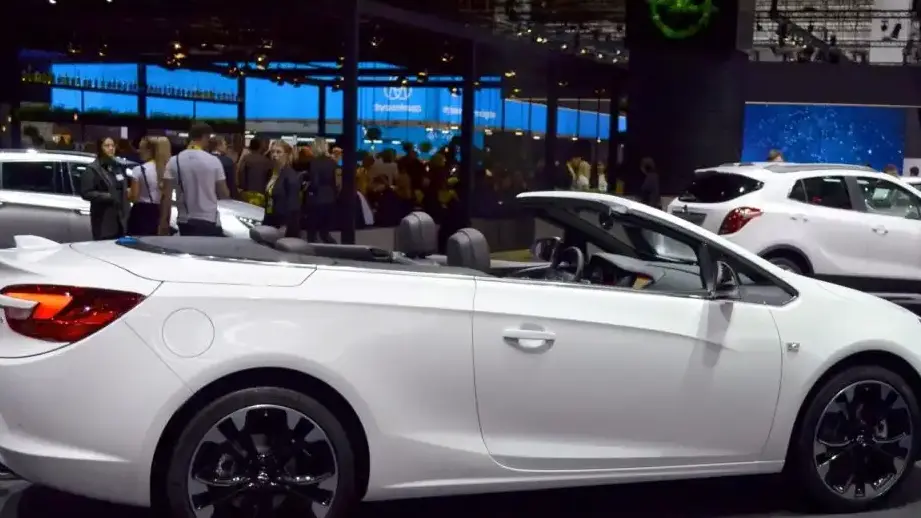
The Opel Cascada 1.6 (136 hp) Automatic, produced from April 2018 to March 2019, represented an entry-level offering within the Cascada range. Positioned as a stylish, four-seat convertible, the Cascada aimed to provide accessible open-top motoring. This variant, powered by a turbocharged 1.6-liter gasoline engine paired with a six-speed automatic transmission, was designed to balance fuel efficiency with reasonable performance. It served as a more affordable alternative to the higher-powered versions of the Cascada, targeting buyers prioritizing comfort and style over outright speed.
Technical Specifications
| Brand | Opel |
| Model | Cascada |
| Generation | Cascada |
| Type (Engine) | 1.6 (136 Hp) Automatic |
| Start of production | April, 2018 |
| End of production | March, 2019 |
| Powertrain Architecture | Internal Combustion engine |
| Body type | Cabriolet |
| Seats | 4 |
| Doors | 2 |
| Fuel consumption (urban) | 10 l/100 km (23.5 US mpg) |
| Fuel consumption (extra urban) | 6.2 l/100 km (37.9 US mpg) |
| Fuel consumption (combined) | 7.6 l/100 km (30.9 US mpg) |
| CO2 emissions | 174 g/km |
| Fuel Type | Petrol (Gasoline) |
| Acceleration 0 – 100 km/h | 11.9 sec |
| Acceleration 0 – 62 mph | 11.9 sec |
| Acceleration 0 – 60 mph | 11.3 sec |
| Maximum speed | 200 km/h (124.27 mph) |
| Emission standard | Euro 6d |
| Weight-to-power ratio | 12.7 kg/Hp |
| Weight-to-torque ratio | 7.2 kg/Nm |
| Power | 136 Hp @ 4000-6000 rpm |
| Torque | 240 Nm @ 1650-3500 rpm (177.01 lb.-ft.) |
| Engine layout | Front, Transverse |
| Engine Model/Code | D16SHJ |
| Engine displacement | 1598 cm3 (97.52 cu. in.) |
| Number of cylinders | 4 |
| Engine configuration | Inline |
| Cylinder Bore | 79 mm (3.11 in.) |
| Piston Stroke | 81.5 mm (3.21 in.) |
| Compression ratio | 10.5:1 |
| Number of valves per cylinder | 4 |
| Fuel injection system | Direct injection |
| Engine aspiration | Turbocharger, Intercooler |
| Engine oil capacity | 5.5 l (5.81 US qt | 4.84 UK qt) |
| Kerb Weight | 1733 kg (3820.61 lbs.) |
| Max. weight | 2170 kg (4784.03 lbs.) |
| Max load | 437 kg (963.42 lbs.) |
| Trunk (boot) space – minimum | 380 l (13.42 cu. ft.) |
| Trunk (boot) space – maximum | 750 l (26.49 cu. ft.) |
| Fuel tank capacity | 56 l (14.79 US gal | 12.32 UK gal) |
| Permitted trailer load with brakes (12%) | 1300 kg (2866.01 lbs.) |
| Permitted trailer load without brakes | 750 kg (1653.47 lbs.) |
| Length | 4696 mm (184.88 in.) |
| Width | 1839 mm (72.4 in.) |
| Width including mirrors | 2020 mm (79.53 in.) |
| Height | 1443 mm (56.81 in.) |
| Wheelbase | 2695 mm (106.1 in.) |
| Front track | 1587 mm (62.48 in.) |
| Rear (Back) track | 1587 mm (62.48 in.) |
| Minimum turning circle | 12.2 m (40.03 ft.) |
| Drivetrain Architecture | Front wheel drive |
| Number of gears and type of gearbox | 6 gears, automatic transmission |
| Front brakes | Ventilated discs |
| Rear brakes | Ventilated discs |
| Assisting systems | ABS (Anti-lock braking system) |
| Steering type | Steering rack and pinion |
| Power steering | Electric Steering |
| Tires size | 225/55 R17 |
| Wheel rims size | 7J x 17 |
Powertrain & Engine Architecture
The Cascada 1.6 Automatic utilized the Opel/Vauxhall D16SHJ engine, a 1.6-liter turbocharged inline-four cylinder gasoline engine. This engine featured direct fuel injection and an intercooled turbocharger, contributing to its relatively efficient power output. The D16SHJ is part of the Small Engine Family (SEF) developed by General Motors, and it’s known for its responsiveness and decent fuel economy. The engine produced 136 horsepower at 4000-6000 rpm and 240 Nm (177 lb-ft) of torque between 1650 and 3500 rpm. This torque curve provided good low-end and mid-range pull, making it suitable for everyday driving. The engine was paired with a six-speed automatic transmission, designed to offer smooth gear changes and enhance driving comfort. While not a performance-oriented transmission, it was well-suited to the engine’s power characteristics.
Driving Characteristics
The 1.6-liter engine and automatic transmission combination in the Cascada delivered a comfortable, rather than sporty, driving experience. Acceleration from 0-60 mph took around 11.3 seconds, and top speed was limited to 124 mph. The automatic transmission, while smooth, wasn’t particularly quick to downshift, and the engine could feel somewhat strained when pushed hard. The gear ratios were optimized for fuel efficiency and cruising, rather than aggressive acceleration. Compared to the more powerful 2.0-liter turbo variants, the 1.6 offered a more relaxed driving experience, prioritizing comfort and ease of use. The automatic transmission eliminated the need for manual gear changes, making it ideal for city driving and long journeys.
Equipment & Trim Levels
The Cascada 1.6 Automatic typically came with a reasonable level of standard equipment. This included air conditioning, electric front windows, a touchscreen infotainment system with Bluetooth connectivity, and alloy wheels. Safety features such as ABS, electronic stability control, and multiple airbags were also standard. Higher trim levels offered additional features like leather upholstery, heated seats, a premium sound system, and parking sensors. The Cascada’s interior was generally well-appointed, with a focus on comfort and style. The convertible top was electrically operated and provided good insulation from the elements when closed.
Chassis & Braking
The Cascada featured a front-wheel-drive chassis with independent suspension at the front and a semi-independent torsion beam suspension at the rear. The front brakes were ventilated discs, while the rear brakes were also ventilated discs. The steering was electrically assisted, providing light and precise control. The suspension was tuned for comfort, offering a smooth ride over most road surfaces. The Cascada’s chassis was designed to provide good stability and handling, although it wasn’t as sporty as some other convertibles in its class. The weight distribution was reasonably balanced, contributing to predictable handling characteristics.
Market Reception & Comparison
The Opel Cascada 1.6 Automatic received mixed reviews from automotive critics. While praised for its stylish design and comfortable ride, it was often criticized for its lack of performance and somewhat unrefined automatic transmission. Fuel economy was considered reasonable for a convertible, but not class-leading. Compared to other convertibles in its price range, the Cascada offered a good balance of features and affordability. However, it faced competition from more established rivals such as the Ford Focus Cabriolet and the Volkswagen Eos. The 1.6-liter engine offered a lower purchase price and potentially lower running costs compared to the more powerful 2.0-liter turbo variants, making it an attractive option for budget-conscious buyers.
Legacy
The Opel Cascada, and specifically the 1.6 Automatic variant, has established a modest following in the used car market. The D16SHJ engine is generally considered reliable, although regular maintenance is essential to prevent issues with the turbocharger and direct injection system. The automatic transmission is also generally reliable, but it’s important to check for smooth gear changes and any signs of slippage. The Cascada’s convertible top can be prone to wear and tear, so it’s important to inspect it carefully before purchasing a used model. Overall, the Cascada 1.6 Automatic offers a stylish and comfortable open-top motoring experience at an affordable price, making it a viable option for buyers seeking a used convertible.
