
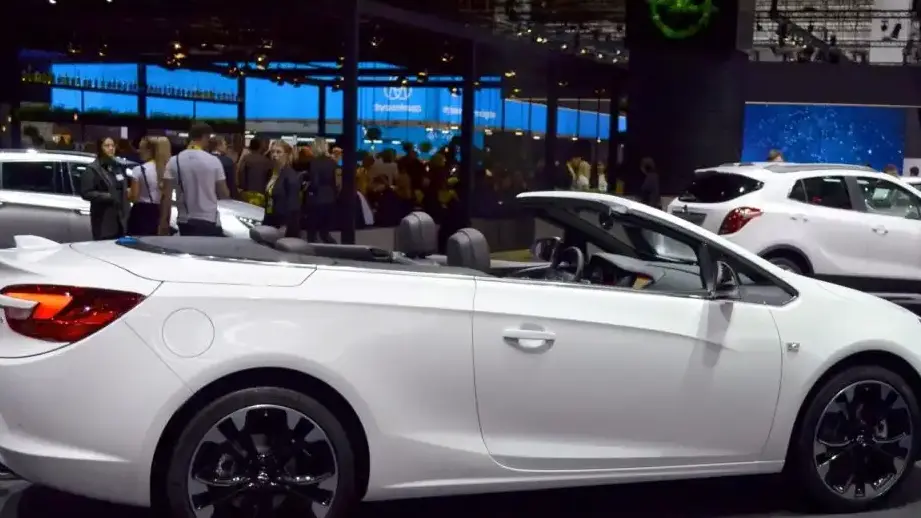
The Opel Cascada 1.6 (170 hp) Start/Stop was a front-wheel-drive, four-seater convertible produced between April 2018 and April 2019. Positioned as a mid-range offering within the Cascada lineup, it aimed to provide a balance between performance and fuel efficiency for buyers seeking an open-top motoring experience. The Cascada itself was Opel’s entry into the mid-size convertible market, competing with vehicles like the Ford Mustang Convertible and Volkswagen Eos. This particular variant utilized a turbocharged 1.6-liter gasoline engine paired with a six-speed manual transmission, representing a popular configuration for European drivers.
Technical Specifications
| Brand | Opel |
| Model | Cascada |
| Generation | Cascada |
| Type (Engine) | 1.6 (170 Hp) Start/Stop |
| Start of production | April, 2018 |
| End of production | April, 2019 |
| Powertrain Architecture | Internal Combustion engine |
| Body type | Cabriolet |
| Seats | 4 |
| Doors | 2 |
| Fuel consumption (urban) | 9.3 l/100 km (25.3 US mpg) |
| Fuel consumption (extra urban) | 5.9 l/100 km (39.9 US mpg) |
| Fuel consumption (combined) | 7.2 l/100 km (32.7 US mpg) |
| CO2 emissions | 164 g/km |
| Fuel Type | Petrol (Gasoline) |
| Acceleration 0 – 100 km/h | 9.9 sec |
| Acceleration 0 – 62 mph | 9.9 sec |
| Acceleration 0 – 60 mph | 9.4 sec |
| Maximum speed | 220 km/h (136.7 mph) |
| Emission standard | Euro 6d |
| Weight-to-power ratio | 10.2 kg/Hp |
| Weight-to-torque ratio | 6.2 kg/Nm |
| Power | 170 Hp @ 4750-6000 rpm |
| Torque | 280 Nm @ 1650-4500 rpm (206.52 lb.-ft.) |
| Engine layout | Front, Transverse |
| Engine Model/Code | D16SHL |
| Engine displacement | 1598 cm3 (97.52 cu. in.) |
| Number of cylinders | 4 |
| Engine configuration | Inline |
| Cylinder Bore | 79 mm (3.11 in.) |
| Piston Stroke | 81.5 mm (3.21 in.) |
| Compression ratio | 10.5:1 |
| Number of valves per cylinder | 4 |
| Fuel injection system | Direct injection |
| Engine aspiration | Turbocharger, Intercooler |
| Engine oil capacity | 5.5 l (5.81 US qt | 4.84 UK qt) |
| Kerb Weight | 1733 kg (3820.61 lbs.) |
| Max. weight | 2150 kg (4739.94 lbs.) |
| Max load | 417 kg (919.33 lbs.) |
| Trunk (boot) space – minimum | 380 l (13.42 cu. ft.) |
| Trunk (boot) space – maximum | 750 l (26.49 cu. ft.) |
| Fuel tank capacity | 56 l (14.79 US gal | 12.32 UK gal) |
| Permitted trailer load with brakes (12%) | 1300 kg (2866.01 lbs.) |
| Permitted trailer load without brakes | 750 kg (1653.47 lbs.) |
| Length | 4696 mm (184.88 in.) |
| Width | 1839 mm (72.4 in.) |
| Width including mirrors | 2020 mm (79.53 in.) |
| Height | 1443 mm (56.81 in.) |
| Wheelbase | 2695 mm (106.1 in.) |
| Front track | 1587 mm (62.48 in.) |
| Rear (Back) track | 1587 mm (62.48 in.) |
| Minimum turning circle | 12.2 m (40.03 ft.) |
| Drivetrain Architecture | Front wheel drive |
| Number of gears and type of gearbox | 6 gears, manual transmission |
| Front brakes | Ventilated discs |
| Rear brakes | Ventilated discs |
| Assisting systems | ABS (Anti-lock braking system) |
| Steering type | Steering rack and pinion |
| Power steering | Electric Steering |
| Tires size | 225/55 R17 |
| Wheel rims size | 7J x 17 |
Introduction
The Opel Cascada, launched in 2013, was designed to fill a gap in Opel’s lineup for a stylish, mid-size convertible. The 1.6 (170 hp) Start/Stop variant, introduced in 2018 as part of a mid-cycle refresh, offered a more economical engine option compared to the higher-powered 2.0-liter alternatives. Built on the GM Delta platform (also known as the 1HX0 platform), the Cascada aimed to provide a comfortable and refined driving experience with the added enjoyment of open-top motoring. This model year also saw the Cascada updated to meet the more stringent Euro 6d emissions standards.
Powertrain & Engine Architecture
At the heart of the Cascada 1.6 was the D16SHL engine, a 1.6-liter turbocharged inline-four cylinder gasoline engine. This engine featured direct fuel injection, optimizing fuel delivery for improved efficiency and power output. The turbocharger, coupled with an intercooler, helped to mitigate turbo lag and provide a broader torque curve. The engine produced 170 horsepower at 4750-6000 rpm and 280 Nm (206.52 lb.-ft.) of torque between 1650-4500 rpm. The Start/Stop system, standard on this variant, automatically shut off the engine when the vehicle came to a halt, further enhancing fuel economy in urban driving conditions. The engine was mated to a six-speed manual transmission, providing drivers with precise control over gear selection. This transmission was chosen to balance cost and driver engagement, unlike some competitors who offered continuously variable transmissions (CVTs).
Driving Characteristics
The Cascada 1.6 offered a respectable, though not particularly sporty, driving experience. The 170 hp engine provided adequate power for everyday driving and cruising, with the turbocharger providing a noticeable boost in acceleration. The 0-60 mph time of around 9.4 seconds was typical for a mid-size convertible in this class. Compared to the more powerful 2.0-liter versions, the 1.6 felt less eager to rev, but the broader torque band made it more flexible in real-world traffic. The six-speed manual transmission allowed for precise gear changes, but the gear ratios were tuned more for fuel efficiency than outright performance. The Cascada’s suspension prioritized comfort over handling, resulting in a smooth ride, but with some noticeable body roll during cornering.
Equipment & Trim Levels
The Cascada 1.6 typically came with a good level of standard equipment. This included air conditioning, a touchscreen infotainment system with Bluetooth connectivity, alloy wheels, and a leather-wrapped steering wheel. Safety features such as ABS, electronic stability control, and multiple airbags were also standard. Optional extras included heated seats, a premium sound system, and a wind deflector to reduce turbulence in the cabin when the roof was down. Interior upholstery was typically cloth, with leather options available as an upgrade. The dashboard layout was relatively straightforward and functional, with a focus on ease of use.
Chassis & Braking
The Cascada’s chassis was designed to provide a comfortable and stable ride. It utilized a MacPherson strut front suspension and a multi-link rear suspension. Braking duties were handled by ventilated discs on all four wheels, providing adequate stopping power. The steering was electrically assisted, offering a light and precise feel. The Cascada 1.6, being a lighter variant compared to the 2.0-liter models, benefited from slightly improved handling balance. Stabilizer bars were fitted front and rear to reduce body roll, but the Cascada was not intended to be a performance-focused vehicle.
Market Reception & Comparison
The Opel Cascada 1.6 received mixed reviews from automotive critics. While praised for its stylish design and comfortable ride, it was often criticized for its lack of outright performance and somewhat bland handling. Compared to the 2.0-liter versions, the 1.6 offered better fuel economy (around 32.7 US mpg combined) but at the expense of acceleration. The 1.6 was generally considered a good option for buyers who prioritized fuel efficiency and comfort over sporty driving dynamics. It competed with vehicles like the Ford Mustang Convertible and Volkswagen Eos, offering a more affordable alternative to some of the more premium convertibles on the market.
Legacy
The Opel Cascada was discontinued in 2019, with no direct replacement. The D16SHL engine proved to be a relatively reliable unit, although regular maintenance is crucial for long-term durability. On the used car market, the Cascada 1.6 represents a relatively affordable entry point into the world of open-top motoring. Its combination of style, comfort, and reasonable running costs makes it an appealing option for buyers seeking a practical and enjoyable convertible. However, potential buyers should be aware of the potential for convertible top wear and tear, and ensure that the vehicle has been properly maintained.
