
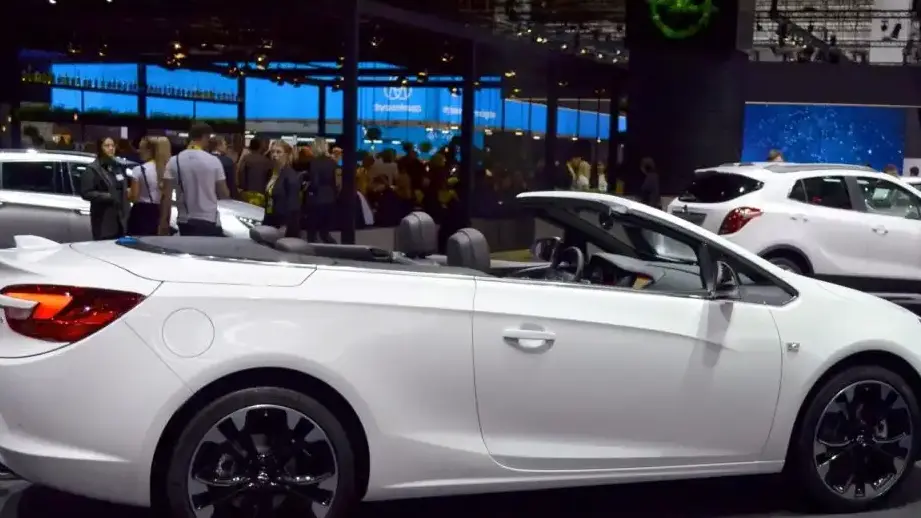
The Opel Cascada 1.6 Turbo Ecotec Automatic, produced from January 2013 to April 2018, was a mid-range offering within the Cascada lineup. Positioned as a stylish, four-seat convertible, the Cascada aimed to recapture Opel’s presence in the premium mid-size cabriolet segment. This variant, powered by the A16XHT engine and paired with a six-speed automatic transmission, offered a balance between performance and fuel efficiency, targeting buyers seeking a comfortable and refined open-top driving experience. The Cascada itself represented Opel’s attempt to create a more sophisticated and upscale vehicle, moving away from its traditionally budget-focused image, primarily for the European market.
Technical Specifications
| Brand | Opel |
| Model | Cascada |
| Generation | Cascada |
| Type (Engine) | 1.6 (170 Hp) Turbo Ecotec Automatic |
| Start of production | January, 2013 |
| End of production | April, 2018 |
| Powertrain Architecture | Internal Combustion engine |
| Body type | Cabriolet |
| Seats | 4 |
| Doors | 2 |
| Fuel consumption (urban) | 9.3-9.4 l/100 km (25.3 – 25 US mpg) |
| Fuel consumption (extra urban) | 5.9 l/100 km (39.9 US mpg) |
| Fuel consumption (combined) | 7.2 l/100 km (32.7 US mpg) |
| CO2 emissions | 168-169 g/km |
| Fuel Type | Petrol (Gasoline) |
| Acceleration 0 – 100 km/h | 9.9 sec |
| Acceleration 0 – 62 mph | 9.9 sec |
| Acceleration 0 – 60 mph | 9.4 sec |
| Maximum speed | 217 km/h (134.84 mph) |
| Emission standard | Euro 5 |
| Weight-to-power ratio | 10 kg/Hp |
| Weight-to-torque ratio | 6.5 kg/Nm |
| Power | 170 Hp @ 6000 rpm |
| Torque | 260 Nm @ 1650-3200 rpm (191.77 lb.-ft.) |
| Engine layout | Front, Transverse |
| Engine Model/Code | A16XHT |
| Engine displacement | 1598 cm3 (97.52 cu. in.) |
| Number of cylinders | 4 |
| Engine configuration | Inline |
| Cylinder Bore | 79 mm (3.11 in.) |
| Piston Stroke | 81.5 mm (3.21 in.) |
| Fuel injection system | Direct injection |
| Engine aspiration | Turbocharger, Intercooler |
| Engine oil capacity | 5.5 l (5.81 US qt | 4.84 UK qt) |
| Kerb Weight | 1701-1816 kg (3750.06 – 4003.59 lbs.) |
| Max. weight | 2105-2200 kg (4640.73 – 4850.17 lbs.) |
| Max load | 384-404 kg (846.58 – 890.67 lbs.) |
| Trunk (boot) space – minimum | 280 l (9.89 cu. ft.) |
| Trunk (boot) space – maximum | 630 l (22.25 cu. ft.) |
| Fuel tank capacity | 56 l (14.79 US gal | 12.32 UK gal) |
| Permitted trailer load with brakes (12%) | 1250-1300 kg (2755.78 – 2866.01 lbs.) |
| Permitted trailer load without brakes | 750 kg (1653.47 lbs.) |
| Length | 4696 mm (184.88 in.) |
| Width | 1839 mm (72.4 in.) |
| Width including mirrors | 2020 mm (79.53 in.) |
| Height | 1443 mm (56.81 in.) |
| Wheelbase | 2695 mm (106.1 in.) |
| Front track | 1587 mm (62.48 in.) |
| Rear (Back) track | 1587 mm (62.48 in.) |
| Ride height (ground clearance) | 145 mm (5.71 in.) |
| Drag coefficient (Cd) | 0.30 |
| Minimum turning circle (turning diameter) | 12.2 m (40.03 ft.) |
| Drivetrain Architecture | Front wheel drive |
| Number of gears and type of gearbox | 6 gears, automatic transmission |
| Front brakes | Ventilated discs |
| Rear brakes | Disc |
Powertrain & Engine Architecture
The heart of the Cascada 1.6 Turbo Ecotec Automatic is the A16XHT engine, a 1.6-liter inline-four cylinder powerplant. This engine utilizes direct fuel injection and a single turbocharger with an intercooler to deliver a respectable 170 horsepower at 6000 rpm and 260 Nm (191.77 lb.-ft.) of torque between 1650 and 3200 rpm. The direct injection system allows for precise fuel delivery, improving both efficiency and performance. The turbocharger provides a boost in power, compensating for the relatively small displacement. The engine is transversely mounted in the front of the vehicle. The six-speed automatic transmission, while providing convenience, was not known for particularly rapid shifts, prioritizing smooth operation over outright performance.
Driving Characteristics
The 1.6-liter turbo engine, coupled with the automatic transmission, provided adequate, but not exhilarating, performance. Acceleration from 0 to 100 km/h (0-62 mph) took approximately 9.9 seconds. The automatic transmission’s gear ratios were tuned for fuel economy and comfortable cruising rather than aggressive acceleration. Compared to the more powerful 2.0-liter Turbo Ecotec variants, the 1.6 felt noticeably less responsive, particularly during overtaking maneuvers. However, the readily available torque at lower engine speeds made it suitable for everyday driving. The automatic transmission, while smooth, lacked the engagement and control offered by the available manual gearbox.
Equipment & Trim Levels
The Cascada 1.6 Turbo Ecotec Automatic typically came equipped with a reasonable level of standard features. These included air conditioning, electric windows, a basic audio system, and alloy wheels. Higher trim levels added features such as leather upholstery, heated seats, a more advanced infotainment system with navigation, and parking sensors. Optional extras included a premium sound system, a wind deflector (to reduce wind buffeting with the top down), and various cosmetic enhancements. The interior design was generally considered modern and well-built, though not particularly luxurious compared to some of its competitors.
Chassis & Braking
The Cascada featured a conventional front-wheel-drive layout with MacPherson strut suspension at the front and a multi-link setup at the rear. The braking system consisted of ventilated discs at the front and solid discs at the rear. ABS (Anti-lock Braking System) was standard. The suspension was tuned for comfort, providing a relatively smooth ride, but it wasn’t particularly sporty. The steering was electrically assisted, offering light and easy maneuverability. Stabilizer bars were fitted front and rear to reduce body roll during cornering, though the Cascada was primarily designed as a comfortable cruiser rather than a performance vehicle.
Market Reception & Comparison
The Cascada 1.6 Turbo Ecotec Automatic received mixed reviews. Critics praised its stylish design and comfortable ride, but some found the engine to be underpowered, especially when paired with the automatic transmission. Fuel economy was generally considered good for a vehicle of its size and type, averaging around 7.2 l/100 km (32.7 US mpg). Compared to the more powerful 2.0-liter variants, the 1.6 offered a lower price point and better fuel efficiency, making it an attractive option for buyers prioritizing value and economy. However, the 2.0-liter models provided a significantly more engaging driving experience.
Legacy
The Opel Cascada, while not a massive sales success, offered a stylish and comfortable open-top driving experience. The 1.6 Turbo Ecotec engine, while not known for exceptional reliability, proved to be generally durable with proper maintenance. Common issues included occasional turbocharger problems and oil leaks. On the used car market, the Cascada 1.6 Automatic represents a relatively affordable entry point into the world of premium convertibles. Its combination of style, comfort, and reasonable running costs makes it a viable option for buyers seeking a well-equipped and enjoyable open-top vehicle.
