
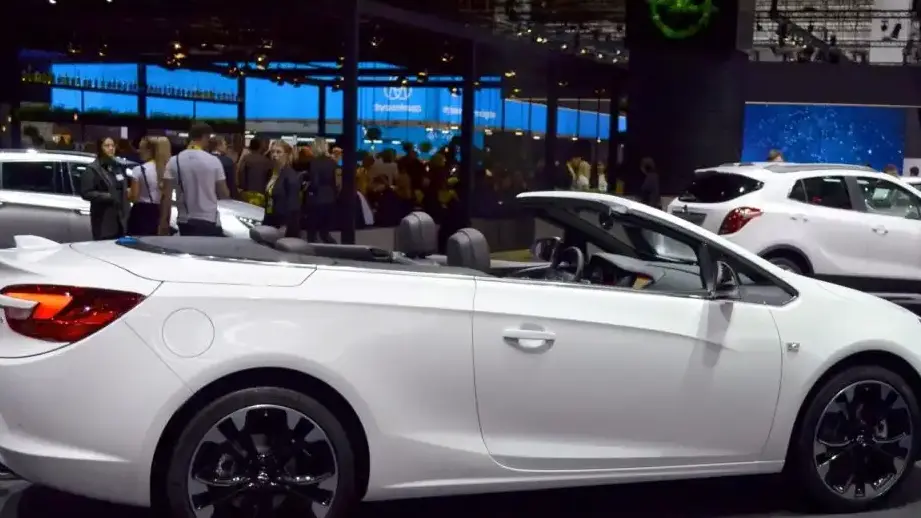
Technical Specifications
| Brand | Opel |
| Model | Cascada |
| Generation | Cascada |
| Type (Engine) | 1.6 (170 Hp) Turbo Ecotec start/stop |
| Start of production | January, 2013 |
| End of production | April, 2018 |
| Powertrain Architecture | Internal Combustion engine |
| Body type | Cabriolet |
| Seats | 4 |
| Doors | 2 |
| Fuel consumption (urban) | 8 l/100 km (29.4 US mpg, 35.3 UK mpg, 12.5 km/l) |
| Fuel consumption (extra urban) | 5.3-5.4 l/100 km (44.4 – 43.6 US mpg, 53.3 – 52.3 UK mpg, 18.9 – 18.5 km/l) |
| Fuel consumption (combined) | 6.3 l/100 km (37.3 US mpg, 44.8 UK mpg, 15.9 km/l) |
| CO2 emissions | 148-149 g/km |
| Fuel Type | Petrol (Gasoline) |
| Acceleration 0 – 100 km/h | 9.6 sec |
| Acceleration 0 – 62 mph | 9.6 sec |
| Acceleration 0 – 60 mph | 9.1 sec |
| Maximum speed | 222 km/h (137.94 mph) |
| Emission standard | Euro 5 |
| Weight-to-power ratio | 10 kg/Hp, 99.9 Hp/tonne |
| Weight-to-torque ratio | 6.5 kg/Nm, 152.9 Nm/tonne |
| Power | 170 Hp @ 6000 rpm |
| Power per litre | 106.4 Hp/l |
| Torque | 260 Nm @ 1650-3200 rpm (191.77 lb.-ft. @ 1650-3200 rpm) |
| Engine layout | Front, Transverse |
| Engine Model/Code | A16XHT |
| Engine displacement | 1598 cm3 (97.52 cu. in.) |
| Number of cylinders | 4 |
| Engine configuration | Inline |
| Cylinder Bore | 79 mm (3.11 in.) |
| Piston Stroke | 81.5 mm (3.21 in.) |
| Fuel injection system | Direct injection |
| Engine aspiration | Turbocharger, Intercooler |
| Engine oil capacity | 5.5 l (5.81 US qt | 4.84 UK qt) |
| Kerb Weight | 1701-1816 kg (3750.06 – 4003.59 lbs.) |
| Max. weight | 2105-2200 kg (4640.73 – 4850.17 lbs.) |
| Max load | 384-404 kg (846.58 – 890.67 lbs.) |
| Trunk (boot) space – minimum | 280 l (9.89 cu. ft.) |
| Trunk (boot) space – maximum | 630 l (22.25 cu. ft.) |
| Fuel tank capacity | 56 l (14.79 US gal | 12.32 UK gal) |
| Permitted trailer load with brakes (12%) | 1250-1300 kg (2755.78 – 2866.01 lbs.) |
| Permitted trailer load without brakes | 750 kg (1653.47 lbs.) |
| Length | 4696 mm (184.88 in.) |
| Width | 1839 mm (72.4 in.) |
| Width including mirrors | 2020 mm (79.53 in.) |
| Height | 1443 mm (56.81 in.) |
| Wheelbase | 2695 mm (106.1 in.) |
| Front track | 1587 mm (62.48 in.) |
| Rear (Back) track | 1587 mm (62.48 in.) |
| Ride height (ground clearance) | 145 mm (5.71 in.) |
| Drag coefficient (Cd) | 0.30 |
| Minimum turning circle (turning diameter) | 12.2 m (40.03 ft.) |
| Drivetrain Architecture | The Internal combustion engine (ICE) drives the front wheels of the vehicle. |
| Drive wheel | Front wheel drive |
| Number of gears and type of gearbox | 6 gears, manual transmission |
| Front brakes | Ventilated discs |
| Rear brakes | Disc |
| Assisting systems | ABS (Anti-lock braking system) |
| Steering type | Steering rack and pinion |
| Power steering | Electric Steering |
The Opel Cascada 1.6 Turbo Ecotec start/stop, produced from January 2013 to April 2018, occupied a mid-range position within the Cascada lineup. This stylish, four-seat convertible was designed to compete with premium drop-top vehicles such as the Audi A3 Cabriolet and BMW 2 Series Convertible. This particular variant, powered by the A16XHT engine, aimed to strike a balance between fuel efficiency and respectable performance, making it an attractive option for buyers prioritizing a comfortable and relatively economical open-top experience. The Cascada itself represented Opel’s return to the mid-size convertible market after a period of absence, utilizing a flexible platform capable of supporting both coupe and convertible body styles.
Powertrain & Engine Architecture
The core of the Cascada 1.6 Turbo Ecotec was the A16XHT engine, a 1.6-liter inline-four cylinder powerplant. This engine incorporated direct fuel injection and a single turbocharger equipped with an intercooler, technologies intended to maximize both power output and fuel economy. The direct injection system allowed for precise fuel metering, optimizing combustion and reducing emissions. The turbocharger increased power by forcing more air into the cylinders, resulting in 170 horsepower and 260 Nm (191.77 lb.-ft.) of torque. The engine’s torque curve was relatively flat, providing good responsiveness across a broad RPM range, peaking between 1650 and 3200 rpm. Power was delivered to the front wheels through a six-speed manual transmission. A standard start/stop system further enhanced fuel savings by automatically shutting down the engine when the vehicle was stationary.
Driving Characteristics
The 1.6-liter turbocharged engine provided adequate performance for the Cascada, achieving a 0-60 mph time of approximately 9.1 seconds. While not designed as a sports car, the Cascada 1.6 offered a comfortable and enjoyable driving experience. The turbocharger provided a noticeable power boost during acceleration, but the engine didn’t feel strained at lower engine speeds. The six-speed manual transmission allowed drivers to select optimal engine RPMs for both fuel efficiency and performance. Compared to the more powerful 2.0-liter Turbo Ecotec models, the 1.6-liter engine offered a more relaxed driving experience, prioritizing fuel economy over outright speed. The gear ratios were tuned to balance acceleration and cruising comfort, making it well-suited for longer highway journeys.
Equipment & Trim Levels
The Cascada 1.6 Turbo Ecotec typically came with a reasonable level of standard equipment. This included features such as air conditioning, a touchscreen infotainment system with Bluetooth connectivity, alloy wheels, and a leather-wrapped steering wheel. Higher trim levels offered additional features like leather upholstery, heated seats, a premium sound system, and advanced driver-assistance systems such as parking sensors and a rearview camera. The electrically operated convertible top featured relatively quiet operation. Interior upholstery was generally cloth on base models, with leather options available on higher trims. The dashboard configuration was largely consistent across the range, emphasizing user-friendly controls and a modern aesthetic.
Chassis & Braking
The Cascada utilized a front-wheel-drive chassis with independent suspension on all four wheels. The front suspension featured MacPherson struts, while the rear employed a multi-link setup. This configuration provided a good compromise between ride comfort and handling. The braking system consisted of ventilated discs at the front and solid discs at the rear, equipped with ABS (Anti-lock Braking System) as standard. The steering was electrically assisted, providing light and precise control. Stabilizer bars were fitted to both the front and rear axles to minimize body roll during cornering. The Cascada’s chassis was reinforced to compensate for the absence of a fixed roof, ensuring structural rigidity and reducing scuttle shake.
Market Reception & Comparison
The Opel Cascada 1.6 Turbo Ecotec was generally well-received by automotive critics. It was praised for its stylish design, comfortable ride, and relatively fuel-efficient engine. However, some reviewers noted that the 1.6-liter engine could feel somewhat underpowered when the vehicle was fully loaded or when tackling steep inclines. Compared to the more powerful 2.0-liter variants, the 1.6-liter offered improved fuel economy but less exhilarating performance. In terms of reliability, the A16XHT engine proved to be generally dependable, although some owners reported minor issues with the turbocharger and fuel injection system. The Cascada’s fuel economy figures were competitive within its segment, achieving around 37.3 US mpg on the combined cycle.
Legacy
The Opel Cascada, while not a runaway sales success, remains a popular choice among used car buyers seeking a stylish and affordable convertible. The 1.6 Turbo Ecotec engine has proven to be relatively durable, and parts availability is generally good. The Cascada’s comfortable ride and well-equipped interior continue to appeal to buyers looking for a relaxed open-top driving experience. While it may not possess the prestige of some of its German competitors, the Cascada represents a compelling value proposition in the used car market, offering a blend of style, comfort, and fuel efficiency. It provides a viable alternative for those seeking a European convertible experience without the higher price tag associated with premium brands.
