
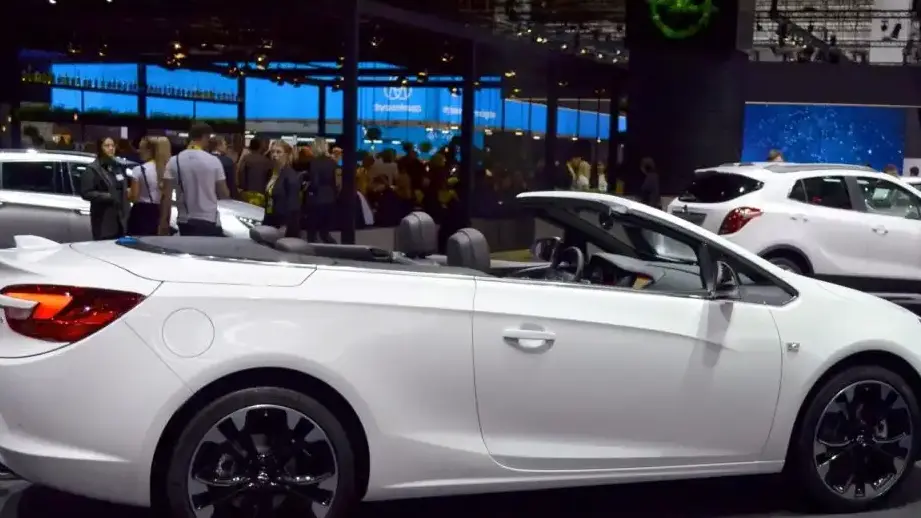
The Opel Cascada 2.0 CDTI (165 Hp) Ecotec start/stop, produced from January 2013 to August 2015, represents a mid-range offering within the Cascada lineup. The Cascada itself was Opel’s entry into the mid-size convertible market, aiming to compete with vehicles like the Ford Focus CC and Peugeot 308 CC. Positioned between the base 1.4L turbo petrol and the more powerful 2.0L BiTurbo diesel, the 2.0 CDTI offered a balance of performance and fuel economy for buyers seeking a comfortable and relatively efficient open-top experience. It was primarily sold in European markets, leveraging Opel’s established presence and reputation for value.
Technical Specifications
| Brand | Opel |
| Model | Cascada |
| Generation | Cascada |
| Type (Engine) | 2.0 CDTI (165 Hp) Ecotec start/stop |
| Start of production | January, 2013 |
| End of production | August, 2015 |
| Powertrain Architecture | Internal Combustion engine |
| Body type | Cabriolet |
| Seats | 4 |
| Doors | 2 |
| Fuel consumption (urban) | 6.3-6.4 l/100 km (37.3 – 36.8 US mpg, 44.8 – 44.1 UK mpg, 15.9 – 15.6 km/l) |
| Fuel consumption (extra urban) | 4.6 l/100 km (51.1 US mpg, 61.4 UK mpg, 21.7 km/l) |
| Fuel consumption (combined) | 5.2-5.3 l/100 km (45.2 – 44.4 US mpg, 54.3 – 53.3 UK mpg, 19.2 – 18.9 km/l) |
| CO2 emissions | 138-139 g/km |
| Fuel Type | Diesel |
| Acceleration 0 – 100 km/h | 10.3 sec |
| Acceleration 0 – 62 mph | 10.3 sec |
| Acceleration 0 – 60 mph | 9.8 sec |
| Maximum speed | 218 km/h (135.46 mph) |
| Emission standard | Euro 5 |
| Weight-to-power ratio | 10.3 kg/Hp, 97 Hp/tonne |
| Weight-to-torque ratio | 4.9 kg/Nm, 205.8 Nm/tonne |
| Power | 165 Hp @ 4000 rpm |
| Power per litre | 84.4 Hp/l |
| Torque | 350 Nm @ 1750-2500 rpm (258.15 lb.-ft. @ 1750-2500 rpm) |
| Engine layout | Front, Transverse |
| Engine Model/Code | A20DTH |
| Engine displacement | 1956 cm3 (119.36 cu. in.) |
| Number of cylinders | 4 |
| Engine configuration | Inline |
| Cylinder Bore | 83 mm (3.27 in.) |
| Piston Stroke | 90.4 mm (3.56 in.) |
| Fuel injection system | Diesel Commonrail |
| Engine aspiration | Turbocharger, Intercooler |
| Engine oil capacity | 4.5 l (4.76 US qt | 3.96 UK qt) |
| Kerb Weight | 1701-1816 kg (3750.06 – 4003.59 lbs.) |
| Max. weight | 2105-2200 kg (4640.73 – 4850.17 lbs.) |
| Max load | 384-404 kg (846.58 – 890.67 lbs.) |
| Trunk (boot) space – minimum | 280 l (9.89 cu. ft.) |
| Trunk (boot) space – maximum | 630 l (22.25 cu. ft.) |
| Fuel tank capacity | 56 l (14.79 US gal | 12.32 UK gal) |
| Permitted trailer load with brakes (12%) | 1250-1300 kg (2755.78 – 2866.01 lbs.) |
| Permitted trailer load without brakes | 750 kg (1653.47 lbs.) |
| Length | 4696 mm (184.88 in.) |
| Width | 1839 mm (72.4 in.) |
| Width including mirrors | 2020 mm (79.53 in.) |
| Height | 1443 mm (56.81 in.) |
| Wheelbase | 2695 mm (106.1 in.) |
| Front track | 1587 mm (62.48 in.) |
| Rear (Back) track | 1587 mm (62.48 in.) |
| Ride height (ground clearance) | 145 mm (5.71 in.) |
| Drag coefficient (Cd) | 0.30 |
| Minimum turning circle (turning diameter) | 12.2 m (40.03 ft.) |
| Drivetrain Architecture | The Internal combustion engine (ICE) drives the front wheels of the vehicle. |
| Drive wheel | Front wheel drive |
| Number of gears and type of gearbox | 6 gears, manual transmission |
| Front brakes | Ventilated discs |
| Rear brakes | Disc |
| Assisting systems | ABS (Anti-lock braking system) |
| Steering type | Steering rack and pinion |
| Power steering | Electric Steering |
Powertrain & Engine Architecture
The heart of the Cascada 2.0 CDTI is the A20DTH engine, a 1.956-liter inline-four cylinder diesel. This engine is part of Opel/Vauxhall’s Ecotec family, known for its focus on efficiency and refinement. The A20DTH utilizes a common rail direct injection system, delivering fuel at extremely high pressures for optimized combustion. A turbocharger with intercooling further enhances performance, providing increased air intake to the engine. The engine produces 165 horsepower at 4000 rpm and a substantial 350 Nm (258 lb-ft) of torque between 1750 and 2500 rpm. The engine also featured Opel’s Start/Stop system, automatically shutting off the engine when the vehicle is stationary to reduce fuel consumption and emissions. The engine was paired with a six-speed manual transmission, delivering power to the front wheels.
Driving Characteristics
The 2.0 CDTI with the manual transmission offered a reasonably engaging driving experience for a front-wheel-drive convertible. While not a sports car, the 350 Nm of torque provided ample pulling power for everyday driving and overtaking maneuvers. The six-speed gearbox was well-matched to the engine’s characteristics, allowing for comfortable cruising on the highway. Acceleration from 0-100 km/h (0-62 mph) took around 10.3 seconds. Compared to the 1.4L turbo petrol, the 2.0 CDTI offered significantly more torque and a more relaxed driving experience, particularly when fully loaded or on inclines. However, it lacked the responsiveness of the higher-output 2.0 BiTurbo diesel. The steering was light and precise, making it easy to maneuver in urban environments. The convertible top mechanism did slightly impact the structural rigidity of the chassis, but Opel implemented bracing to minimize flex.
Equipment & Trim Levels
The Cascada 2.0 CDTI typically came equipped with a good level of standard features. These included air conditioning, electric front windows, a CD/MP3 stereo system, and alloy wheels. Higher trim levels, such as ‘Sport’ or ‘Cosmo’, added features like leather upholstery, heated front seats, a more advanced infotainment system with touchscreen display, and parking sensors. Optional extras included a panoramic sunroof, adaptive cruise control, and a premium sound system. Interior upholstery was typically cloth on base models, with leather options available on higher trims. The dashboard layout was modern and functional, with a focus on ergonomics.
Chassis & Braking
The Cascada utilized a MacPherson strut front suspension and a multi-link rear suspension, providing a comfortable ride quality. The suspension was tuned to balance handling and comfort, making it suitable for both city driving and longer journeys. Braking duties were handled by ventilated discs at the front and solid discs at the rear, equipped with ABS (Anti-lock Braking System) as standard. The braking system provided adequate stopping power for the vehicle’s weight and performance. The steering employed an electric power steering system, offering light and precise control.
Market Reception & Comparison
The Opel Cascada 2.0 CDTI was generally well-received by automotive critics. It was praised for its comfortable ride, refined engine, and good fuel economy. However, some critics noted that the interior quality wasn’t quite on par with some of its more premium competitors. Compared to the 1.4L turbo petrol, the 2.0 CDTI offered superior torque and fuel efficiency, making it a more practical choice for long-distance driving. Compared to the 2.0 BiTurbo diesel, it offered a lower price point but sacrificed some performance. Fuel economy figures of around 5.2-5.3 l/100 km (45.2-44.4 US mpg) were competitive for its class.
Legacy
The A20DTH engine, found in the Cascada 2.0 CDTI, has proven to be a relatively reliable unit when properly maintained. Common issues include diesel particulate filter (DPF) clogging, particularly on vehicles used primarily for short journeys, and occasional turbocharger wear. However, these issues are not uncommon for modern diesel engines. On the used car market, the Cascada 2.0 CDTI represents a relatively affordable entry point into the mid-size convertible segment. Its combination of comfort, fuel efficiency, and reasonable performance makes it an attractive option for buyers seeking a stylish and practical open-top car.
