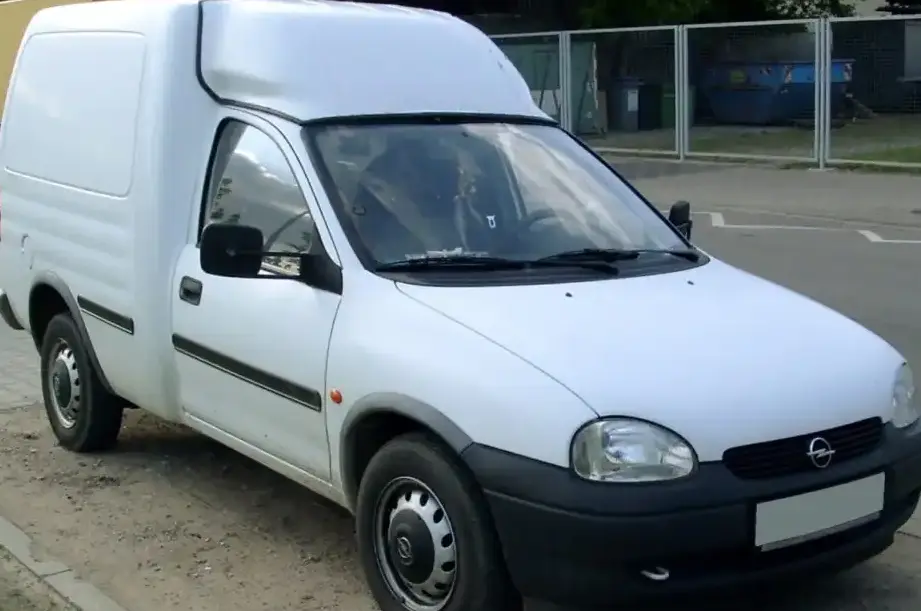
The Opel Combo Tour B 1.2, producing 45 horsepower, was a utilitarian light commercial vehicle offered between 1993 and 1996. Part of the broader Combo Tour B generation (1993-2001), this variant represented the entry point into the Combo range, primarily aimed at businesses and individuals requiring a basic, affordable, and practical vehicle for light-duty tasks. It was built upon the Corsa B platform, sharing many components with its passenger car sibling. The Combo Tour B was a popular choice in Europe, particularly in countries where small vans and pickups were favored for their maneuverability and low running costs.
Technical Specifications
| Brand | Opel |
| Model | Combo |
| Generation | Combo Tour B |
| Type (Engine) | 1.2 (45 Hp) |
| Start of production | 1993 |
| End of production | 1996 |
| Powertrain Architecture | Internal Combustion engine |
| Body type | Pick-up |
| Seats | 2 |
| Doors | 3 |
| Fuel Type | Petrol (Gasoline) |
| Weight-to-power ratio | 23.7 kg/Hp, 42.3 Hp/tonne |
| Weight-to-torque ratio | 12.1 kg/Nm, 82.6 Nm/tonne |
| Power | 45 Hp @ 5000 rpm |
| Power per litre | 37.7 Hp/l |
| Torque | 88 Nm @ 2400 rpm (64.91 lb.-ft. @ 2400 rpm) |
| Engine layout | Front, Transverse |
| Engine Model/Code | C12NZ |
| Engine displacement | 1195 cm3 (72.92 cu. in.) |
| Number of cylinders | 4 |
| Engine configuration | Inline |
| Cylinder Bore | 72 mm (2.83 in.) |
| Piston Stroke | 73.4 mm (2.89 in.) |
| Compression ratio | 10:1 |
| Number of valves per cylinder | 2 |
| Fuel injection system | Single-point injection |
| Engine aspiration | Naturally aspirated engine |
| Engine oil capacity | 3.5 l (3.7 US qt | 3.08 UK qt) |
| Coolant | 5.9 l (6.23 US qt | 5.19 UK qt) |
| Kerb Weight | 1065 kg (2347.92 lbs.) |
| Max. weight | 1620 kg (3571.49 lbs.) |
| Max load | 555 kg (1223.57 lbs.) |
| Trunk (boot) space – maximum | 3000 l (105.94 cu. ft.) |
| Length | 4230 mm (166.54 in.) |
| Width | 1686 mm (66.38 in.) |
| Height | 1805 mm (71.06 in.) |
| Wheelbase | 2480 mm (97.64 in.) |
| Front track | 1387 mm (54.61 in.) |
| Rear (Back) track | 1427 mm (56.18 in.) |
| Ride height (ground clearance) | 160 mm (6.3 in.) |
| Drivetrain Architecture | The Internal combustion engine (ICE) drives the front wheels of the vehicle. |
| Drive wheel | Front wheel drive |
| Number of gears and type of gearbox | 4 gears, manual transmission |
Powertrain & Engine Architecture
The heart of the Combo Tour B 1.2 was the C12NZ engine, a 1.2-liter inline-four cylinder petrol engine. This engine was a relatively simple design, featuring a single overhead camshaft and two valves per cylinder. It utilized a single-point fuel injection system, which, while cost-effective, was less sophisticated than multi-point injection systems found in more expensive vehicles. The C12NZ was known for its durability and ease of maintenance, but its performance was modest. The engine produced 45 horsepower at 5000 rpm and 88 Nm (64.91 lb-ft) of torque at 2400 rpm. This power was delivered to the front wheels through a four-speed manual transmission. The transmission was chosen for its simplicity and robustness, aligning with the overall utilitarian nature of the vehicle.
Driving Characteristics
The 1.2-liter engine in the Combo Tour B provided adequate, but not exhilarating, performance. Acceleration was slow, and overtaking required careful planning. The four-speed gearbox was geared for economy rather than speed, with relatively short gear ratios. This meant that the engine needed to be revved to maintain speed, especially when carrying a load. Compared to other Combo Tour B variants, such as the 1.6-liter models, the 1.2 was significantly slower. However, the lower power output also contributed to better fuel economy. The suspension was tuned for comfort and load-carrying capacity, resulting in a somewhat soft and wallowy ride when unladen. The front-wheel-drive configuration provided predictable handling, but the vehicle was not particularly sporty.
Equipment & Trim Levels
The Combo Tour B 1.2 was typically offered with a very basic level of equipment. Standard features included a driver’s airbag, central locking, and power steering (depending on the market). The interior was functional and durable, with hard-wearing plastic trim and cloth upholstery. Options were limited, but could include a radio/cassette player and upgraded seat coverings. The focus was on providing a practical and affordable vehicle, rather than luxury or refinement. The pickup body style offered a large cargo bed, ideal for transporting goods. The rear tailgate could be opened wide for easy loading and unloading.
Chassis & Braking
The Combo Tour B utilized a simple MacPherson strut front suspension and a twist-beam rear suspension. The front brakes were disc brakes, while the rear brakes were typically drum brakes, contributing to cost savings. The braking system was adequate for the vehicle’s weight and performance, but lacked the sophistication of more advanced systems. The steering was a rack-and-pinion system, providing reasonable precision and feel. The vehicle’s relatively narrow track and short wheelbase contributed to its maneuverability in tight spaces.
Market Reception & Comparison
The Opel Combo Tour B 1.2 was generally well-received as a practical and affordable light commercial vehicle. Critics praised its durability, low running costs, and spacious cargo area. However, the engine’s lack of power was a common criticism. Compared to the 1.6-liter Combo, the 1.2 offered significantly less performance, but at a lower purchase price. The 1.7-liter diesel versions provided better fuel economy and torque, but were more expensive to buy and maintain. The Combo Tour B competed with other small vans and pickups, such as the Citroën Berlingo, Peugeot Partner, and Renault Kangoo.
Legacy
The Opel Combo Tour B 1.2, while not a performance icon, remains a popular choice among those seeking a simple, reliable, and affordable light commercial vehicle. The C12NZ engine is known for its longevity, and many examples are still on the road today. Parts availability is generally good, and maintenance is relatively straightforward. In the used car market, the 1.2-liter version is often the most affordable option, making it an attractive choice for budget-conscious buyers. While it may not offer the refinement or performance of more modern vehicles, the Combo Tour B 1.2 continues to serve as a testament to the enduring appeal of a practical and well-built workhorse.