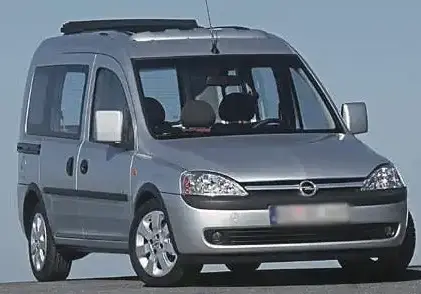
The Opel Combo Tour C 1.6i, producing 87 horsepower, was a mainstay of the Opel Combo Tour C range from its introduction in March 2002 until 2003. Positioned as an entry-level offering, it provided affordable transportation within the compact minivan segment, primarily aimed at families and commercial users needing a versatile vehicle. The Combo Tour C itself was based on the shared GM/Fiat platform, also underpinning vehicles like the Fiat Doblo and Renault Kangoo, representing a collaborative effort to reduce development costs and offer a competitive product in the European market. This variant, with its 1.6-liter engine and five-speed manual transmission, offered a balance between fuel economy and practicality, though it wasn’t intended for performance driving.
Technical Specifications
| Brand | Opel |
| Model | Combo |
| Generation | Combo Tour C |
| Type (Engine) | 1.6i (87 Hp) |
| Start of production | March, 2002 |
| End of production | 2003 |
| Powertrain Architecture | Internal Combustion engine |
| Body type | Minivan |
| Seats | 5 |
| Doors | 5 |
| Fuel consumption (urban) | 10.5 l/100 km (22.4 US mpg) |
| Fuel consumption (extra urban) | 6.4 l/100 km (36.8 US mpg) |
| Fuel consumption (combined) | 7.8 l/100 km (30.2 US mpg) |
| Fuel Type | Petrol (Gasoline) |
| Acceleration 0 – 100 km/h | 14 sec |
| Acceleration 0 – 62 mph | 14 sec |
| Acceleration 0 – 60 mph | 13.3 sec |
| Maximum speed | 164 km/h (101.9 mph) |
| Weight-to-power ratio | 13.9 kg/Hp |
| Weight-to-torque ratio | 8.8 kg/Nm |
| Power | 87 Hp @ 5400 rpm |
| Torque | 138 Nm @ 3000 rpm (101.78 lb.-ft. @ 3000 rpm) |
| Engine layout | Front, Transverse |
| Engine Model/Code | Z16SE |
| Engine displacement | 1598 cm3 (97.52 cu. in.) |
| Number of cylinders | 4 |
| Engine configuration | Inline |
| Cylinder Bore | 79 mm (3.11 in.) |
| Piston Stroke | 81.5 mm (3.21 in.) |
| Compression ratio | 9.6:1 |
| Number of valves per cylinder | 2 |
| Fuel injection system | Multi-port manifold injection |
| Engine aspiration | Naturally aspirated engine |
| Valvetrain | OHC |
| Engine oil capacity | 3.5 l (3.7 US qt | 3.08 UK qt) |
| Coolant | 5.8 l (6.13 US qt | 5.1 UK qt) |
| Kerb Weight | 1210 kg (2667.59 lbs.) |
| Max. weight | 1730 kg (3814 lbs.) |
| Max load | 520 kg (1146.4 lbs.) |
| Trunk (boot) space – minimum | 455 l (16.07 cu. ft.) |
| Trunk (boot) space – maximum | 2700 l (95.35 cu. ft.) |
| Fuel tank capacity | 52 l (13.74 US gal | 11.44 UK gal) |
| Length | 4320 mm (170.08 in.) |
| Width | 1685 mm (66.34 in.) |
| Height | 1800 mm (70.87 in.) |
| Wheelbase | 2715 mm (106.89 in.) |
| Front track | 1430 mm (56.3 in.) |
| Rear (Back) track | 1470 mm (57.87 in.) |
| Drivetrain Architecture | Front wheel drive |
| Number of gears and type of gearbox | 5 gears, manual transmission |
| Front suspension | Spring Strut |
| Rear suspension | Coil spring |
| Front brakes | Ventilated discs |
| Rear brakes | Drum |
| Assisting systems | ABS (Anti-lock braking system) |
| Steering type | Steering rack and pinion |
| Power steering | Hydraulic Steering |
| Tires size | 175/65 R14 |
| Wheel rims size | 14 |
Powertrain & Engine Architecture
The heart of the Combo Tour C 1.6i was the Z16SE engine, a 1.6-liter inline-four cylinder gasoline engine. This engine was a relatively simple design, utilizing a single overhead camshaft (OHC) valvetrain with two valves per cylinder. Fuel delivery was handled by a multi-port fuel injection system, providing adequate, though not exceptional, fuel atomization. The Z16SE was known for its durability and relative ease of maintenance, but it wasn’t a particularly sophisticated engine. The five-speed manual transmission paired with the 1.6i engine featured typical gear ratios for a vehicle of this class, prioritizing fuel efficiency over rapid acceleration. First gear was relatively short for easy starts, while fifth gear was geared for comfortable highway cruising.
Driving Characteristics
The 87 horsepower and 101.78 lb-ft of torque produced by the 1.6i engine translated to modest performance. Acceleration from 0-60 mph took around 13.3 seconds, and top speed was limited to approximately 101.9 mph. Compared to higher-output versions of the Combo Tour C, such as those equipped with the 1.7L diesel engine, the 1.6i felt noticeably slower, especially when fully loaded. The manual transmission allowed for reasonable control over the engine’s power band, but drivers often needed to downshift to maintain momentum on inclines or when overtaking. The gear ratios were spaced to maximize fuel economy, resulting in a somewhat lethargic feel at lower speeds.
Equipment & Trim Levels
The 1.6i variant of the Combo Tour C typically came with a basic level of equipment. Standard features generally included power steering, central locking, and a basic audio system. Interior upholstery was typically cloth, and the dashboard featured a functional, if somewhat utilitarian, design. Optional extras included air conditioning, electric windows, and upgraded audio systems. The trim level was generally considered the base model, focusing on providing essential transportation at an affordable price point.
Chassis & Braking
The Combo Tour C utilized a relatively simple chassis design. Front suspension consisted of MacPherson strut springs, while the rear employed a coil spring setup. This configuration provided a comfortable ride, but handling was not particularly sporty. The front brakes were ventilated discs, offering adequate stopping power, while the rear brakes were drums, a cost-saving measure common in this class of vehicle. ABS (Anti-lock Braking System) was standard, enhancing safety during emergency braking situations.
Market Reception & Comparison
The Opel Combo Tour C 1.6i was generally well-received as an affordable and practical minivan. Critics noted its spacious interior and versatility, but also pointed out its lack of refinement and modest performance. Compared to the diesel-powered versions, the 1.6i offered lower fuel economy but a quieter and smoother driving experience. It was often seen as a good choice for buyers who prioritized affordability and practicality over performance and luxury.
Legacy
The Z16SE engine, while not known for groundbreaking technology, proved to be a reliable and durable unit. Many examples of the Combo Tour C 1.6i remain on the road today, a testament to its robust construction. In the used car market, these vehicles are often sought after as affordable and practical transportation, particularly by those needing a versatile vehicle for work or family use. Maintenance costs are generally low, and parts availability remains good, making it a sensible choice for budget-conscious buyers. However, potential buyers should be aware of the engine’s relatively low power output and the basic level of equipment.