Technical Specifications
| Brand | Opel |
| Model | Combo |
| Generation | Combo Tour C |
| Type (Engine) | 1.7 DI 16V (65 Hp) ECOTEC |
| Start of production | March, 2002 |
| End of production | 2003 |
| Powertrain Architecture | Internal Combustion engine |
| Body type | Minivan |
| Seats | 5 |
| Doors | 5 |
| Fuel consumption (urban) | 6.9 l/100 km (34.1 US mpg, 40.9 UK mpg, 14.5 km/l) |
| Fuel consumption (extra urban) | 4.9 l/100 km (48 US mpg, 57.6 UK mpg, 20.4 km/l) |
| Fuel consumption (combined) | 5.8 l/100 km (40.6 US mpg, 48.7 UK mpg, 17.2 km/l) |
| Fuel Type | Diesel |
| Acceleration 0 – 100 km/h | 18.5 sec |
| Acceleration 0 – 62 mph | 18.5 sec |
| Acceleration 0 – 60 mph | 17.6 sec |
| Maximum speed | 147 km/h (91.34 mph) |
| Weight-to-power ratio | 19.4 kg/Hp, 51.6 Hp/tonne |
| Weight-to-torque ratio | 9.7 kg/Nm, 103.2 Nm/tonne |
| Power | 65 Hp @ 4400 rpm |
| Power per litre | 38.6 Hp/l |
| Torque | 130 Nm @ 2000 rpm (95.88 lb.-ft. @ 2000 rpm) |
| Engine layout | Front, Transverse |
| Engine Model/Code | Y17DTL |
| Engine displacement | 1686 cm3 (102.89 cu. in.) |
| Number of cylinders | 4 |
| Engine configuration | Inline |
| Cylinder Bore | 79 mm (3.11 in.) |
| Piston Stroke | 86 mm (3.39 in.) |
| Compression ratio | 18.4:1 |
| Number of valves per cylinder | 4 |
| Fuel injection system | Diesel Commonrail |
| Engine aspiration | Turbocharger, Intercooler |
| Valvetrain | DOHC |
| Engine oil capacity | 4.5 l (4.76 US qt | 3.96 UK qt) |
| Coolant capacity | 6.1 l (6.45 US qt | 5.37 UK qt) |
| Kerb Weight | 1260 kg (2777.82 lbs.) |
| Max. weight | 1995 kg (4398.22 lbs.) |
| Max load | 735 kg (1620.4 lbs.) |
| Trunk (boot) space – minimum | 455 l (16.07 cu. ft.) |
| Trunk (boot) space – maximum | 2700 l (95.35 cu. ft.) |
| Fuel tank capacity | 52 l (13.74 US gal | 11.44 UK gal) |
| Length | 4320 mm (170.08 in.) |
| Width | 1685 mm (66.34 in.) |
| Height | 1800 mm (70.87 in.) |
| Wheelbase | 2715 mm (106.89 in.) |
| Front track | 1430 mm (56.3 in.) |
| Rear track | 1470 mm (57.87 in.) |
| Drivetrain Architecture | Front wheel drive |
| Number of gears | 5 |
| Gearbox type | Manual transmission |
| Front suspension | Spring Strut |
| Rear suspension | Coil spring |
| Front brakes | Ventilated discs |
| Rear brakes | Drum |
| Assisting systems | ABS (Anti-lock braking system) |
| Steering type | Steering rack and pinion |
| Power steering | Hydraulic Steering |
| Tires size | 175/65 R14 |
| Wheel rims size | 14 |
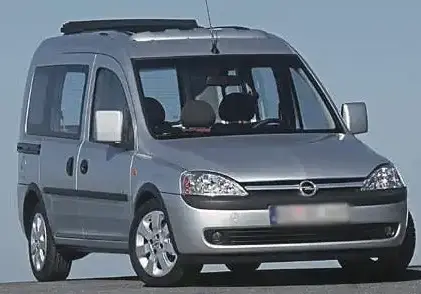
The Opel Combo Tour C 1.7 DI 16V, produced from March 2002 to 2003, represents the entry-level variant within the broader Combo Tour C range. This model, built on the Opel/Fiat Doblo platform (shared with the Fiat Combo), was primarily aimed at the European market as an affordable and practical light commercial vehicle and family minivan. It served as a budget-friendly option for those needing a versatile vehicle for both work and personal use. The “Tour” designation indicated a more passenger-focused configuration compared to the panel van versions. This particular engine and transmission combination occupied the lower end of the Combo Tour C lineup, prioritizing fuel efficiency and low running costs over outright performance.
Powertrain & Engine Architecture
The heart of this Combo Tour C variant is the 1.7-liter (1686 cc) Y17DTL diesel engine. This engine belongs to Opel’s ECOTEC family and features a turbocharged, intercooled configuration. The Y17DTL is a four-cylinder, inline engine with a double overhead camshaft (DOHC) valvetrain and four valves per cylinder. It utilizes a diesel common rail direct injection system, which delivers fuel directly into the combustion chamber at very high pressure, improving efficiency and reducing emissions. The turbocharger and intercooler work together to increase air density entering the engine, boosting power output. The engine produces 65 horsepower at 4400 rpm and 130 Nm (95.88 lb-ft) of torque at 2000 rpm. This engine was paired with a five-speed manual transmission, chosen for its simplicity and cost-effectiveness. The transmission’s gear ratios were optimized for fuel economy rather than rapid acceleration.
Driving Characteristics
The 1.7 DI 16V engine, coupled with the five-speed manual transmission, provided modest performance. Acceleration was slow, with a 0-100 km/h (0-62 mph) time of around 18.5 seconds. The engine’s torque delivery was relatively flat, making it suitable for hauling loads or navigating hilly terrain, but it lacked the punch of higher-powered versions. The gear ratios were spaced to prioritize fuel efficiency, meaning the engine often needed to be revved to maintain speed, especially when loaded. Compared to the more powerful 1.9-liter CDTI engine offered in other Combo Tour C models, this 1.7 DI felt significantly underpowered. However, the 1.7 DI offered a smoother, quieter driving experience than some of the older, naturally aspirated diesel engines available at the time.
Equipment & Trim Levels
The 1.7 DI 16V variant typically represented the base trim level for the Combo Tour C. Standard equipment generally included power steering, ABS brakes, a driver’s airbag, and basic interior trim. The interior typically featured cloth upholstery and a functional, if somewhat spartan, dashboard layout. Optional extras included air conditioning, power windows, and a radio/CD player. The focus was on providing a practical and affordable vehicle, so luxury features were kept to a minimum. The Combo Tour C was designed to be a workhorse, and the base trim reflected that.
Chassis & Braking
The Combo Tour C utilized a relatively simple chassis design. The front suspension consisted of MacPherson strut springs, while the rear suspension employed a coil spring setup. The front brakes were ventilated discs, providing adequate stopping power, while the rear brakes were drums, a cost-saving measure common in this segment. The steering was a hydraulic rack and pinion system, offering reasonable precision. The vehicle’s weight-to-power ratio of 19.4 kg/hp meant that the braking system was adequate for normal driving conditions, but it wasn’t designed for aggressive stopping.
Market Reception & Comparison
The Opel Combo Tour C 1.7 DI 16V was generally well-received as a practical and economical vehicle. Critics praised its fuel efficiency and versatility, but noted its lack of power. Compared to other small vans and MPVs in the European market, the Combo Tour C offered a competitive price point. The 1.7 DI engine provided better fuel economy than the more powerful 1.9 CDTI, but at the expense of performance. The manual transmission was favored by many for its simplicity and reliability. However, some reviewers found the interior to be somewhat basic and lacking in refinement.
Legacy
The Y17DTL engine, while not known for its blistering performance, proved to be a relatively reliable unit when properly maintained. Common issues included turbocharger wear and potential problems with the fuel injection system. Today, used examples of the Combo Tour C 1.7 DI 16V are relatively affordable and can be found in reasonable condition. They remain popular with those seeking a low-cost, practical vehicle for light commercial or family use. The engine’s simplicity makes it relatively easy to repair, and parts availability is generally good. While not a collector’s item, the Combo Tour C 1.7 DI 16V represents a solid and dependable workhorse from the early 2000s.