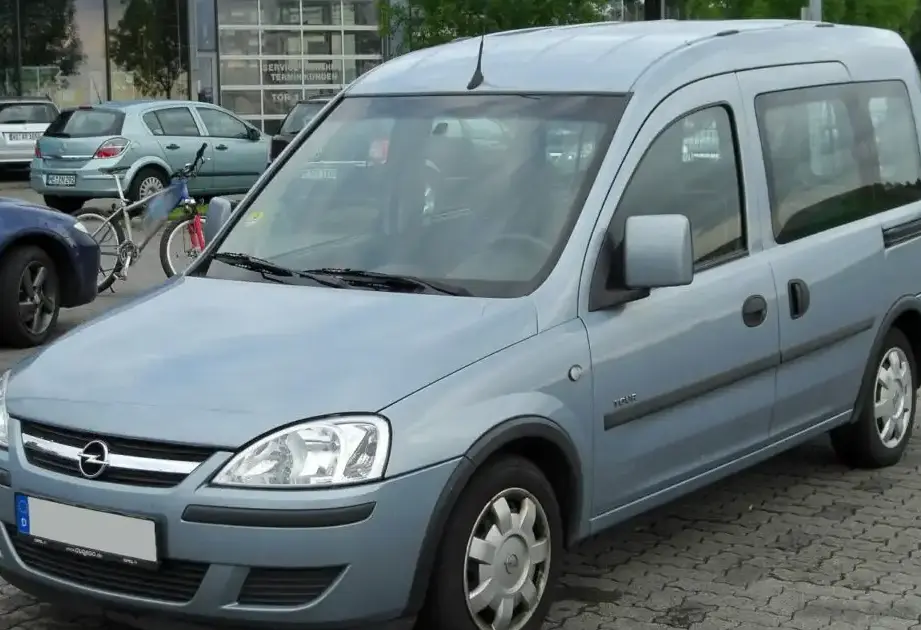
The Opel Combo Tour C (facelift, produced from 2004-2006) 1.3 CDTI 70 hp represents an entry-level offering within the Combo Tour C range. Introduced as part of the facelifted second generation (launched in 2003), this variant aimed to provide an economical and practical option for buyers seeking a small, versatile van. Built on the Opel/Fiat Doblo platform, the Combo Tour C was marketed primarily in Europe as a commercial and family vehicle, offering a blend of utility and affordability. This specific 1.3 CDTI engine and five-speed manual transmission combination was positioned as the base model, appealing to budget-conscious buyers and those prioritizing fuel efficiency over outright performance.
Technical Specifications
| Brand | Opel |
| Model | Combo |
| Generation | Combo Tour C (facelift 2003) |
| Type (Engine) | 1.3 CDTI (70 Hp) |
| Start of production | July, 2004 |
| End of production | September, 2006 |
| Powertrain Architecture | Internal Combustion engine |
| Body type | Minivan |
| Seats | 5 |
| Doors | 5 |
| Fuel consumption (urban) | 6.5 l/100 km (36.2 US mpg, 43.5 UK mpg, 15.4 km/l) |
| Fuel consumption (extra urban) | 4.3 l/100 km (54.7 US mpg, 65.7 UK mpg, 23.3 km/l) |
| Fuel consumption (combined) | 5.1 l/100 km (46.1 US mpg, 55.4 UK mpg, 19.6 km/l) |
| Fuel Type | Diesel |
| Acceleration 0 – 100 km/h | 17 sec |
| Acceleration 0 – 62 mph | 17 sec |
| Acceleration 0 – 60 mph | 16.2 sec |
| Maximum speed | 150 km/h (93.21 mph) |
| Weight-to-power ratio | 18.9 kg/Hp, 52.8 Hp/tonne |
| Weight-to-torque ratio | 7.8 kg/Nm, 128.3 Nm/tonne |
| Power | 70 Hp @ 4000 rpm |
| Power per litre | 56.1 Hp/l |
| Torque | 170 Nm @ 1750 rpm (125.39 lb.-ft. @ 1750 rpm) |
| Engine layout | Front, Transverse |
| Engine Model/Code | Z13DT |
| Engine displacement | 1248 cm3 (76.16 cu. in.) |
| Number of cylinders | 4 |
| Engine configuration | Inline |
| Cylinder Bore | 69.6 mm (2.74 in.) |
| Piston Stroke | 82 mm (3.23 in.) |
| Compression ratio | 18:1 |
| Number of valves per cylinder | 4 |
| Fuel injection system | Diesel Commonrail |
| Engine aspiration | Turbocharger, Intercooler |
| Valvetrain | DOHC |
| Engine oil capacity | 3.2 l (3.38 US qt | 2.82 UK qt) |
| Coolant | 6.3 l (6.66 US qt | 5.54 UK qt) |
| Kerb Weight | 1325 kg (2921.12 lbs.) |
| Max. weight | 1815 kg (4001.39 lbs.) |
| Max load | 490 kg (1080.27 lbs.) |
| Trunk (boot) space – minimum | 455 l (16.07 cu. ft.) |
| Trunk (boot) space – maximum | 2700 l (95.35 cu. ft.) |
| Fuel tank capacity | 52 l (13.74 US gal | 11.44 UK gal) |
| Length | 4322 mm (170.16 in.) |
| Width | 1684 mm (66.3 in.) |
| Width including mirrors | 1892 mm (74.49 in.) |
| Height | 1801 mm (70.91 in.) |
| Wheelbase | 2716 mm (106.93 in.) |
| Front track | 1417 mm (55.79 in.) |
| Rear (Back) track | 1440 mm (56.69 in.) |
| Front overhang | 747 mm (29.41 in.) |
| Rear overhang | 859 mm (33.82 in.) |
| Drivetrain Architecture | The Internal combustion engine (ICE) drives the front wheels of the vehicle. |
| Drive wheel | Front wheel drive |
| Number of gears and type of gearbox | 5 gears, manual transmission |
| Front suspension | Spring Strut |
| Rear suspension | Coil spring |
| Front brakes | Ventilated discs |
| Rear brakes | Drum |
| Assisting systems | ABS (Anti-lock braking system) |
| Steering type | Steering rack and pinion |
| Power steering | Electric Steering |
| Tires size | 185/60 R15 |
| Wheel rims size | 6J x 15 |
Powertrain & Engine Architecture
The heart of this Combo variant is the 1.3 CDTI (Z13DT) engine, a four-cylinder diesel unit. This engine is part of the Fiat-developed engine family, utilized by both Opel/Vauxhall and Fiat in various models. It features a common rail direct injection system, delivering fuel directly into the combustion chamber at high pressure for improved efficiency and reduced emissions. The engine employs a single overhead camshaft (SOHC) design, operating four valves per cylinder. A turbocharger with an intercooler is included to boost power output and improve torque delivery. The five-speed manual transmission was the standard offering, chosen for its simplicity and fuel efficiency. The transmission’s gear ratios were optimized for low-speed torque, prioritizing usability over sporty performance.
Driving Characteristics
The 1.3 CDTI 70 hp Combo Tour C offered modest performance. Acceleration was leisurely, with a 0-60 mph time of around 16.2 seconds. The engine’s 170 Nm (125 lb-ft) of torque, available from 1750 rpm, provided adequate pulling power for everyday driving and moderate loads. However, overtaking maneuvers required careful planning. Compared to higher-output versions of the Combo, such as those equipped with the 1.7 CDTI engine, this variant felt noticeably slower. The manual transmission, while precise, had relatively long throws. The suspension was tuned for comfort, providing a reasonably smooth ride, but handling was not particularly sharp. The focus was on practicality and ease of driving rather than dynamic performance.
Equipment & Trim Levels
The base-level 1.3 CDTI variant of the Combo Tour C was typically equipped with basic features. Standard equipment included power steering, ABS brakes, a driver’s airbag, and a basic audio system. Interior upholstery was typically cloth, and the dashboard featured a functional, if somewhat utilitarian, design. Optional extras included air conditioning, electric windows, and a passenger airbag. Higher trim levels, such as the ‘Sport’ or ‘Cosmo’ offered more luxurious appointments, including upgraded upholstery, alloy wheels, and additional comfort features. However, the 1.3 CDTI was generally offered with a limited range of options to keep the price competitive.
Chassis & Braking
The Combo Tour C utilized a relatively simple chassis design. Front suspension consisted of MacPherson struts, while the rear employed a twist beam setup with coil springs. This configuration prioritized cost-effectiveness and space efficiency. The braking system featured ventilated discs on the front wheels and drum brakes on the rear. ABS (Anti-lock Braking System) was standard, enhancing safety during emergency braking. The steering was a rack-and-pinion system with electric power assistance, providing light and easy steering feel.
Market Reception & Comparison
The Opel Combo Tour C 1.3 CDTI 70 hp was generally well-received as an affordable and practical van. Critics praised its fuel efficiency and low running costs, but noted its lack of performance. Compared to other small vans in the segment, such as the Citroën Berlingo and Renault Kangoo, the Combo offered a competitive price point and a spacious interior. However, some reviewers found the interior materials to be somewhat low-quality. The 1.3 CDTI engine offered significantly better fuel economy than the larger 1.7 CDTI, but at the expense of performance. Buyers prioritizing fuel efficiency and low running costs were likely to favor this variant, while those needing more power or carrying heavier loads would opt for the more expensive engine options.
Legacy
The 1.3 CDTI engine, while not known for its blistering performance, proved to be relatively reliable. Common issues included turbocharger wear and occasional problems with the fuel injection system. However, with regular maintenance, these engines could provide many years of service. Today, the Combo Tour C 1.3 CDTI can be found on the used car market at very affordable prices. It remains a popular choice for budget-conscious buyers seeking a practical and economical van. Its simplicity and relatively low maintenance costs make it an attractive option for those needing a reliable workhorse.