Technical Specifications
| Brand | Opel |
| Model | Combo |
| Generation | Combo Tour C (facelift 2003) |
| Type (Engine) | 1.6 CNG (97 Hp) ECOTEC |
| Start of production | April, 2005 |
| End of production | October, 2007 |
| Powertrain Architecture | Internal Combustion engine |
| Body type | Minivan |
| Seats | 5 |
| Doors | 5 |
| Fuel consumption (urban – CNG) | 6.6 kg/100 km |
| Fuel consumption (extra urban – CNG) | 3.9 kg/100 km |
| Fuel consumption (combined – CNG) | 4.9 kg/100 km |
| CO2 emissions (CNG) | 133 g/km |
| Fuel Type | Petrol / CNG |
| Acceleration 0 – 100 km/h | 14 sec |
| Acceleration 0 – 62 mph | 14 sec |
| Acceleration 0 – 60 mph | 13.3 sec |
| Maximum speed | 166 km/h (103.15 mph) |
| Weight-to-power ratio | 14.1 kg/Hp |
| Weight-to-torque ratio | 9.8 kg/Nm |
| Power | 97 Hp @ 6200 rpm |
| Power per litre | 60.7 Hp/l |
| Torque | 140 Nm @ 4500 rpm (103.26 lb.-ft. @ 4500 rpm) |
| Engine layout | Front, Transverse |
| Engine Model/Code | Z16YNG |
| Engine displacement | 1598 cm3 (97.52 cu. in.) |
| Number of cylinders | 4 |
| Engine configuration | Inline |
| Cylinder Bore | 79 mm (3.11 in.) |
| Piston Stroke | 81.5 mm (3.21 in.) |
| Compression ratio | 12.5:1 |
| Number of valves per cylinder | 4 |
| Fuel injection system | Multi-port manifold injection |
| Engine aspiration | Naturally aspirated |
| Valvetrain | DOHC |
| Engine oil capacity | 3.5 l (3.7 US qt | 3.08 UK qt) |
| Coolant capacity | 6.1 l (6.45 US qt | 5.37 UK qt) |
| Kerb Weight | 1367 kg (3013.72 lbs.) |
| Max. weight | 1945 kg (4287.99 lbs.) |
| Max load | 578 kg (1274.27 lbs.) |
| Trunk (boot) space – minimum | 510 l (18.01 cu. ft.) |
| Trunk (boot) space – maximum | 3200 l (113.01 cu. ft.) |
| Fuel tank capacity | 14 l (3.7 US gal | 3.08 UK gal) |
| CNG cylinder capacity | 19 kg |
| Max. roof load | 100 kg (220.46 lbs.) |
| Permitted trailer load (braked) | 750 kg (1653.47 lbs.) |
| Permitted trailer load (unbraked) | 550 kg (1212.54 lbs.) |
| Length | 4332 mm (170.55 in.) |
| Width | 1684 mm (66.3 in.) |
| Width including mirrors | 1892 mm (74.49 in.) |
| Height | 1801 mm (70.91 in.) |
| Wheelbase | 2716 mm (106.93 in.) |
| Front track | 1417 mm (55.79 in.) |
| Rear track | 1440 mm (56.69 in.) |
| Front overhang | 757 mm (29.8 in.) |
| Rear overhang | 859 mm (33.82 in.) |
| Turning circle | 11.25 m (36.91 ft.) |
| Drivetrain | Front wheel drive |
| Number of gears | 5 |
| Gearbox type | Manual transmission |
| Front suspension | Independent, McPherson with coil spring and anti-roll bar |
| Rear suspension | Trailing arm, Coil spring |
| Front brakes | Ventilated discs |
| Rear brakes | Drum |
| Assisting systems | ABS |
| Steering type | Steering rack and pinion |
| Power steering | Hydraulic |
| Tires size | 185/60 R15; 195/50 R16 |
| Wheel rims size | 6J x 15; 6J x 16 |
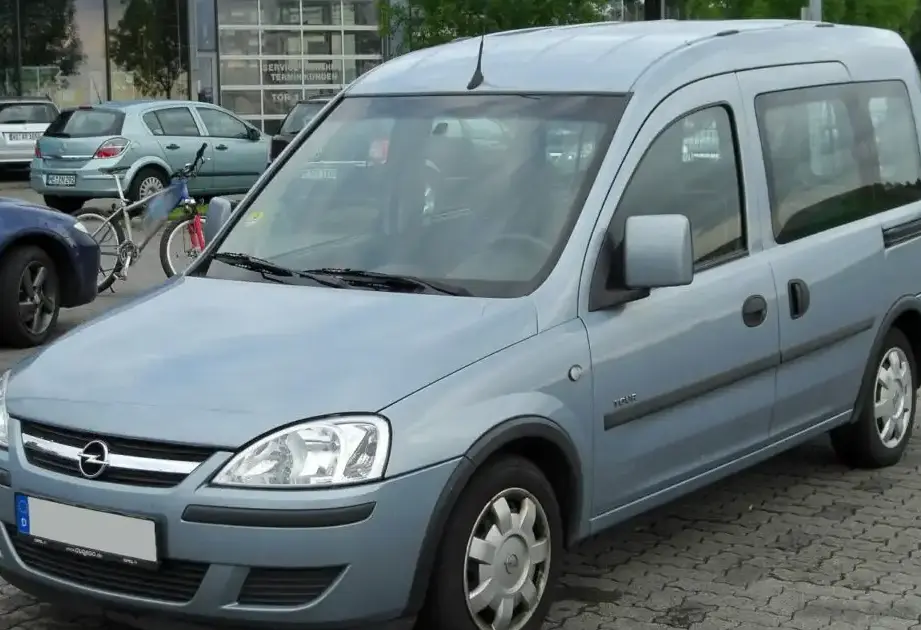
The Opel Combo Tour C (facelift, introduced in 2003) 1.6 CNG (97 hp) ECOTEC represents a unique offering within the Combo Tour C range, primarily aimed at the European market. Production of this specific variant ran from April 2005 to October 2007. Positioned as an economical and environmentally conscious option, it utilized a dedicated Compressed Natural Gas (CNG) powertrain within the versatile, van-based body style of the Combo Tour C, which itself was based on the 1HX0/A3 platform shared with models like the Opel Corsa and Fiat Doblo. This model catered to buyers seeking lower running costs and reduced emissions, particularly in regions with established CNG infrastructure.
Powertrain & Engine Architecture
The heart of the Combo Tour C 1.6 CNG was the Z16YNG engine, a 1.6-liter inline-four cylinder powerplant specifically adapted for Compressed Natural Gas operation. While based on Opel’s ECOTEC family of engines, the Z16YNG featured significant modifications to accommodate CNG, including reinforced pistons, hardened valve seats, and a dedicated CNG fuel injection system. The engine utilized multi-port fuel injection and a double overhead camshaft (DOHC) valvetrain. The compression ratio was set at 12.5:1, higher than its gasoline counterpart, to optimize combustion efficiency with CNG. The engine produced 97 horsepower at 6200 rpm and 140 Nm (103.26 lb-ft) of torque at 4500 rpm. The engine was paired with a five-speed manual transmission, which was the only transmission option available for this variant. The CNG system included a high-pressure cylinder, typically mounted under the floor, capable of storing approximately 19 kg of CNG.
Driving Characteristics
The 1.6 CNG variant of the Combo Tour C offered a noticeably different driving experience compared to the gasoline-powered versions. With 97 hp, acceleration was modest, taking approximately 14 seconds to reach 62 mph (100 km/h). The focus was on fuel economy and low-end torque rather than outright performance. The five-speed manual transmission was geared to maximize efficiency, with relatively tall gear ratios. While adequate for everyday driving and urban commutes, the CNG Combo Tour C struggled when fully loaded or tackling steep inclines. Compared to the more powerful gasoline engines available in the Combo range, the CNG version felt significantly less responsive. However, the smooth and quiet operation of the CNG engine, combined with the lower running costs, appealed to a specific segment of buyers.
Equipment & Trim Levels
The Combo Tour C 1.6 CNG typically came with a fairly basic level of equipment, reflecting its position as an economical choice. Standard features generally included power steering, central locking, and a driver’s airbag. Interior upholstery was typically cloth, and the dashboard featured a functional, if somewhat spartan, design. Optional extras included air conditioning, electric windows, and a radio/CD player. Trim levels were relatively limited, with most CNG models being offered in a single, well-equipped base specification. The emphasis was on practicality and affordability rather than luxury.
Chassis & Braking
The Combo Tour C utilized a relatively simple chassis design. Front suspension consisted of independent McPherson struts with a coil spring and anti-roll bar, while the rear suspension employed a trailing arm setup with coil springs. The front brakes were ventilated discs, providing adequate stopping power, while the rear brakes were drums. ABS (Anti-lock Braking System) was standard equipment. The suspension was tuned for comfort and practicality, prioritizing ride quality over sporty handling. The weight distribution was influenced by the location of the CNG tank, which was typically positioned under the vehicle floor.
Market Reception & Comparison
The Opel Combo Tour C 1.6 CNG was generally well-received by critics and consumers in markets with established CNG infrastructure. Its primary advantage was its significantly lower running costs compared to gasoline or diesel alternatives. Fuel economy was excellent, and CNG was often cheaper than gasoline. However, the limited availability of CNG refueling stations and the lower performance were drawbacks. Compared to the 1.7-liter diesel versions of the Combo Tour C, the CNG model offered similar fuel economy but less torque and acceleration. Against the gasoline-powered 1.4-liter engine, the CNG version provided comparable performance but with significantly lower emissions.
Legacy
The Opel Combo Tour C 1.6 CNG represents an early attempt to offer a commercially viable alternative fuel vehicle in the compact van segment. While not a mainstream success, it demonstrated the potential of CNG as a fuel source and paved the way for future alternative fuel vehicles. Today, these vehicles are relatively rare on the used car market. The Z16YNG engine is generally considered reliable, but the CNG system requires regular maintenance to ensure safe and efficient operation. Parts availability for the CNG-specific components can be a challenge. For buyers seeking an economical and environmentally friendly van, a well-maintained Combo Tour C 1.6 CNG can still be a viable option, provided access to a CNG refueling network is available.